How to Verify Emails in Magento
Magento stores hold a customer email on every account and order record. Across a long sales history those lists fill with typos and inboxes that have since closed. Verifying your exported Magento customer list with VeriMails removes the bad addresses so order and marketing emails reach real customers.
Export the Magento customer entity as CSV, map the customer email field in VeriMails, and use bulk verification before campaign imports, store migrations, or loyalty sends. Keep valid rows available for ecommerce email workflows, route catch-all and role-based addresses to review, and exclude invalid or disposable addresses from normal marketing segments.
Why Verify Your Magento Contacts
Magento, now also known as Adobe Commerce, powers high-volume ecommerce stores where email carries the customer relationship. Order confirmations, invoice and shipment notices, account messages, abandoned cart reminders, and newsletter campaigns all route to the address on a customer's account. When that address is wrong, the message is lost, and a large catalog with many orders feels the cost quickly.
Transactional order mail has to arrive
An order confirmation, invoice, or shipment notice is the customer's record that the purchase went through. A bounce here means a customer left in doubt, a support ticket opened, and trust in the store weakened. Verifying the email on each Magento account keeps transactional mail reaching the inbox it is meant for.
Abandoned cart sequences recover real revenue
Abandoned cart and follow-up emails are among the highest-earning messages a Magento store sends, because the recipient already showed purchase intent. That revenue only materializes when the email lands in a live inbox. A mistyped checkout email turns a recoverable cart into a hard bounce, and the recovery flow never runs.
Deliverability protects high-volume sending
Magento stores often send large campaign and transactional volumes, and mailbox providers watch the bounce rate on every sending domain. Once that rate climbs out of the healthy range, providers can throttle delivery and route more mail to spam. Email addresses decay every year as customers change jobs and abandon old inboxes, so a Magento list that was clean a year ago needs another check. Verifying before a major send keeps the sending domain healthy.
Marketing spend reaches reachable customers
If you sync Magento customers into an email platform that charges by contact, every dead address is a cost with no chance of return. A focused email list cleaning pass before the sync keeps your contact count, and your spend, focused on customers you can reach.
What VeriMails Checks
VeriMails applies a layered set of checks to every address in your Magento export and returns a clear result. The email verification process explains how those deliverability checks work before a customer file reaches campaigns.
It starts with syntax validation, which rejects malformed addresses produced by checkout typos. It then runs MX and DNS checks to confirm the customer's email domain exists and is configured to receive mail. The decisive test is a live SMTP handshake, where VeriMails connects to the receiving mail server and confirms whether that exact mailbox accepts mail, without sending anything to the customer.
Three more checks classify the difficult cases. Catch-all detection identifies domains configured to accept mail for any address, so you know when an individual mailbox cannot be confirmed. This is detection of how the domain is set up, not a quality score. Disposable detection flags temporary inbox providers, which appear when shoppers use a throwaway address to claim a discount. Role-based detection spots shared addresses such as info@ or orders@ that are usually not the right target for a marketing list.
Pricing for Magento Users
You can start with no commitment. Every new VeriMails account includes 100 free verification credits, with no credit card required, and those credits never expire. That free balance is enough to trial the workflow on a sample of your customer base, and the pricing page helps estimate cost for full customer exports.
For a full customer list, credit packs start at 10,000 credits for $19, which is $0.0019 per email, and scale up to 5 million credits for $1,499, a range that suits the large customer bases Magento stores often carry. Because credits never expire, you can buy a pack, verify before a campaign, and keep the remaining balance for the next cleanup. Stores that verify on a regular cadence can choose a monthly subscription instead, with annual plans from $12.50/month when billed yearly. One credit covers one verified address, so a Magento customer export of any size has a clear, predictable cost.
Workflow Visual
Use this flow to clean Magento customer emails before they feed promotions, lifecycle campaigns, or CRM syncs.
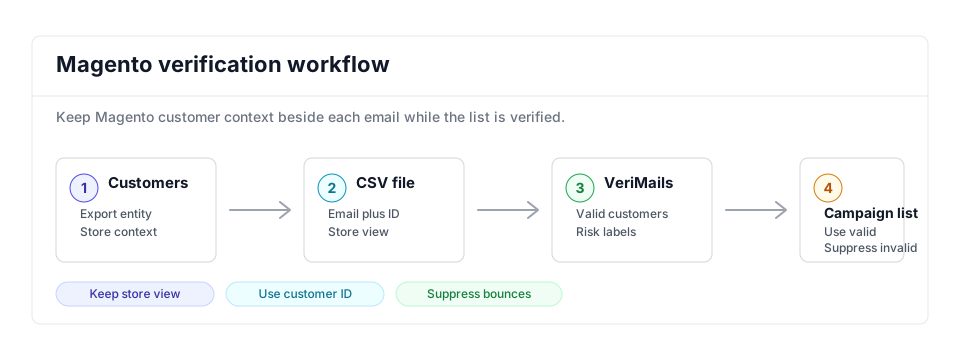
- Export scope: Use the Customers Main File export or a customer segment that matches the campaign or lifecycle flow; store teams can compare the BigCommerce workflow when cleaning multi-platform data.
- Matching field: Keep customer ID, website, store view, and email so bulk verification results can be reconciled across Magento contexts.
- Result action: Use valid customers in marketing tools and suppress invalid, disposable, and risky addresses before they push campaigns above healthy bounce rate benchmarks.
Step-by-Step
Export your customer list from Magento
In the Magento 2 admin, go to System, then Data Transfer, then Export. Set the Entity Type to Customers Main File, which holds account data including email, name, group, and status. Leave the format as CSV, select the attributes you want, and click Continue to generate the file. Before uploading, confirm the export includes customer ID, website, store view, email, status, and opt-in fields, because those columns are what make the cleanup reversible.
Create a free VeriMails account
Sign up for VeriMails. You get 100 verification credits free with no credit card required, enough to test the process. If your store's list is larger, choose a credit pack or monthly plan that covers your customer count before you upload.
Upload the CSV to VeriMails
Open the bulk verification workflow and drag in the CSV exported from Magento. The uploader automatically detects and maps the email column, so the other attributes from the Customers Main File export can stay in the file. Larger customer exports run as asynchronous bulk jobs. For recurring exports, developers can also wire the Email Verification API into the data pipeline instead of doing every run by hand.
Review valid, invalid, catch-all, and risky results
When the job completes, VeriMails sorts every address into clear categories: valid and safe to mail, invalid and certain to bounce, catch-all where the server will not confirm the mailbox, and risky addresses such as disposable or role-based. Review the status mix by website, store view, and customer group before deciding whether suppression should happen globally or only in the marketing platform.
Bring the cleaned list back
Download the filtered results. Use the valid addresses for your marketing sends, and suppress or remove the invalid ones in your email tool or in Magento so they never receive another campaign. QA the update by matching customer IDs, checking a sample from each store view, and confirming the accepted-row count before launching a promotion.
Magento Cleanup Checklist
Use this table before customer exports feed promotions, lifecycle flows, or CRM syncs. Magento and Adobe Commerce stores often have multiple websites and store views, so matching fields matter.
| Check | What to do | Why it matters |
|---|---|---|
| Entity choice | Use Customers Main File for account-level email verification; add address exports only when billing or shipping context is needed. | Keeps the verification run focused on the account email field that receives store mail. |
| Store context | Preserve customer ID, website, store view, group, email, status, and opt-in fields. | Large Magento stores need these fields to reconcile results across storefronts and marketing tools. |
| Valid audience | Send valid rows to campaign, loyalty, and lifecycle tools after mapping the email and customer ID columns. | Ensures promotions use reachable customer records, not stale account data. |
| Suppression action | Suppress invalid and disposable rows in the marketing platform and update store records only after operator review. | Protects deliverability without making careless account-data changes in Magento. |
| Review statuses | Hold catch-all and role-based rows for B2B, wholesale, or high-value customer review. | Shared inboxes can be legitimate in commerce, but they should not enter broad campaigns unchecked. |
Frequently Asked Questions
Related Guides
Try VeriMails Free
100 free credits on signup. No credit card required. Put this guide into practice today.
Start Free