VeriMails vs Bouncer
Bouncer is a capable email verification platform with public one-time credits, real-time and batch APIs, a separate Toxicity Check, Bouncer Shield, and a Deliverability Kit. VeriMails is narrower by design: low-cost verification credits, bulk list cleaning, a straightforward API, and explicit catch-all segmentation.
Updated May 24, 2026
At a Glance
| Decision point | VeriMails | Bouncer |
|---|---|---|
| 10,000 | $19 | $0.0019 |
| 25,000 | $39 | $0.00156 |
| 50,000 | $59 | $0.00118 |
| 100,000 | $99 | $0.00099 |
| 250,000 | $199 | $0.000796 |
| 500,000 | $349 | $0.000698 |
| 1,000,000 | $499 | $0.000499 |
| 2,500,000 | $999 | $0.0004 |
| 5,000,000 | $1,499 | $0.0003 |
Email Finder costs 20 credits only when VeriMails returns a verified person-level email. At the 10,000-credit pack, that is $0.038 per found email. Monthly plans start at $12.50/mo when billed yearly.
Bouncer Pricing at a Glance
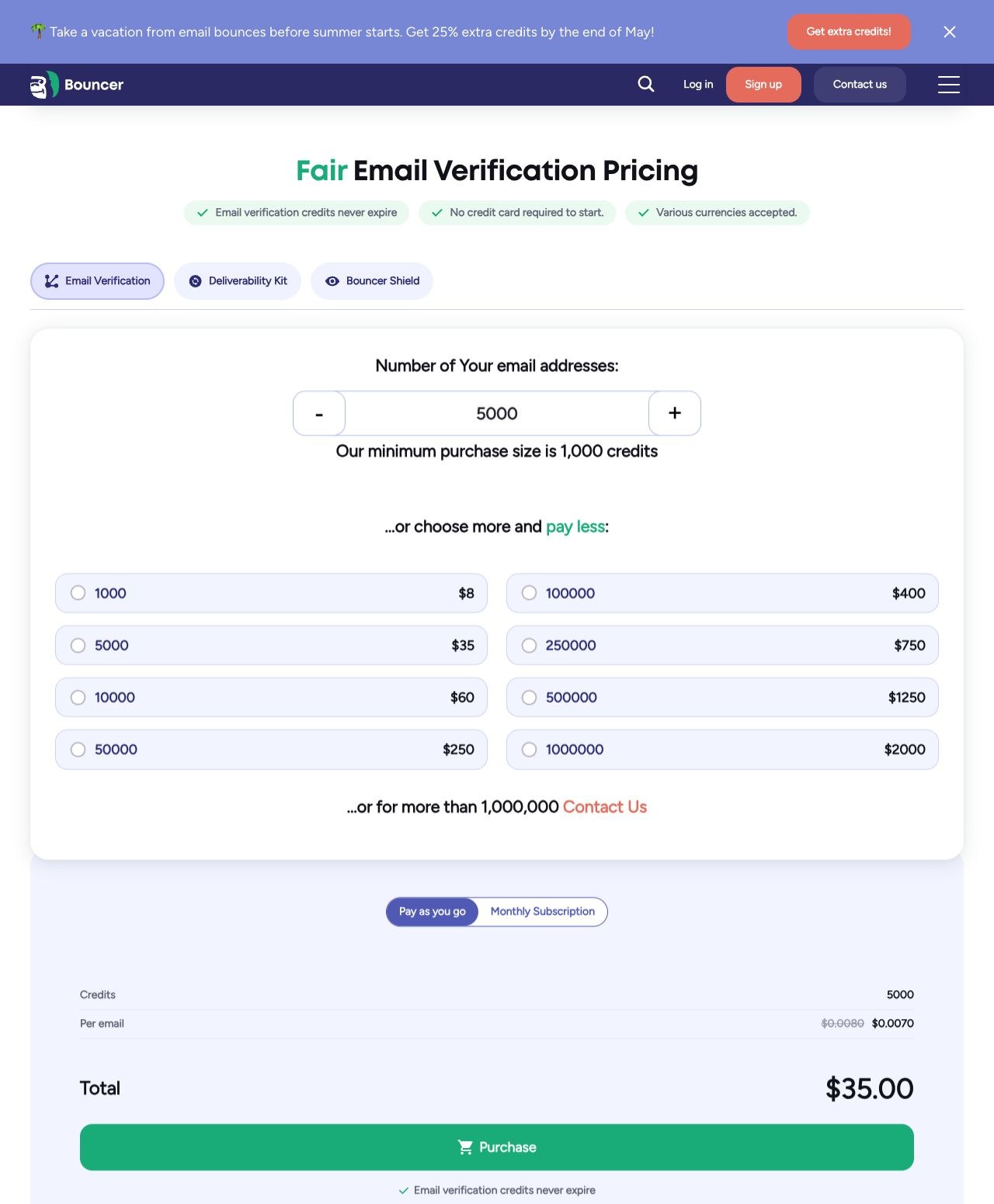
Bouncer's pricing page lists 1,000 credits for $8, 10,000 for $60, 100,000 for $400, 250,000 for $750, 500,000 for $1,250, and 1,000,000 for $2,000. That makes Bouncer competitive among broader verification platforms, but common list sizes remain more expensive than VeriMails: 10,000 Bouncer credits cost $60 versus $19 at VeriMails, and 100,000 cost $400 versus $99.
Bouncer Pricing and Catch-All Visuals
Use these visuals to sanity-check the pricing and catch-all fields that drive the buying decision.
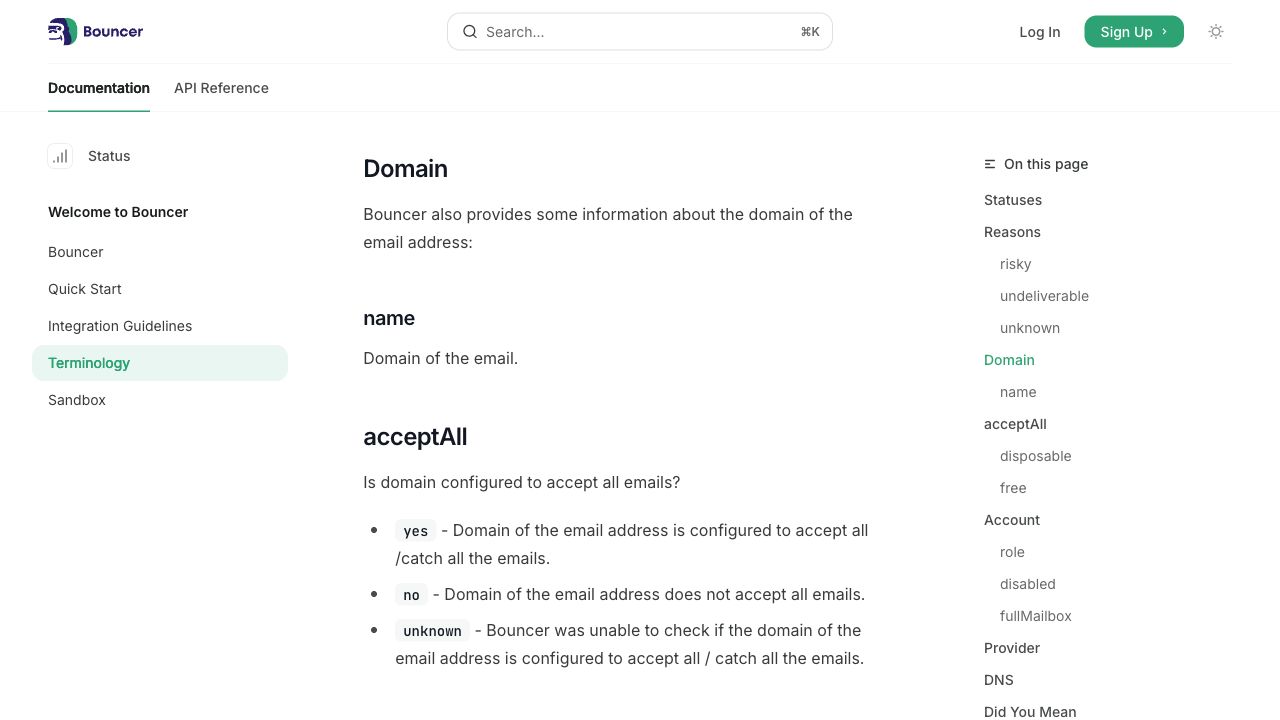
domain.acceptAll values are the fields buyers need when separating catch-all risk from confirmed-valid addresses.Pricing and Total Cost
Both products sell verification credits that do not expire. The difference is the public unit cost at normal list sizes and what surrounds the verification result. Bouncer bundles verification into a wider platform story, including Toxicity Check, Bouncer Shield, integrations, and deliverability testing. VeriMails prices verification as the primary product.
Credit-pack costs at common volumes
| Volume | VeriMails | Bouncer one-time credits | Bouncer calculation |
|---|---|---|---|
| 10,000 emails | $19 | $60 | 10,000 x $0.006 |
| 100,000 emails | $99 | $400 | 100,000 x $0.004 |
| 500,000 emails | $349 | $1,250 | 500,000 x $0.0025 |
| 1,000,000 emails | $499 | $2,000 | 1,000,000 x $0.002 |
Bouncer also lists a 1,000-credit minimum purchase and says it does not charge for duplicated addresses within a list or for unknown results.
Bouncer one-time credit pricing tiers
| Bouncer credits | Listed pack price | Computed price per email |
|---|---|---|
| 1,000 | $8 | $0.008 |
| 5,000 | $35 | $0.007 |
| 10,000 | $60 | $0.006 |
| 50,000 | $250 | $0.005 |
| 100,000 | $400 | $0.004 |
| 250,000 | $750 | $0.003 |
| 500,000 | $1,250 | $0.0025 |
| 1,000,000 | $2,000 | $0.002 |
The same Bouncer pricing page says email verification credits never expire, no credit card is required to start, and users receive 100 starter credits.
VeriMails credit pricing
| Credits | VeriMails price | Price per email |
|---|---|---|
| 10,000 | $19 | $0.0019 |
| 25,000 | $39 | $0.00156 |
| 50,000 | $59 | $0.00118 |
| 100,000 | $99 | $0.00099 |
| 250,000 | $199 | $0.000796 |
| 500,000 | $349 | $0.000698 |
| 1,000,000 | $499 | $0.000499 |
VeriMails credits never expire. New accounts receive 100 free credits on signup.
Catch-all Handling
Bouncer exposes catch-all behavior through the domain.acceptAll field, with possible values of yes, no, and unknown. Its terminology page also says risky addresses include Accept All, Full Mailbox, or Disposable results, and the integration guidelines say some teams may keep risky addresses with domain.acceptAll set to yes when their list is relatively clean and deliverability is not impacted.
That is a reasonable, honest signal: a catch-all domain accepts mail broadly, so the verifier cannot always prove that the specific mailbox exists. VeriMails keeps that operational decision explicit by returning catch-all segmentation as part of the verification workflow. For cold outreach and CRM cleanup, that helps teams separate normal deliverable addresses from catch-all addresses before they upload to a sender.
| Catch-all question | VeriMails | Bouncer |
|---|---|---|
| Does the tool identify catch-all domains? | Yes, as a visible verification segment | Yes, through domain.acceptAll |
| Published values | Catch-all flag in verification output | yes, no, or unknown |
| Operational tradeoff | Clear segmentation before send decisions | Strong raw field, but risky can also include full mailbox or disposable cases |
API and Developer Experience
Bouncer's API reference is clear and useful. The real-time endpoint verifies one address synchronously, checks syntax and domain, checks receiving mail systems, and returns the best result it can gather within 10 seconds by default, with a maximum of 30 seconds. Bouncer also states that real-time verification is limited to 1,000 requests per minute by default, and that it may return about 5% more unknown results than full batch verification because speed is prioritized.
Bouncer also documents batch and batch-sync flows. Batch is better for large databases, while batch-sync keeps a managed queue, avoids remembering batch IDs, returns some results before the full batch finishes, and keeps a 24-hour cache so the same email is not verified multiple times in that period. VeriMails is less expansive, but simpler to price and integrate when the project only needs verification, bulk cleaning, and clear catch-all segmentation.
Toxicity Check and Platform Add-ons
Bouncer's main advantage is not price. It is the additional risk layer. Bouncer's Toxicity Check documentation says it identifies widely circulated, breached or hacked addresses, addresses belonging to complainers or litigators, and potential spam traps, then represents toxicity on a 1 to 5 scale. Its integration guidelines also recommend suppressing toxicity values 4 and 5 because they may affect sending infrastructure reputation.
That makes Bouncer a better fit when a team wants a broader deliverability workflow around verification. VeriMails does not currently offer an equivalent toxicity database product. VeriMails is the more focused choice when the buying priority is low-cost verification, a clean bulk workflow, and an API that returns the signals needed to decide whether to send, suppress, or segment.
Who Should Choose Which?
Choose VeriMails if
You mainly need to verify emails at scale, reduce verification spend, clean CSV files, integrate a real-time verification API, and keep catch-all addresses visible as a separate segment before campaigns or CRM imports.
Choose Bouncer if
You want verification plus Toxicity Check, Bouncer Shield, deliverability testing, integrations, and Bouncer's broader platform. Bouncer is especially relevant if toxicity scoring is worth the higher verification credit cost.
Run the Next Check in VeriMails
After comparing pricing, credits, API behavior, and catch-all handling, the practical next step is to verify a real sample from your own list.
Verification Accuracy
Both VeriMails and Bouncer can help reduce bad addresses before a campaign. The difference is how clearly the result fits your next send: VeriMails keeps valid, invalid, disposable, role-based, catch-all, and unknown rows separate for decision-making.
Use a recent sample from your own CRM, not a perfect test list. The addresses that matter are the ones you plan to mail this week: old leads, imported contacts, role inboxes, catch-all domains, and records from mixed sources.
Who VeriMails Is Best For
Choose VeriMails when verification is the job and you want the result before the send.
- You already have a list and need to clean it before a campaign.
- You want prepaid verification credits that never expire.
- You need API and CSV verification without paying for a larger sales platform.
Frequently Asked Questions
Why teams switch to VeriMails
“We added verification to our customer-facing product as a feature. VeriMails API runs under the hood. Our users don't know and don't need to. Just works.”
— Max H. — CTO at Workflow Automation Startup, Switzerland
“At our volume the cost difference between verifiers is six figures annually. VeriMails gives us the same accuracy at a fraction of the cost. That's not a nice-to-have, it's margin.”
— Andreas K. — COO at Digital Services Company, Germany
Related Comparisons
Try VeriMails Free
100 free credits on signup. No credit card required. Compare your own Bouncer workflow against a focused verification engine.
Start Free