VeriMails vs Emailable
Emailable is a mature verification platform with public one-time credits, subscriptions, a REST API, batch verification, a JavaScript widget, 50+ integrations, inbox reports, blacklist monitoring, DMARC monitoring, and a published deliverability guarantee. VeriMails is narrower by design: low-cost verification credits, bulk list cleaning, a straightforward API, and explicit catch-all segmentation.
Updated May 20, 2026
At a Glance
| Decision point | VeriMails | Emailable |
|---|---|---|
| 10,000 | $19 | $0.0019 |
| 25,000 | $39 | $0.00156 |
| 50,000 | $59 | $0.00118 |
| 100,000 | $99 | $0.00099 |
| 250,000 | $199 | $0.000796 |
| 500,000 | $349 | $0.000698 |
| 1,000,000 | $499 | $0.000499 |
| 2,500,000 | $999 | $0.0004 |
| 5,000,000 | $1,499 | $0.0003 |
Email Finder costs 20 credits only when VeriMails returns a verified person-level email. At the 10,000-credit pack, that is $0.038 per found email. Monthly plans start at $12.50/mo when billed yearly.
Emailable Pricing and Credit Notes
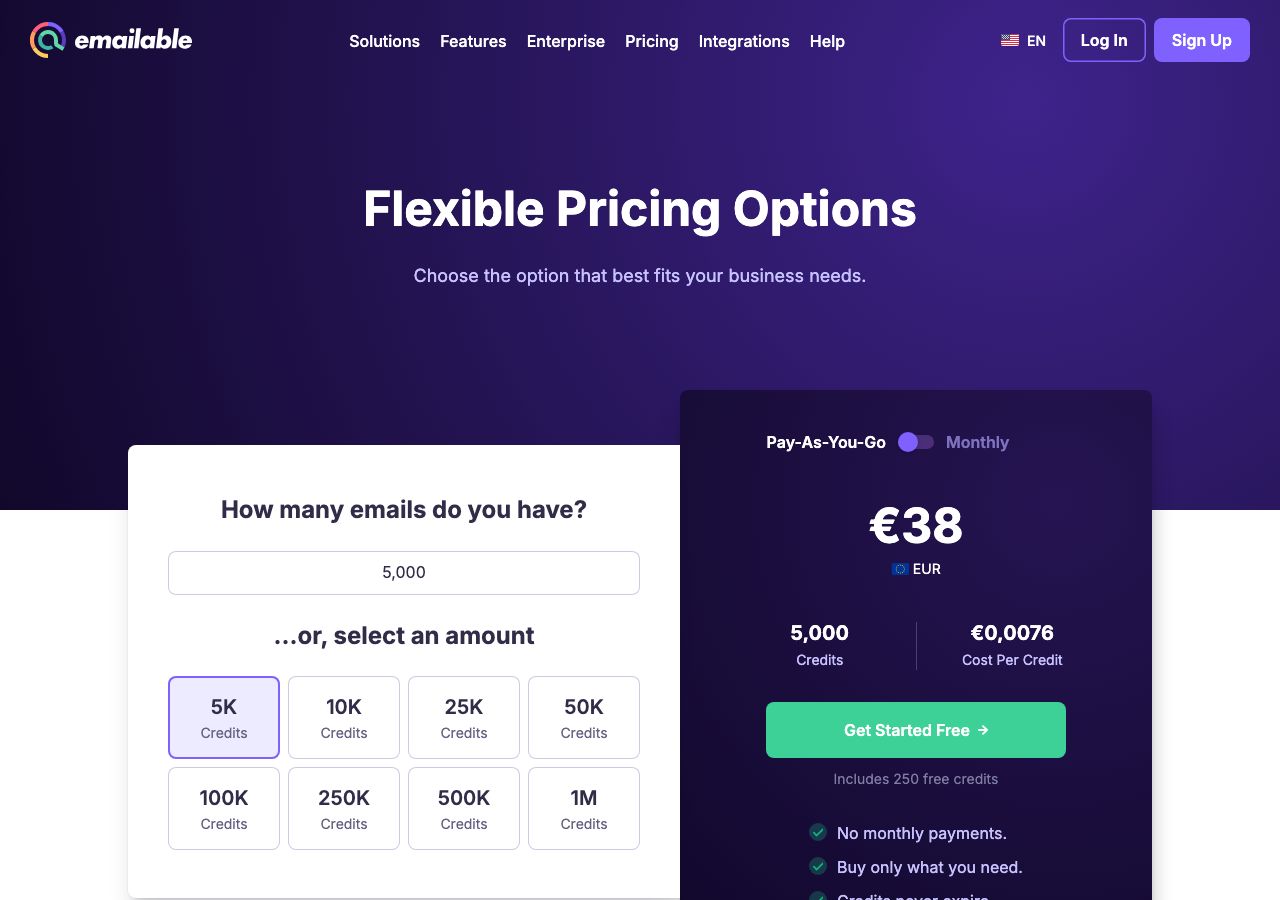
Emailable gives buyers a broader platform bundle than a pure verifier: 250 free credits, a minimum 5,000-credit purchase, non-expiring credits, unknown-result billing relief, subscription discounts, a widget, integrations, and deliverability extras. The key buyer question is whether those extras justify the higher per-credit cost at your normal list size.
Emailable Pricing Preview
This visual highlights the buying tradeoff: Emailable has a wider feature set, while VeriMails keeps the verification workflow and credit math narrower.
Pricing and Total Cost
Both products sell verification credits. Emailable has a stronger published free-credit offer and broader platform bundle. VeriMails has materially lower listed prices at the list sizes most teams compare. For example, Emailable's listed USD pricing data lists 10,000 credits at $60 and 100,000 credits at $420; VeriMails lists 10,000 at $19 and 100,000 at $99.
Credit-pack costs at common volumes
| Volume | VeriMails | Emailable one-time credits | Emailable calculation |
|---|---|---|---|
| 10,000 emails | $19 | $60 | 10,000 x $0.006 |
| 50,000 emails | $59 | $245 | 50,000 x $0.0049 |
| 100,000 emails | $99 | $420 | 100,000 x $0.0042 |
| 500,000 emails | $349 | $1,350 | 500,000 x $0.0027 |
| 1,000,000 emails | $499 | $2,100 | 1,000,000 x $0.0021 |
Emailable also lists a 5,000-credit minimum purchase, no long-term contract requirement, and a 15% subscription discount. The table uses one-time credit prices because that is the cleanest like-for-like comparison with VeriMails credit packs.
Emailable listed USD one-time credit pricing tiers
| Emailable credits | Listed one-time credit pack price | Computed price per credit |
|---|---|---|
| 5,000 | $38 | $0.0076 |
| 10,000 | $60 | $0.006 |
| 25,000 | $141 | $0.00564 |
| 50,000 | $245 | $0.0049 |
| 100,000 | $420 | $0.0042 |
| 250,000 | $750 | $0.003 |
| 500,000 | $1,350 | $0.0027 |
| 1,000,000 | $2,100 | $0.0021 |
Emailable says Bulk, Single, API, and Widget verifications use 1 credit per verification. Inbox Reports use 100 credits per report, and Blacklist Monitors use 5 credits per check.
VeriMails credit pricing
| Credits | VeriMails price | Price per email |
|---|---|---|
| 10,000 | $19 | $0.0019 |
| 25,000 | $39 | $0.00156 |
| 50,000 | $59 | $0.00118 |
| 100,000 | $99 | $0.00099 |
| 250,000 | $199 | $0.000796 |
| 500,000 | $349 | $0.000698 |
| 1,000,000 | $499 | $0.000499 |
VeriMails credits never expire. New accounts receive 100 free credits on signup.
Credit, Billing, and Refund Nuance
Emailable's credit policy is buyer-friendly in several places. Credits do not expire. Emailable says unknown results are free. The pricing FAQ says duplicates and unknown results are refunded and credited back to the credit balance after a list verification completes. Subscription credits reload every billing cycle, unused credits roll over, and subscriptions can be canceled at any time. Emailable also accepts major cards, PayPal, Apple Pay, Google Pay, and bank debits or transfers upon request.
The guarantee is narrower than a blanket refund. Emailable publishes 97%+ deliverability for Microsoft-managed addresses and 99%+ deliverability for other addresses, but eligibility requires at least 1,000 unique emails, messages sent within 24 hours of verification, addresses classified as Deliverable, invalid-address bounces, and opt-in lists. Customers must contact support within 72 hours, and paying customers receive a 100% refund for qualifying emails that fail the guarantee.
| Policy detail | VeriMails | Emailable |
|---|---|---|
| Credits expire? | No | No |
| Free credits | 100 signup credits | 250 free credits |
| Unknown results | Simple credit pool | Listed as free; credited back after list completion |
| Duplicate list rows | Simple credit pool | Credited back after list completion |
| Subscription option | No subscription required | Optional subscription saves 15%; cancel anytime |
| Guarantee refund | No comparable published guarantee listed here | 100% refund for qualifying emails that fail published guarantee terms |
Accept-all and Catch-all Handling
Emailable should not be described as only a binary catch-all flag. Its API response includes accept_all, and the single verification endpoint has an optional accept_all parameter that defaults to false because the check heavily impacts response time. Emailable's help center also explains that accept-all domains can resolve into Deliverable, Undeliverable, or Risky results depending on what the verifier can prove. When certainty is not possible, Emailable leaves the result as Risky with an Accept-All annotation rather than guessing.
That is a reasonable accuracy posture. VeriMails is simpler operationally: catch-all detection is surfaced as a clear segment during verification so teams can decide whether to suppress, test, or route catch-all addresses differently before importing a list or launching a campaign.
| Catch-all question | VeriMails | Emailable |
|---|---|---|
| Does the tool identify accept-all/catch-all domains? | Yes, as a visible verification segment | Yes, through accept_all and accept-all annotations |
| Can the signal affect speed? | Designed into the verification workflow | Emailable notes that the accept-all check can heavily affect API response time |
| Operational tradeoff | Clear segmentation before send decisions | More nuanced classification, with Risky used when certainty is not possible |
API, Bulk, and Widget Experience
Emailable's REST API is well documented. The API reference publishes https://api.emailable.com/v1/ as the base URL and list Ruby, Node.js, and Python client libraries. The single verify endpoint returns fields such as accept_all, did_you_mean, disposable, free, mailbox_full, reason, role, score, smtp_provider, and state. Standard API limits are 25 requests per second for /v1/verify and 5 per second for /v1/batch and /v1/account; enterprise accounts can request custom limits.
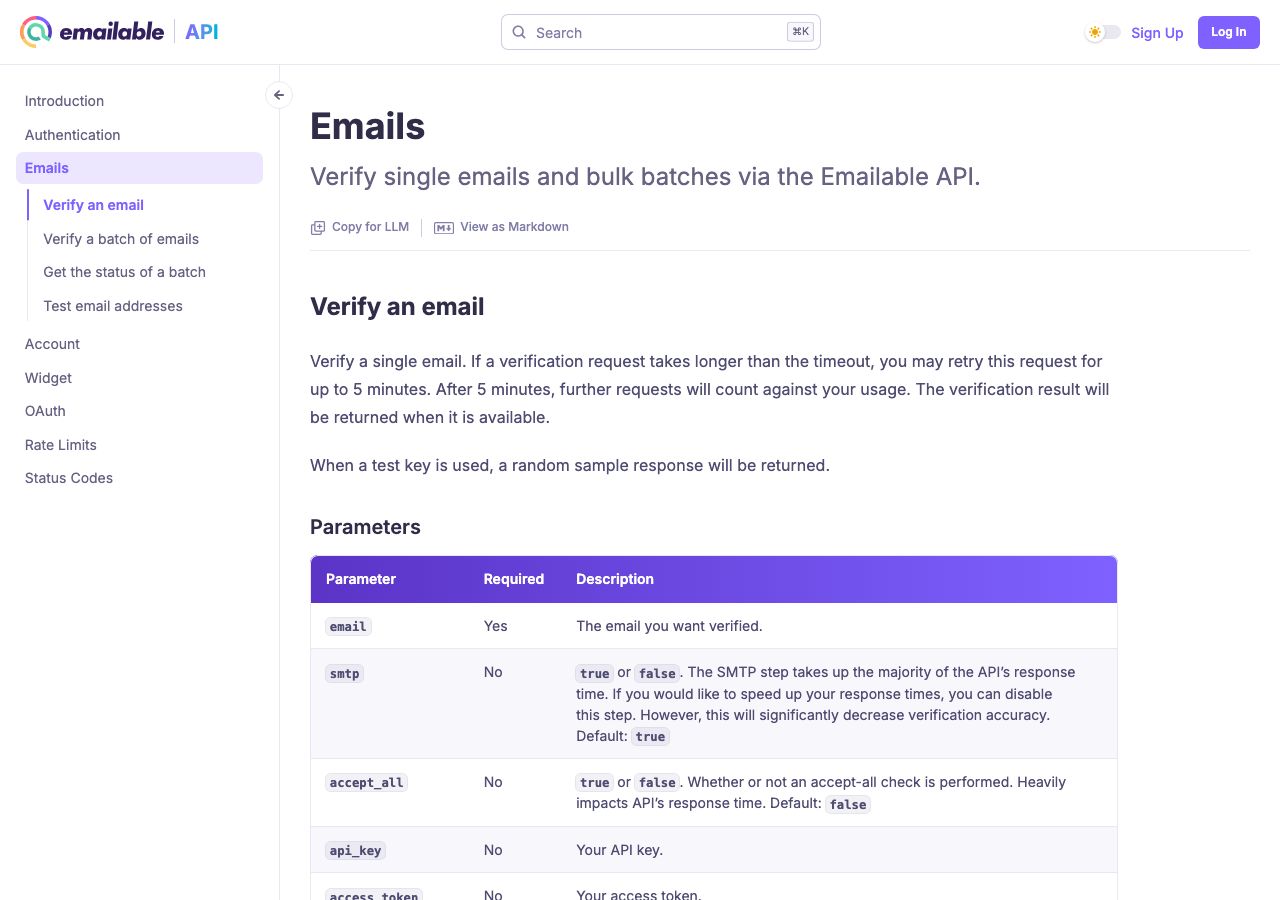
For bulk work, Emailable's API supports batches up to 50,000 emails, optional callback URLs, response-field selection, and retry behavior. The status endpoint returns per-email results for batches up to 1,000 emails, while batches over 1,000 include a download_file URL for a ZIP-compressed CSV. The Bulk verification documentation says lists can be uploaded or imported through 50+ integrations, 10,000 emails usually process in 2 to 3 minutes, 250,000 average about 10 minutes, cache is limited to a maximum of 5 minutes, and data is retained up to 30 days after verification unless deleted earlier.
The widget is useful if a team wants point-of-capture validation without building its own form logic. Emailable says public widget API keys require trusted domains and are limited to 10 unique verifications per day per IP address, with additional attempts returning 429. Widget options let teams allow or block states, free email, role addresses, disposable addresses, and customize timeout, delay, selectors, messages, and event listeners.
Deliverability Extras
Emailable has a broader deliverability layer than VeriMails. Its Deliverability Center includes inbox reports, blacklist monitoring, and DMARC monitoring. The pricing page says Inbox Reports cost 100 credits each and Blacklist Monitors cost 5 credits per check. Emailable's deliverability page says inbox reports cover insights, authentication, inbox placement, spam reports, link and image validation, and blacklist reports. Its blacklist monitoring page says it checks over 120 real-time blacklists and can notify users when domains or IP addresses are listed or delisted.
Those add-ons make Emailable a stronger fit when verification is only one part of a larger deliverability workflow. VeriMails is the leaner fit when the buying priority is lower verification cost, CSV cleaning, API verification, and explicit catch-all segmentation without paying for adjacent deliverability tooling.
Who Should Choose Which?
Choose VeriMails if
You mainly need low-cost verification credits, bulk list cleaning, a simple REST API, and clear catch-all segmentation for sales, marketing, recruiting, or CRM hygiene workflows.
Choose Emailable if
You want verification bundled with a widget, Ruby/Node/Python client libraries, integrations, inbox reports, blacklist monitoring, DMARC monitoring, subscription billing, and published guarantee terms.
Run the Next Check in VeriMails
After comparing pricing, credits, API behavior, and catch-all handling, the practical next step is to verify a real sample from your own list.
Verification Accuracy
Both VeriMails and Emailable can help reduce bad addresses before a campaign. The difference is how clearly the result fits your next send: VeriMails keeps valid, invalid, disposable, role-based, catch-all, and unknown rows separate for decision-making.
Use a recent sample from your own CRM, not a perfect test list. The addresses that matter are the ones you plan to mail this week: old leads, imported contacts, role inboxes, catch-all domains, and records from mixed sources.
Who VeriMails Is Best For
Choose VeriMails when verification is the job and you want the result before the send.
- You already have a list and need to clean it before a campaign.
- You want prepaid verification credits that never expire.
- You need API and CSV verification without paying for a larger sales platform.
Frequently Asked Questions
Why teams switch to VeriMails
“We verify over a million emails a month. At the 1M credit tier it costs us $499. Our old provider charged $2,700 for the same volume.”
— James P. — CTO at Recruitment Tech Startup, Australia
“We were on Emailable paying $400 a month. Same volume on VeriMails costs $99. Switched in a day, no difference in accuracy.”
— Hannah L. — Email Operations Manager at SaaS Company, Ireland
Related Comparisons
Try VeriMails Free
100 free credits on signup. No credit card required. Compare your own Emailable workflow against a focused verification engine.
Start Free