How to Verify Emails in WooCommerce
WooCommerce stores capture a customer email with every order and every account signup. Those addresses build up over years, and a share of them go stale or were mistyped at checkout. Verifying your exported WooCommerce customer list with VeriMails removes the bad addresses so your store mail reaches real inboxes.
Export your WooCommerce customers or order contacts to CSV, keep the Email column intact, and run the file through bulk verification. Use valid rows for lifecycle campaigns and ecommerce syncs, hold catch-all and role-based rows for review, and keep invalid or disposable addresses out of regular sends. For new forms, pair cleanup with the verification API.
Why Verify Your WooCommerce Contacts
WooCommerce runs on top of WordPress and stores every customer as a user record with a billing email. Order confirmations, processing and shipping updates, account notifications, and any marketing you send all route to that address. When the address is wrong, none of that mail arrives, and a store that depends on email feels the effect quickly.
Transactional order mail must be delivered
When a customer checks out, WooCommerce sends an order confirmation and follow-up status emails. These are the customer's record that the purchase succeeded. A bounce here means a confused customer, a support ticket, and sometimes a chargeback. Verifying the email a customer entered keeps transactional mail flowing to the inbox that needs it.
Abandoned cart and follow-up emails recover sales
Many WooCommerce stores run abandoned cart plugins and post-purchase follow-up sequences. These emails earn well because the recipient already engaged with the store. That return on effort only happens when the email lands. A checkout typo turns a recoverable cart into a hard bounce and the follow-up never gets seen.
Deliverability and sender reputation are on the line
WordPress sites often send mail through a connected SMTP service or transactional provider, and that provider watches your bounce rate. When the rate climbs, mailbox providers can throttle delivery and push more mail to spam. Customer addresses decay over time, so a list that worked last season needs another pass. Verifying before a campaign keeps the sending domain healthy.
You pay only for customers you can reach
If you sync WooCommerce customers into an email marketing platform that bills by contact, dead addresses inflate the bill without any chance of a sale. Cleaning the export before the sync keeps your contact count, and your spend, focused on reachable customers.
What VeriMails Checks
VeriMails applies a layered set of checks to each address in your WooCommerce export and returns a clear result, using layered deliverability checks.
It begins with syntax validation, which rejects malformed addresses such as a missing @ sign or a stray space from a checkout typo. Next come MX and DNS checks, which confirm the customer's email domain exists and is configured to accept mail. The core test is a live SMTP handshake: VeriMails opens a connection to the receiving server and asks whether that specific mailbox accepts mail, without ever sending a message to the customer.
Three more checks handle the difficult cases. Catch-all detection identifies domains set to accept mail for any address, so you know when a server will not confirm an individual mailbox. This is detection of how the domain is configured, not a quality score. Disposable detection flags temporary inbox providers, which appear when shoppers use a throwaway address to claim a coupon. Role-based detection identifies shared addresses such as orders@ or info@ that are usually not the right fit for a marketing list.
Pricing for WooCommerce Users
You can begin at no cost. Every new VeriMails account includes 100 free verification credits, with no credit card required, and they never expire. That is enough for a smaller WooCommerce store to clean a starter list or for any store to trial the workflow before committing.
For a full customer base, credit packs start at 10,000 credits for $19, which works out to $0.0019 per email, and run up to 5 million credits for $1,499. Since credits never expire, you can buy a pack, verify before a promotion, and keep the rest for the next cleanup. Stores that verify on a steady schedule can choose a monthly subscription instead, with annual plans from $12.50/month when billed yearly. One verified address uses one credit, so a WooCommerce export of any size carries a clear, predictable cost.
Workflow Visual
WooCommerce stores usually rely on an export extension, so the practical workflow is to keep the customer fields intact, verify the billing email column, and only sync clean rows into campaigns.
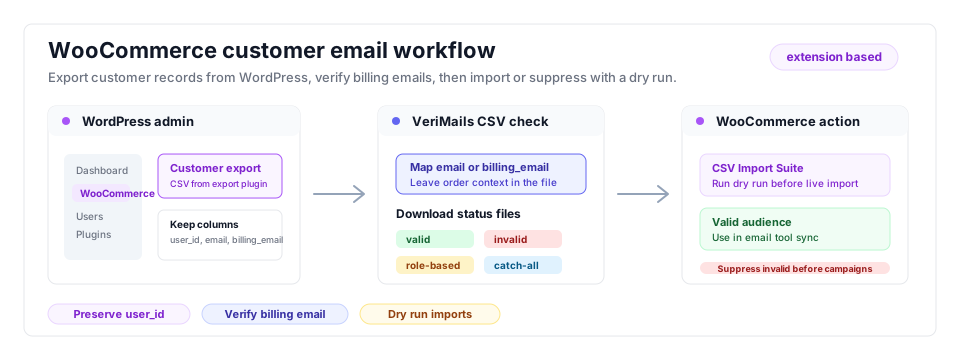
- Store audience quality: Use this workflow before ecommerce campaign sends and customer list syncs.
- CSV cleanup: Run bulk verification on the export while preserving order and billing fields for later matching.
- Adjacent store guide: Compare this with the Shopify customer verification workflow.
Step-by-Step
Export your customer list from WooCommerce
WooCommerce does not ship a one-click customer export, so use an export plugin. The official Customer, Order, and Coupon CSV Export extension or a free plugin such as WebToffee Import Export both work. Choose the customer entity, set the format to CSV, and run the export to download the file.
Create a free VeriMails account
Sign up for VeriMails. You get 100 verification credits free with no credit card required, enough to test the process. If your store's list is larger, pick a credit pack or monthly plan that covers your customer count before uploading.
Upload the CSV to VeriMails
Open the bulk verification tool and drag in the CSV exported from WooCommerce. The uploader automatically detects and maps the email column, so you can leave columns such as billing name and order count untouched. The job runs as a queued bulk verification and shows downloadable filtered results when it completes.
Review valid, invalid, catch-all, and risky results
When the job completes, VeriMails sorts every address into clear categories: valid and safe to send, invalid and certain to bounce, catch-all where the server will not confirm the mailbox, and risky addresses such as disposable or role-based. Use these categories to decide who stays on your list.
Bring the cleaned list back
Download the filtered results. Use the valid addresses for your marketing sends, and suppress or remove the invalid ones in your email tool or in WooCommerce so they never receive another message. Your store now reaches only customers with a working inbox.
WooCommerce Cleanup Checklist
Use this table before customer exports feed newsletters, abandoned-cart tools, or ecommerce retention campaigns.
| Check | What to do | Why it matters |
|---|---|---|
| Export plugin | Use a customer-capable export plugin or extension and choose CSV output for the customer or opted-in marketing audience. | WooCommerce stores vary by plugin stack, so the export path should match the data you actually need. |
| Matching fields | Keep email, user ID, billing email, name, order count, customer role, and consent or newsletter fields. | Lets the verified results match WordPress users, WooCommerce customers, and marketing-tool contacts. |
| Valid audience | Use valid rows for newsletter, retention, and abandoned-cart platforms after preserving customer identifiers. | Campaigns target reachable customers without losing store context. |
| Suppression action | Suppress invalid and disposable rows in the email platform before changing store records. | Reduces campaign bounces while avoiding accidental account changes in WordPress. |
| Review queue | Review catch-all, role-based, and high-order-value rows before removal. | Some B2B buyers use shared inboxes, so valuable customers deserve a manual pass. |
Frequently Asked Questions
Related Guides
Try VeriMails Free
100 free credits on signup. No credit card required. Put this guide into practice today.
Start Free