How to Verify Emails in Mixmax
Mixmax adds Sequences, tracking, and scheduling on top of Gmail, which means every Sequence you run sends through your own Workspace mailbox and your own reputation. Recipient lists assembled from CRM exports and prospecting tools collect dead addresses quickly, and those become bounces as soon as a Sequence starts. Verifying the list first keeps bounces low and your mailbox healthy. This guide covers exporting your Mixmax recipients, cleaning them with VeriMails, and re-importing a verified list.
TLDR
- Export either the contact group you plan to use or the Sequence report for recipients already in motion.
- For Sequence imports, keep the recipient email column titled email and save the cleaned file in UTF-8.
- Verify the CSV in VeriMails before starting or restarting a Sequence.
- Import valid rows only; hold catch-all, disposable, role-based, and invalid rows outside the main Sequence.
- Run a test import or preview when personalization fields are critical to the Sequence copy.
Mixmax CSV Decisions
Mixmax is strict about recipient columns. Preserve the import format while you clean the list.
| Decision | Best operating choice | Why it matters |
|---|---|---|
| Export source | Use Contacts for broad hygiene or the Sequence report for campaign-specific recipients. | Keeps pre-send cleanup separate from performance analysis. |
| Email header | Use the header email for the recipient address column during import. | Mixmax expects that field name when importing recipients. |
| Encoding | Save the cleaned file as UTF-8 CSV. | Prevents quotes, apostrophes, and names from breaking in personalization fields. |
| Personalization fields | Keep company, title, and any custom variables used by the Sequence. | Verification should not strip the data that makes the outreach useful. |
| Sequence gate | Start only after invalid and review statuses are removed. | Protects your Workspace mailbox before the first automated step sends. |
Why Verify Your Mixmax Contacts
Mixmax is a sales engagement platform built around Gmail and Google Workspace. It layers automated Sequences, calendaring, templates, and engagement tracking onto the inbox. Recipients are added to a Sequence in several ways, including uploading a CSV, importing from a CRM, or adding contacts directly, and CSV upload is one of the most common starting points.
The first reason to verify is that Mixmax sends through your real mailbox. Sequences go out as you, from your Workspace account, so there is no intermediary sending service to absorb the impact of bad data. Every hard bounce from a Sequence is recorded against your own sending reputation, and that reputation governs inbox placement for all of your future mail.
The second reason is the state of the data feeding your Sequences. CSV lists are often built from CRM exports, event lists, enrichment tools, and older outbound files, all of which decay as people change roles. A list that looked fine a few months ago will contain addresses that no longer resolve. Verifying before the Sequence runs catches them.
The third reason is Google's sending thresholds. Gmail and Workspace enforce daily sending caps and watch bounce and complaint rates closely. A Sequence with a high bounce rate is the kind of pattern that triggers throttling or routes your messages to spam. A verified list keeps you inside safe limits. The fourth reason is accurate Sequence reporting. Mixmax reports opens, clicks, and replies per stage, and those numbers only reflect reality if the first stage was actually delivered. Verifying upfront keeps your stage-by-stage metrics honest, which is what makes optimizing a Sequence worthwhile.
What VeriMails Checks
VeriMails runs each address through a layered verification process, so the recipients you load into a Mixmax Sequence are ones you can actually reach. The email verification process explains how each layer targets a different reason a send would otherwise fail.
Syntax validation confirms the address is correctly formatted. MX and DNS checks confirm the domain exists and is configured to receive mail, which removes typo domains and defunct companies before deeper checks run. The live SMTP handshake connects to the receiving mail server to confirm the individual mailbox is present, which is the strongest single indicator that a Sequence send will be delivered rather than bounced.
VeriMails also performs catch-all detection. A catch-all domain accepts mail for any address at that domain, so the server cannot confirm whether one specific mailbox is real. VeriMails reports this as a detection result, not a score, leaving the decision with you. Disposable detection flags temporary inbox domains that signal a low-value contact, and role-based detection identifies generic addresses such as info@, sales@, and team@ that perform poorly in personalized Sequences. VeriMails returns a clear verification result for each address.
Pricing for Mixmax Users
VeriMails pricing is simple and fits the cadence of sales outreach. Verification starts at $0.0019 per email. A 10,000-credit pack costs $19, which covers a solid round of Sequence prep, and credit packs scale up to 5 million credits for $1,499 for larger sales teams. Use the pricing page to plan the right pack before a large CSV import.
If your team prospects on a steady schedule, annual plans start at $12.50/month when billed yearly and often cost less than buying separate credit packs for every Sequence. Every new account starts with 100 free credits and no credit card required, so you can verify a sample of your Mixmax list and see the results before spending anything. Credits never expire, so a pack carries over to your next Sequence.
Reading Your Verification Results
When a VeriMails run completes, every address from your Mixmax export carries a clear status, and understanding each one tells you exactly what belongs in a Sequence. Valid addresses passed every check, including the live SMTP handshake, and are safe to enroll. Invalid addresses failed a definitive check, usually because the mailbox no longer exists or the domain cannot receive mail, and these should be removed before the Sequence runs so they never bounce.
Catch-all and how to treat it
Catch-all results come from domains set up to accept mail for any address. Because the server will not confirm a single mailbox, VeriMails reports the address as catch-all detection rather than valid or invalid. Plenty of real businesses run catch-all domains, so these are not automatically poor contacts. A practical approach for Mixmax users is to enroll high-value catch-all prospects in a smaller Sequence while watching the bounce data closely, and to hold lower-priority catch-all addresses back until you have stronger signals about the domain.
Disposable and role-based results
Disposable addresses use temporary inbox domains and seldom represent a durable contact, so they generally do not earn a place in a Sequence. Role-based addresses such as info@ or sales@ route to a shared inbox rather than an individual, and personalized Sequence messaging tends to lose impact in a shared mailbox. They are not invalid, but they are best handled as a lower-priority group. Sorting your export by these statuses before re-import keeps each Mixmax Sequence focused on the most reachable, most responsive recipients.
Workflow Visual
Use this flow to clean Mixmax recipients before they enter a sequence.
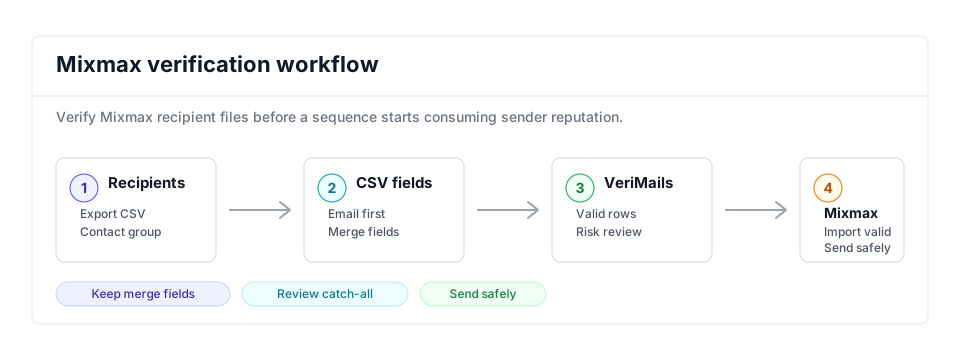
- Export scope: Use the contact group or sequence recipient export that matches the outreach you are preparing; adjacent Gmail workflows can follow the GMass guide.
- Matching field: Keep Email in the required column plus merge fields needed for personalization while bulk verification runs.
- Result action: Import valid recipients and hold invalid, catch-all, disposable, and role-based rows for review before they affect your bounce rate.
Step-by-Step
Export your recipients or contacts from Mixmax as a CSV
For contacts, open the Contacts area, select the group you want such as All contacts, and click Download as CSV in the top right. For a specific Sequence, open the Sequence report and click the Download button to get a CSV that includes recipient emails and personalization fields. Either file works as your VeriMails upload. QA the file by confirming the email header, UTF-8 encoding, row count, and all variables used in the Sequence copy.
Upload the CSV to VeriMails
Log in to VeriMails, open the bulk verification tool, and upload your exported file. VeriMails automatically detects and maps the email column, so no spreadsheet cleanup is needed at this stage. Confirm the mapped column before starting the queued job, and keep the raw Mixmax export unchanged until the filtered results are downloaded.
Review your verification results
When the run completes, VeriMails groups every address by status: valid, invalid, catch-all, disposable, and role-based. Review the breakdown to gauge how much of your list had decayed, then download the filtered results. Check status rates by source or Sequence stage, and sample a few high-value catch-all rows before including any in a monitored segment.
Re-import the cleaned list into Mixmax
When you build a new Sequence, choose the CSV option and upload your cleaned file, or drag and drop it into the import window. Keep the email column titled email, since renaming that field causes the import to fail, and save the file as UTF-8 so personalization variables display correctly. Preview a handful of imported recipients and confirm the accepted-row count before any automated step starts.
Verify before every Sequence
Contact data decays continuously, so verify each new list before it enters a Sequence and re-verify standing lists every few months. Making this routine keeps your Mixmax bounce rate low and your Workspace sending reputation healthy over time. For list builders that feed Mixmax daily, the Email Verification API can check addresses before CSV import.
What to Do With Each Result
Mixmax imports should stay narrow: valid recipients in the Sequence file, review statuses elsewhere.
- Valid Import into Mixmax with the email header and UTF-8 formatting preserved.
- Invalid Exclude and correct the CRM or source list before the next export.
- Catch-all Hold for a smaller monitored Sequence when the account is worth the risk.
- Disposable Remove from sales outreach because the inbox is temporary.
- Role-based Review manually; shared inboxes usually need different copy than named recipients.
Frequently Asked Questions
Related Guides
Try VeriMails Free
100 free credits on signup. No credit card required. Put this guide into practice today.
Start Free