Email Verification for Healthcare Communication

Appointment notices, care reminders, and patient updates only help if they reach the right inbox. VeriMails verifies your contact lists so fewer messages bounce and your sender reputation stays healthy.

Quick take

The short version: verify first, then send.

Patient and provider lists change as people move, switch plans, or update contact details. Verify exported addresses before outreach so reminders and operational notices reach real inboxes.

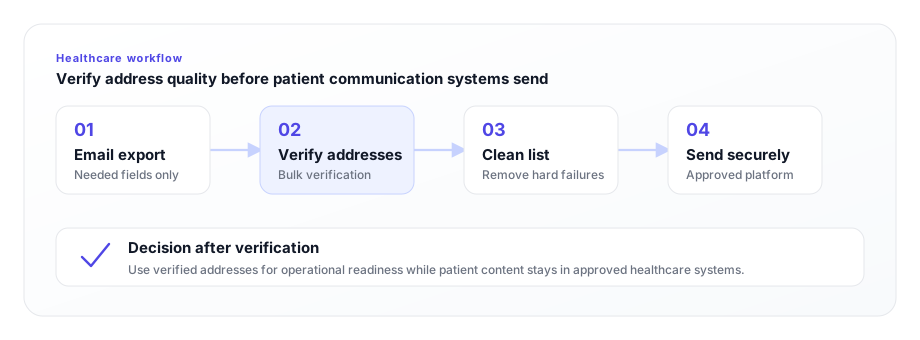
Healthcare workflow from patient email export to verified communication lists
Verify only the address fields needed for deliverability, then send patient content through the approved healthcare communication system.

Healthcare organizations depend on email to keep patients informed and engaged. Appointment confirmations, pre-visit instructions, lab result notifications, billing statements, wellness reminders, and care-plan follow-ups all travel through the inbox. When a patient or contact email address is wrong, that communication does not just fail quietly. It can mean a missed appointment, a delayed follow-up, or a message that lands somewhere it was never meant to go.

Patient contact data is unusually volatile. People change email addresses, switch employers whose work addresses they once provided, move between providers, and occasionally a patient passes away. A patient list that was accurate two years ago will contain a meaningful share of addresses that no longer work today. Front-office staff also transcribe addresses from intake forms by hand, and a single transposed character turns a valid address into a permanent bounce. Across a large practice or health system, those small errors add up to thousands of undeliverable contacts.

Through bulk verification, VeriMails checks every address in your patient and provider lists before your communication platform ever sends to it. You upload the list, you remove the addresses that will never deliver, and your care communications reach real inboxes belonging to the people you actually intended to reach.
Email challenges healthcare teams face

Where patient communication breaks down, and how verification helps.

Hard bounces with real consequences

A hard bounce means the address is permanently undeliverable. A care reminder or billing notice that fails, or reaches a reassigned address, is a problem worth preventing before you send.

Patient data that decays over time

Patients change addresses, switch providers, and move on from old inboxes. Without regular verification, a patient list slowly fills with contacts that can no longer be reached.

Sender reputation across the network

Inbox providers track bounce rates by domain. Poor reputation on one domain can drag down deliverability for an entire health system, so a clean list protects everyone who sends.

Typos from manual intake

Email addresses captured by hand at registration carry a steady rate of transcription errors. Verification flags the mistyped addresses before a message ever bounces.

Catch-all and role addresses

Shared addresses like office@ or info@ and catch-all domains behave unpredictably. VeriMails detects both so messages reach monitored, personal inboxes instead.

No clear picture of list health

Many organizations cannot say how many addresses in their database are dead. A bulk verification gives a clear breakdown of valid, invalid, catch-all, and risky contacts.

Verification, privacy, and a clear scope

It is important to be precise about what VeriMails does and does not do. VeriMails verifies whether an email address is real and able to receive mail. It is not a HIPAA compliance product, it does not send patient communications, and it should not be treated as a substitute for a HIPAA-aware messaging platform or a Business Associate Agreement. Email containing protected health information must be handled through whatever secure, compliant channel your organization already has in place.

Where VeriMails fits is the step before any of that. Confirming that an address is valid means a message intended for a specific patient is far less likely to fail or be exposed to an unintended recipient because the address was mistyped or reassigned. A hard bounce in a healthcare context is not just an inconvenience. It is a signal that something was sent to an address that does not work, and removing those addresses in advance is a sensible, low-cost piece of basic hygiene.

Verification also protects the deliverability you depend on. Inbox providers maintain reputation databases that track bounce rates, spam complaints, and engagement over time. A single domain or IP with poor sender reputation can affect email deliverability across an entire healthcare network. Keeping bounce rates low through regular verification is one of the most direct ways to improve inbox placement so legitimate, time-sensitive messages continue to reach inboxes rather than spam folders. With pricing from $0.0019 per email and 100 free credits on signup with no card required, a routine quarterly cleaning costs very little relative to the value of a message that actually arrives.

How it works

From EHR export to a verified contact list in minutes.

01

Export your contact list

Pull a CSV of patient or provider contacts from your EHR, practice management system, or communication platform. Any file with an email column works.

02

Upload and verify

Drop the file into VeriMails. We auto-detect the email column and run syntax, MX, DNS, and a live SMTP check, plus catch-all and disposable detection, on every address.

03

Communicate with confidence

Download the verified file and import only the deliverable addresses back into your communication platform. Bounce rates fall and messages reach their intended recipients.

SMTP
Live mailbox checks
API
Real-time checks
CSV
Bulk verification
100
Free starting credits

Healthcare email verification checklist

Improve contact accuracy while keeping protected health information in the systems built for it.

Prepare patient and provider lists safely

  • Export only the fields needed for verification. Use email addresses and operational identifiers, not clinical details.
  • Verify before reminder campaigns. Clean recall, wellness, and appointment-notice lists before the messaging platform sends.
  • Keep invalid addresses out of re-imports. Suppress hard failures so stale records do not keep cycling through outreach.
  • Review shared and role inboxes. Department aliases may be fine for provider operations, but not for patient-specific outreach.
  • Use compliant messaging tools for PHI. VeriMails confirms address quality; patient content still belongs in your healthcare communication system.

Where verification fits

MomentVerifyUse next
Recall outreachPatient contact exportsBulk verification
Portal intakeNew patient email fieldsVerification API
Provider updatesReferral and partner contactsCRM hygiene

The safest workflow is simple: verify addresses, then send patient content through the system your organization already approves.

Our patient outreach list had grown for years without a real cleanup. Running it through VeriMails before our next campaign cut our bounce rate dramatically and gave us confidence that reminders were actually reaching patients.
Andrea T. — Patient Communications Manager, Multi-Site Clinic, United States

Frequently asked questions

No. VeriMails verifies whether an email address is valid and able to receive mail. It does not send patient communications and is not a HIPAA compliance solution. Use a HIPAA-aware messaging platform for any email containing protected health information, and use VeriMails to confirm those addresses are real before you send.
A hard bounce means an address is permanently undeliverable. If a patient address has been reassigned or mistyped, a message intended for that patient can fail or be exposed to the wrong recipient. Verifying addresses before you send removes that risk and keeps care communications on track.
Yes. Export your patient or contact list as a CSV from your EHR or practice management system and upload it. VeriMails automatically detects the email column and verifies every address, then returns a clean file you can import back into your communication platform.
Inbox providers track bounce rates across a sending domain. A high bounce rate from invalid addresses lowers the reputation of that domain, and poor reputation on one domain can reduce deliverability across an entire healthcare network. Verifying lists keeps bounce rates low so legitimate messages keep reaching inboxes.
A quarterly verification is a sensible cadence for most healthcare organizations. Patients change addresses and switch providers over time, so a regular check keeps the list deliverable. With pricing from $0.0019 per email and 100 free credits on signup, the cost of staying current is low.

Start verifying emails today

100 free credits. No credit card required.

Get started for free