Email Verification That Reaches Your Whole Congregation

Newsletters, event invites, and prayer updates only matter if members receive them. VeriMails cleans your congregation list so your messages land in inboxes instead of bouncing.

TLDR

The short version: verify first, then send.

Church directories change with every new family, moved member, and old connection card. Verify member emails before newsletters, giving statements, and event invites so messages reach the congregation instead of spam.

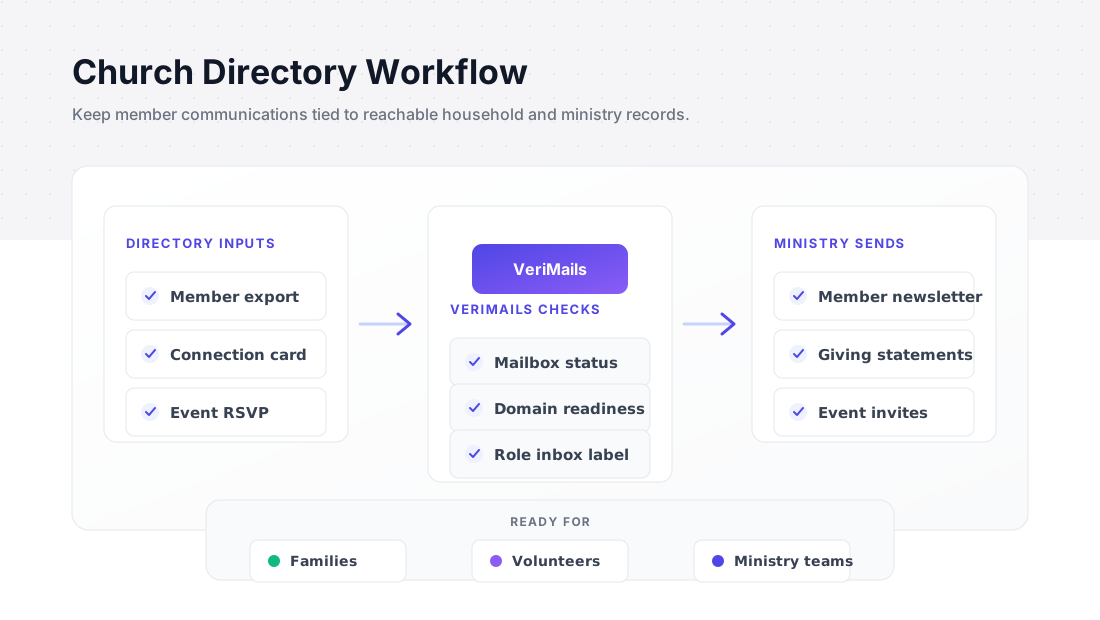
VeriMails church directory email verification workflow for member communications
Verify directory exports and new connection-card entries before newsletters, giving statements, and event invitations.

Email is how a church stays connected through the week. The weekly newsletter, service-time changes, event invitations, volunteer sign-ups, small-group updates, prayer chains, and giving reminders all travel through the inbox. When a member email address is wrong, that message does not reach them. They miss the event, they miss the announcement, and they slowly feel less connected to the life of the church, often without anyone realizing the email simply never arrived.

Church communication lists are notoriously hard to keep clean. Members are added from paper connection cards, welcome forms, sign-up sheets at the back of the sanctuary, and online registration for events and classes. Volunteers and part-time administrators enter much of this data by hand, and handwriting on a connection card is rarely easy to read. People also change email addresses, leave old work inboxes behind, and move away. Over time, a directory that started accurate quietly accumulates addresses that no longer work.

Most churches have no real way to know which addresses are dead. Bounces are not tracked, invalid addresses sit on the list indefinitely, and the volunteer sending the newsletter has no visibility into who actually received it. VeriMails fixes that. Using bulk verification, it checks every address in your congregation list before you send, so you know exactly who can be reached and your messages land where they belong.
Email challenges churches run into

Where congregation communication breaks down, and how verification helps.

Connection cards full of typos

Members are added from handwritten cards and sign-up sheets entered by volunteers. A single misread character creates an address that will bounce every time you send.

A church domain at risk of blocking

When too many emails hard bounce, inbox providers can block or filter your church domain entirely. A clean list keeps your messages from being treated as spam.

Member lists that drift out of date

Members change addresses and families move away. Without regular cleaning, your directory fills with contacts you can no longer reach with important news.

No visibility into who you reach

Most churches cannot tell how many newsletter emails actually arrived. A bulk verification gives a clear count of valid, invalid, catch-all, and risky addresses.

Disposable and role addresses

Event registrations collect temporary inboxes and shared addresses like office@. VeriMails detects both so your messages reach real, personal member inboxes.

A budget with no room for waste

Churches run lean. Verification starts at $0.0019 per email, so cleaning your whole member list costs only a few dollars and protects every message you send.

Why a clean list keeps you out of the spam folder

A healthy email list bounces around one percent or less. When a church repeatedly sends to invalid addresses, inbox providers like Gmail, Yahoo, and Outlook notice. They watch bounce rates closely, and once too many of your emails hard bounce they begin treating your church as a careless sender. The result is reduced inbox placement, messages filtered to spam, and in serious cases the church domain or sending server being blocked outright. When that happens, even your most faithful members stop seeing the newsletter, and the problem is invisible until someone mentions they have not heard from the church in weeks.

Verifying your list breaks that cycle. By removing the dead addresses before you send, you keep your bounce rate low, your sender reputation healthy, and your messages in the inbox where members will actually read them. It also gives you something most churches have never had: an accurate picture of your real reach. Instead of guessing, you can see exactly how many people on your list can be contacted, and you can follow up another way with the families whose addresses have gone stale.

The cost is small enough that it never needs to be a budget conversation. Verification starts at $0.0019 per email, a 10,000-credit pack is $19, and most church lists are well under that size. Monthly subscriptions are available from $15 to $299 per month if you prefer a recurring plan, and every account starts with 100 free credits, no credit card required, with credits that never expire. A bulk list of around 10,000 contacts runs as a background job, so the volunteer running communications can clean the whole directory in a single sitting.

How it works

From church directory export to a clean member list in minutes.

01

Export your member list

Pull a CSV of members from your church management software, directory, or email tool. Any file with an email column is ready to verify.

02

Upload and verify

Drop the file into VeriMails. We auto-detect the email column and run syntax, MX, DNS, and a live SMTP check, plus catch-all and disposable detection, on every address.

03

Send to your congregation

Download the verified file and import only the deliverable addresses back into your communication tool. Your newsletter and invites reach real inboxes.

SMTP
Live mailbox checks
API
Real-time checks
CSV
Bulk verification
100
Free starting credits

Church email list cleanup checklist

A simple rhythm for newsletters, giving statements, events, and member care updates.

Review the list before ministry emails go out

  • Export the current directory. Pull the latest family, member, and visitor records from your church management software.
  • Tag old connection-card entries. Hand-entered addresses are where typos and abandoned inboxes most often hide.
  • Clean before seasonal sends. Verify ahead of Christmas, Easter, giving statements, VBS, retreats, and capital campaign updates.
  • Keep staff aliases separate. Role addresses like office@ can stay in operations, but member newsletters should favor personal inboxes.
  • Document the import. Save the cleaned CSV date so staff know which directory version is safe to use.

Where verification fits

MomentVerifyUse next
Weekly emailMembers, regular attenders, ministry listsBulk verification
Visitor follow-upConnection cards and event guestsVerification API
Giving seasonDonors and household contactsNonprofit workflows

Small churches can start with one directory export and build a quarterly cleanup habit from there.

Our directory had years of old addresses from connection cards. We ran it through VeriMails in one afternoon, cleared out the dead ones, and our weekly email finally started reaching people who had quietly dropped off our list. It cost almost nothing.
Pastor David L. — Community Church, United States

Frequently asked questions

Yes. Export your member list as a CSV from your church management software or directory and upload it. VeriMails automatically detects the email column and verifies every address, then returns a clean file ready to import back into your communication tools.
A clean list bounces around one percent or less. When too many emails hard bounce, inbox providers treat your church as a careless sender and start blocking or filtering your messages. That means newsletters and event invites land in spam where members never see them.
Yes. Verification starts at $0.0019 per email, so a 10,000-credit pack is $19, and most church lists are much smaller than that. You also get 100 free credits on signup with no credit card, and credits never expire.
A review every quarter is a good rhythm for most churches. Members change email addresses and new families join throughout the year, so a regular verification keeps your directory accurate and your messages deliverable.
Each verification checks syntax, MX and DNS records, and runs a live SMTP handshake. It also flags catch-all domains, disposable addresses, and role-based addresses like office@ so you know exactly what is on your congregation list.

Start verifying emails today

100 free credits. No credit card required.

Get started for free