Email Verification for Schools, Colleges, and Universities

Student, applicant, and alumni databases decay faster than any other list. VeriMails verifies your contacts so enrollment messages and alumni outreach reach real inboxes.

TLDR

The short version: verify first, then send.

Student, applicant, and alumni addresses change every term. Verify lists before admissions deadlines, advancement appeals, and parent communications so high-priority messages reach active inboxes.

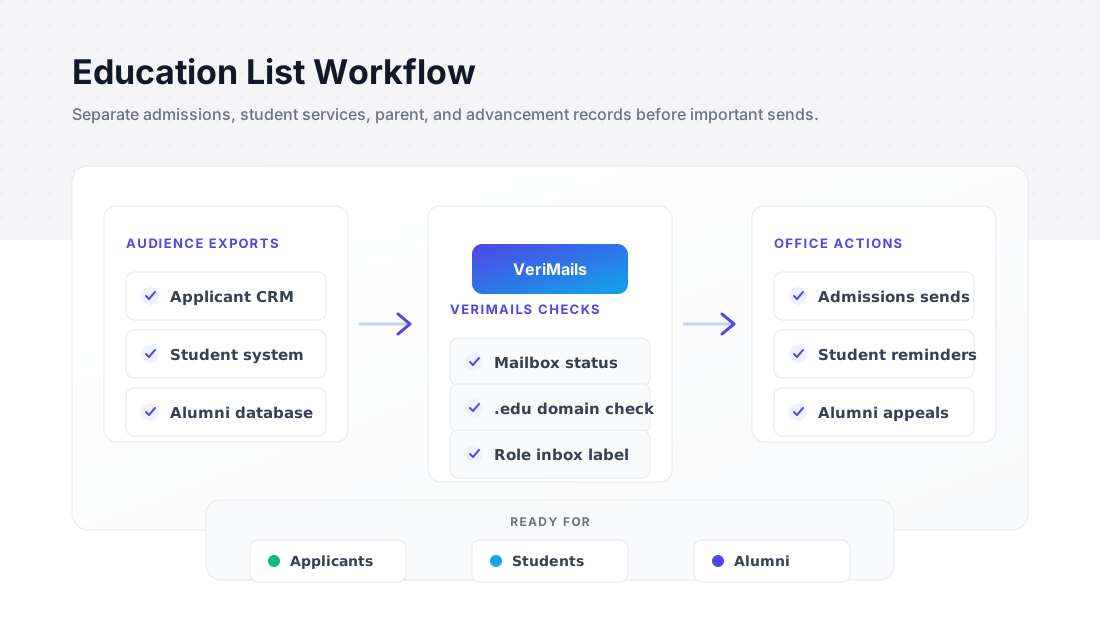
VeriMails education email verification workflow for applicants, students, and alumni
Verify applicants, students, parents, and alumni by audience so each office can apply the right send policy.

Educational institutions live and die by email. Prospective-student recruitment, application status updates, admission decisions, financial aid notices, orientation logistics, registration reminders, and alumni engagement and fundraising all run through the inbox. Yet education has a structural problem that few other sectors face: the contact database is designed to turn over. Every graduating class leaves, every incoming class arrives, and every year the lists grow larger and less accurate at the same time.

The .edu address is the clearest example. Most institutions deactivate a student .edu address within six to twelve months of graduation or withdrawal. That means any database holding .edu addresses from former students is, by design, full of addresses that will bounce. Alumni databases compound the issue. They grow every single year as new classes graduate, but they are rarely cleaned, so they slowly become the largest and most decayed list the institution owns. Prospective-student lists carry their own problem. Lists sourced from standardized testing services and other acquisition channels contain some of the lowest-quality email data in all of enrollment marketing.

Through bulk verification, VeriMails checks every address in your student, applicant, and alumni lists before you send. You upload the file, you remove the addresses that will never deliver, and your enrollment communications and alumni outreach reach the inboxes of people the institution can actually engage.
Email challenges across the student lifecycle

Where institutional communication breaks down, and how verification helps.

Expired .edu addresses

Student .edu addresses are usually deactivated within six to twelve months of graduation. Any list holding former-student .edu addresses is full of guaranteed bounces.

Alumni databases that only decay

Alumni lists grow every year and rarely get cleaned. They become the largest, most decayed database the institution owns, which makes them the best place to start verifying.

Bounced enrollment communications

A bounced admission notification can cost you a student who enrolled elsewhere. Verifying applicant addresses keeps time-sensitive enrollment messages from failing.

Low-quality prospect lists

Recruitment lists from testing services and other channels contain some of the worst email data in marketing. Verify them before spending recruitment effort and budget.

A sending domain under pressure

Inbox providers have tightened their standards. A domain that emails many invalid addresses loses reputation, and lower reputation pushes messages to spam.

Catch-all and disposable addresses

Department catch-all domains and disposable inboxes used at sign-up behave unpredictably. VeriMails detects both so your messages reach monitored, personal inboxes.

Where to start, and why it pays off

When an institution has email automation in place but struggles with deliverability, the fix is almost always list cleaning rather than more software. The single highest-return place to begin is the alumni database. It is the largest list, it is the most decayed, and it is the one tied directly to fundraising revenue. Cleaning it delivers the most immediate return because every dead address you remove is one that was dragging down both your fundraising results and the sender reputation of the domain those appeals go out on.

The enrollment side carries a different but equally real cost. Inbox providers have tightened their requirements, and emails from colleges and universities now have a harder time reaching prospective-student inboxes than they did a few years ago. A domain that repeatedly sends to invalid addresses sees its reputation fall, and lower inbox placement means even valid, important messages get filtered to spam. When the message in question is an admission decision or a financial aid notice, a spam placement or a silent bounce can mean a student who enrolls somewhere else. Verifying applicant and admitted-student lists before those communications go out keeps the most consequential emails the institution sends out of the bounce pile.

The economics make routine verification easy to justify. Verification starts at $0.0019 per email, credit packs scale up to 5 million credits for $1,499, and monthly subscriptions run from $15 to $299 per month, so an institution can match its plan to its actual volume. Bulk verification automatically detects the email column in your file, and a list of around 10,000 rows runs as a background job, so even a very large alumni or prospect database is fast and inexpensive to clean. Every account also starts with 100 free credits, no credit card required, with credits that never expire, so an enrollment or advancement office can test a sample of any list before committing.

How it works

From SIS or CRM export to a verified list in minutes.

01

Export your list

Pull a CSV of students, applicants, or alumni from your student information system, CRM, or advancement database. Any file with an email column works.

02

Upload and verify

Drop the file into VeriMails. We auto-detect the email column and run syntax, MX, DNS, and a live SMTP check, plus catch-all and disposable detection, on every address.

03

Send with confidence

Download the verified file and import only the deliverable addresses back into your communication platform. Enrollment messages and alumni outreach reach inboxes.

SMTP
Live mailbox checks
API
Real-time checks
CSV
Bulk verification
100
Free starting credits

Education email verification checklist

Use this for admissions, advancement, student services, and alumni outreach.

Clean by audience, not just by file

  • Split applicants, students, parents, and alumni. Each group ages differently and needs its own suppression rules.
  • Verify before time-sensitive deadlines. Admissions decisions, deposit reminders, and financial aid messages should not bounce.
  • Audit inactive .edu addresses. Graduating students and withdrawn applicants often lose access faster than advancement teams expect.
  • Keep role inboxes out of personal journeys. Department and office aliases belong in operations, not student or donor personalization.
  • Record the verification date. Advancement and enrollment teams need to know which export is clean enough for the next campaign.

Where verification fits

MomentVerifyUse next
AdmissionsApplicants, admits, parentsBulk verification
AdvancementAlumni and donor filesFundraising guidance
Inquiry formsProspect and event signupsVerification API

Treat verification as a pre-send quality gate for communications where missed inboxes create real student or donor risk.

Our alumni database had decades of addresses, many long dead. Verifying it before the annual giving campaign cut our bounce rate sharply and our appeals clearly reached more inboxes. We now clean the list every term as a matter of routine.
Karen M. — Advancement Services, University, United States

Frequently asked questions

Most institutions deactivate student .edu addresses within six to twelve months of graduation or withdrawal. Alumni databases keep growing every year but rarely get cleaned, so they accumulate a large share of addresses that no longer work. Verifying the list flags those addresses before a campaign goes out.
Yes, and it is a good idea. Prospect lists sourced from standardized testing services are among the lowest-quality email data in enrollment marketing. Upload the list as a CSV and VeriMails verifies every address so you stop wasting recruitment effort on contacts that cannot be reached.
A bounced admission notification can mean a student who enrolled elsewhere because the offer never reached them. Verifying applicant and admitted-student addresses before you send keeps time-sensitive enrollment messages out of the bounce pile and in front of the student.
Inbox providers have tightened their standards, and a sending domain that emails many invalid addresses sees its reputation fall. Lower reputation means more messages filtered to spam. Verifying lists keeps bounce rates low so your domain keeps reaching student and applicant inboxes.
Bulk verification is fast. A file of around 10,000 rows runs as a background job, and VeriMails automatically detects the email column. Larger alumni databases process quickly, and with pricing from $0.0019 per email even a very large list is inexpensive to clean.

Start verifying emails today

100 free credits. No credit card required.

Get started for free