Email Verification for Recruitment and Staffing
Recruiters and staffing firms run on candidate outreach, and outreach runs on the inbox. When a candidate list is full of stale or wrong addresses, bounces pile up, your sending reputation slips, and your best messages quietly land in spam. Verification keeps the channel that your pipeline depends on working.
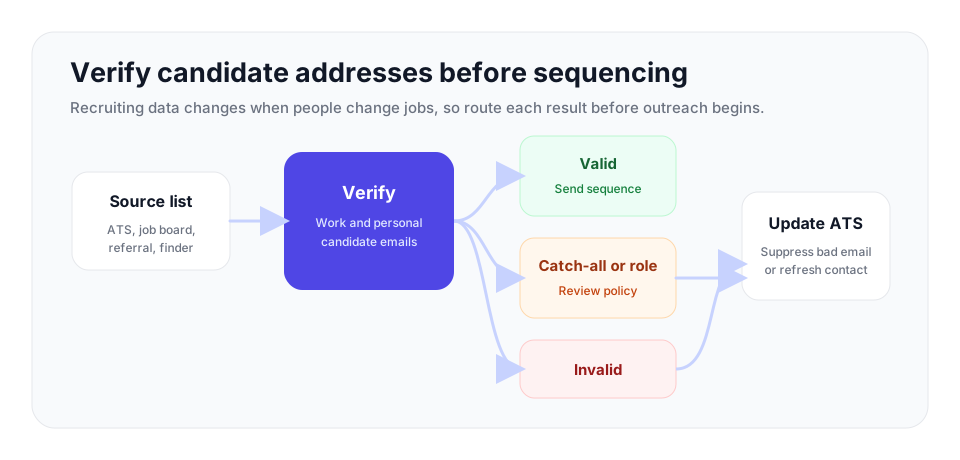
Recruiting teams should verify candidate emails before every sequence, refresh work addresses when candidates change roles, and route catch-all or role-based results for review. Use bulk verification for ATS exports and sourced lists, then use the API for continuous sourcing.
Why Candidate Data Goes Bad Faster Than You Think
Recruitment is unusual in how quickly its contact data decays, because the whole industry exists around people changing jobs. The moment a candidate accepts a new role, their old work email is on a path to deactivation. Multiply that across an entire talent database built up over years and a large share of the work addresses in it are already pointing at mailboxes that no longer exist.
The sourcing methods make it worse. Candidate emails rarely come from opt-in. They come from sourcing platforms, job boards, professional networks, referrals, and inferred work addresses. Every one of those routes carries a real error rate, and none of them can guarantee the address is live today. Layer on normal B2B data decay, and a recruiting database that is not actively maintained drifts steadily toward unreliability.
The practical consequence is simple. If you send a candidate sequence to an unverified list, you are not sending to the list you think you are. A meaningful slice of it is dead, and you will only find out when the bounces come back, by which time the damage is already done.
What Bounces Cost a Recruiting Team
A bounced candidate email is not a neutral event. It carries three separate costs, and the most expensive one is invisible.
The deliverability cost
This is the one that hurts most and is hardest to see. Mailbox providers judge a sending domain on its behavior, and a high hard bounce rate is read as a sign of poor list quality. The penalty is reduced inbox placement for everything you send afterward, including outreach to candidates whose addresses are perfectly valid. A practical bounce-rate benchmark is to keep total bounces under 3%, with anything above 5% treated as a serious deliverability risk. One careless candidate blast can therefore degrade outreach for weeks, affecting every role you are working.
The recruiter time cost
A bounced message is wasted effort. The recruiter researched the candidate, wrote or personalized the message, and queued the follow-ups in the sequence, and none of it reached anyone. In a staffing context where consultants are measured on placements, hours spent emailing addresses that never existed are hours not spent on candidates who could actually be reached.
The pipeline cost
When a candidate sequence reaches a dead address, that candidate silently falls out of the process. There is no reply, no rejection, just nothing. For a role with a tight shortlist, losing strong candidates to bad data rather than to genuine disinterest is a direct hit to your ability to fill the search.
What Verification Does for Recruiters
Email verification checks whether an address is real and able to receive mail before you send to it, and it does so without sending the candidate anything. For a recruiting workflow it delivers several concrete things.
| Candidate source | Main risk | Verification policy |
|---|---|---|
| ATS records older than 6 months | Work addresses may be closed after a job move. | Bulk verify before a new role campaign and refresh invalid records before outreach. |
| Freshly sourced work emails | Inferred formats can be wrong even when the company domain is valid. | Verify before the first touch, then send only to deliverable or reviewed catch-all results. |
| Personal candidate emails | Lower job-change decay, but typos and abandoned inboxes still happen. | Verify before sequences and keep a suppression rule for repeated soft bounces. |
| Hiring-manager or HR aliases | Role-based inboxes may not reach a named candidate. | Use for account research, not personalized candidate outreach, unless reviewed manually. |
Removes the dead addresses
The core benefit. Verification performs a syntax check, an MX and DNS lookup, and a live SMTP handshake against the candidate's mail server to test whether the mailbox exists. Addresses that come back undeliverable are pulled before the sequence runs, so they never become bounces. This is also how verification flags the candidate who has moved on: if their work mailbox was closed when they changed jobs, that address verifies as undeliverable, which is a strong, free signal the contact is stale and worth refreshing.
Flags role-based and disposable addresses
Role-based detection identifies generic addresses such as careers@ or hr@ that route to a shared inbox rather than the individual you want to reach. Disposable detection catches throwaway addresses that occasionally end up in sourced data. Knowing which addresses are which lets a recruiter decide how to handle them rather than wasting a personalized message on an inbox no candidate reads.
Handles catch-all domains honestly
Many employers run catch-all domains that accept mail to every possible address, so a mailbox-level check cannot confirm an individual candidate address there. A good verifier does not guess. It performs catch-all detection and reports the address as catch-all, so the recruiter knows that result is less certain and can decide whether and how to send. You get the truth about your data, including the parts that are genuinely ambiguous.
The Payoff: Cleaner Outreach, Better Response
Verification pays off in two ways recruiters care about. The first is protection. By keeping bounce rates low, you protect the sending reputation of the mailbox and domain every future candidate message depends on. That is the foundation of consistent inbox placement, and it is far cheaper to maintain than to repair.
The second is clarity. Candidate outreach is usually run as a multi-step sequence, and sequences perform well when they actually reach people: cumulative open rates climb meaningfully across the later touches of a well-run sequence. But those numbers only mean something if the sequence is landing in real inboxes. When dead addresses are stripped out first, your open and reply rates reflect genuine candidate interest rather than being dragged down by addresses that were never going to engage. That makes it far easier to judge whether your messaging is working and to forecast a search honestly, because every contact in the sequence genuinely received it.
The economics are firmly in your favor. At $0.0019 per email, verifying a candidate list of 10,000 addresses costs about $19. Set that against the cost of a damaged sending domain, the recruiter hours lost to bounces, and the strong candidates who quietly dropped out of a search because their address was wrong. Verification is one of the lowest-cost steps in the recruiting workflow and one of the highest-impact.
- Verify before adding candidates to an outreach sequence, not after the first bounce report.
- Separate work and personal emails so a stale work address can be refreshed without losing the candidate record.
- Suppress invalid addresses in the ATS so future searches do not reuse known-dead contacts.
- Track bounce rate by sourcing channel to identify the lists and vendors producing weak data.
How to Verify with VeriMails
VeriMails fits a recruiting workflow in two ways. For an existing talent database or a freshly sourced list of candidates for a search, use bulk verification: export the list as a CSV, upload it, and VeriMails verifies every address against live mail servers, returning a results file that marks each one deliverable, undeliverable, catch-all, disposable, or role-based. You then load only the addresses you want into your outreach tool or applicant tracking system.
For continuous sourcing, the REST API verifies each candidate address the moment it is added, whether that is inside a sourcing tool, an enrichment step, or a custom workflow. Each call returns a clear result, so it fits inside an automated pipeline without adding a manual review step, and your database stays clean as it grows rather than decaying between bulk cleans.
VeriMails runs the full set of checks, syntax, MX, DNS, a live SMTP handshake, catch-all detection, disposable detection, and role-based detection, with clear verification statuses. Pricing starts at $0.0019 per email, with 10,000 credits for $19 and volume up to 5 million credits for $1,499, plus annual plans from $12.50/month when billed yearly for teams that source continuously. Every new account includes 100 free credits on signup, with no credit card required, and those credits never expire, so you can verify your next candidate list at no cost.
Frequently Asked Questions
Related Articles
Start with Clean Data
100 free credits on signup. No credit card required. Put the advice into practice today.
Start Free