Email Verification for Marketing Agencies
A marketing agency lives or dies on the results it delivers for clients, and email results depend on messages reaching the inbox. Email verification removes invalid addresses before a campaign, protecting the deliverability of every client an agency manages.
For agencies, email verification is both deliverability insurance and a client operations standard. Verify every inherited list with bulk verification, use the API on client lead forms, and report cleaned-list counts so campaign metrics reflect real reachable contacts.
The shared reputation problem agencies face
An agency is not sending for one brand. It is sending for many, often through shared email infrastructure such as a common email service provider account, shared sending domains, or shared IP pools. That shared setup is efficient, but it creates a risk that an in-house team never has to think about: the lists are not isolated from one another.
When one client hands over a list that has not been cleaned in two years, and the agency sends to it, that campaign bounces. Inbox providers such as Gmail, Outlook, and Yahoo register the high bounce rate against the sending infrastructure. If that infrastructure is shared, the reputation hit does not stay with the one client. It spreads. The agency's other clients, with carefully maintained lists, suddenly see their open rates fall and their campaigns slip into spam folders. One stale list can reduce results for the entire book of business.
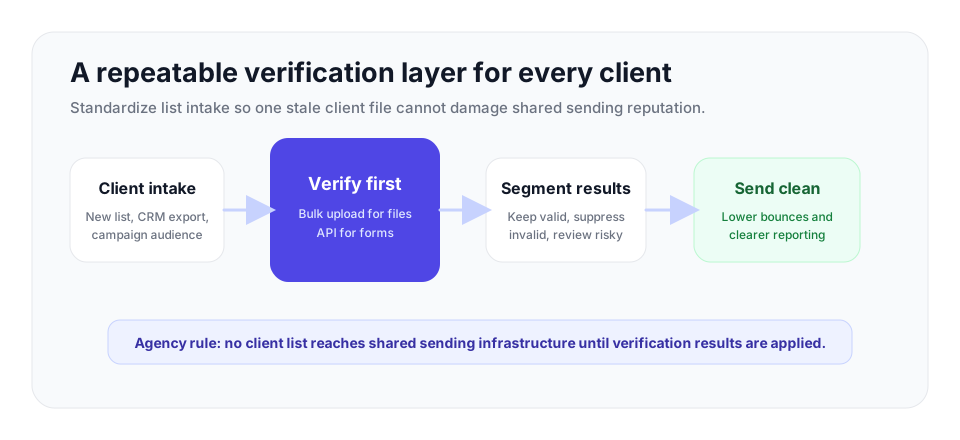
Email verification is how an agency contains that risk. By verifying every list before every send, the agency makes sure no single client's stale or invalid addresses can damage the deliverability of the rest.
Why bounce rate is the number that matters
A bounce is a message rejected by the receiving server because the address does not exist. Inbox providers treat a sender's bounce rate as a core trust signal. A healthy bounce rate is generally under 3 percent, and rates above 5 percent are a clear warning. When a sender crosses that threshold, providers may throttle delivery, route more mail to spam, or review the sending account.
For an agency, that is not an abstract risk. A suspended sending account or a throttled domain means campaigns do not go out on schedule, client reporting looks bad, and the agency has to explain a problem it could have prevented. Keeping bounce rate low through verification is a low-cost safeguard against that outcome.
What email verification checks
Email verification checks an address before you send and tells you whether mail to it is likely to be delivered. VeriMails runs a full sequence of checks on every address. Syntax validation catches typos and malformed entries. DNS and MX lookups confirm the domain exists and can receive mail. A live SMTP handshake connects to the recipient mail server and asks whether it would accept mail for that exact mailbox, without ever sending a message. Catch-all detection identifies domains that accept mail for every address. Disposable detection flags temporary throwaway addresses. Role-based detection flags shared addresses such as info@, sales@, and support@.
The output is a labeled list: valid addresses to keep, invalid addresses to remove, and flagged addresses such as catch-all and role-based that the agency can decide how to handle. VeriMails reports clear verification accuracy, driven by that live SMTP handshake rather than a guess based on formatting.
How agencies verify at scale
An agency manages many lists, so the workflow has to handle volume without manual effort. VeriMails supports two methods, and a single account with one credit balance can serve every client.
| Agency moment | Verification move | Client-facing output |
|---|---|---|
| New client onboarding | Bulk verify the CRM export before importing it into the sending platform. | Cleaned list size, invalid count, catch-all count, and a clear suppression file. |
| Campaign prep | Re-verify the target segment if it has not been used recently or came from multiple sources. | Lower bounce risk and a campaign audience that matches the report denominator. |
| Landing page launch | Add real-time verification to the form so typos and disposable addresses are caught at capture. | Cleaner leads flowing into the client's CRM from day one. |
| Monthly reporting | Include verified, invalid, and suppressed counts alongside sends, opens, clicks, and replies. | A simple data-quality narrative the client can understand. |
Bulk CSV verification for onboarding and campaigns
When an agency takes on a new client, the first task is usually to clean whatever list the client provides. The VeriMails bulk uploader handles this in one pass: upload the CSV, let VeriMails verify every row, and download a labeled results file. The same process runs before each major campaign, so every send starts from a clean list. This is the workhorse of agency verification.
The API for client capture points
Agencies also build landing pages, lead forms, and signup flows for clients. The VeriMails REST API verifies an address in real time, the moment a visitor submits a form. Wiring the API into those capture points means invalid and disposable addresses are caught at the source, so the client's list stays clean as it grows rather than accumulating invalid entries the agency has to clean later.
Many agencies also use an email finder to support client prospecting workflows with results that are verified before outreach.
What email verification costs an agency
VeriMails annual Agency pricing is displayed as $250/month when billed yearly for 1.5 million verifications per month. For agencies that prefer not to commit to a subscription, credit-pack balances never expire and scale from 10,000 for 19 dollars up to 1 million for 499 dollars and 5 million for 1,499 dollars. Because credits never expire, an agency can buy a large block once and draw it down across clients and months without losing what it paid for.
The other annual VeriMails tiers start at $12.50/month when billed yearly, with Business at $57.50/month and Scale at $125/month for agencies growing into larger client volumes. Every account begins with 100 free credits and no credit card, so an agency can verify a sample of a client list and see real results before committing.
Verification as a client-facing advantage
Verification is not only risk management. It is something an agency can put in front of clients. When an agency can show that it verifies every list before every send, it is demonstrating a level of discipline that protects the client's sender reputation, an asset the client owns and depends on. Clean data also makes the agency's reporting honest: open and click rates measured on a verified list reflect real engagement, not numbers distorted by bounces. That makes campaign results easier to interpret and easier to defend. When a campaign underperforms, the agency can rule out list quality as the cause, because it verified the list. For an agency competing on results and on trust, building verification into the standard process is a straightforward way to deliver both.
- Ask for list age, last send date, acquisition source, and prior bounce rate during intake.
- Suppress invalid addresses before the first send instead of leaving that decision to the client.
- Keep catch-all and role-based addresses in a separate review segment for higher-risk campaigns.
- Document verification results in the launch checklist so clean data becomes part of delivery quality.
Frequently Asked Questions
Start with Clean Data
100 free credits on signup. No credit card required. Put the advice into practice today.
Start Free