Email Verification Pricing Compared in 2026
Email verification pricing looks simple until you compare two tools side by side and realize the headline rate rarely matches the real cost. This guide breaks down what the major email verification tools charge in 2026, how credit packs compare with subscriptions, and the billing details that quietly change your bill.
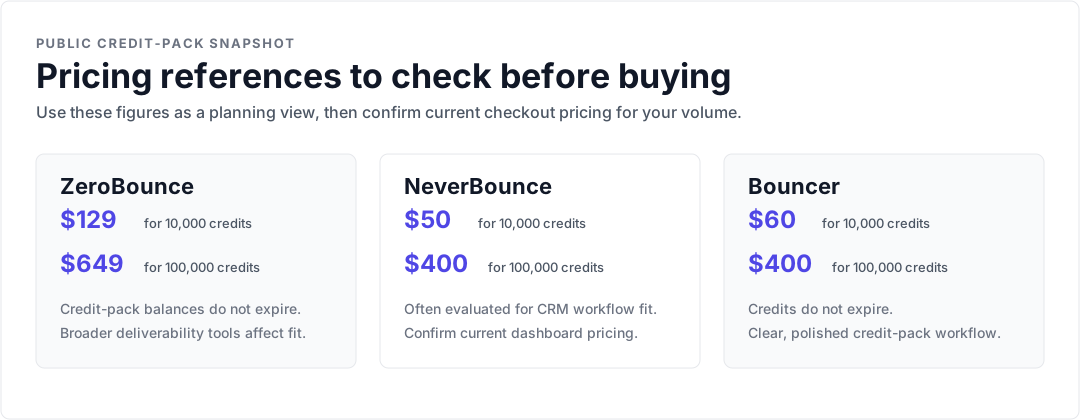
Compare email verification tools at the list sizes you actually run, not only at the smallest advertised tier. At 10,000 emails, the gap between providers can already be large; at 100,000 emails, credit expiry, API parity, duplicate handling, and catch-all or unknown billing can change the real invoice.
How email verification pricing works
Almost every email verification tool prices on a per-credit basis, where one credit verifies one email address. The price per credit drops as you buy in larger volume, so a tool that costs roughly a cent per email on a small pack might cost a third of that at high volume. That is why a single per-email number is rarely the whole story. The volume you buy, the billing model you choose, and the way the tool counts certain results all feed into the figure that lands on your invoice.
Two billing models dominate. Credit packs let you buy credits and draw them down whenever you need to. Subscriptions give you a monthly credit allowance, usually at a small discount, in exchange for a recurring commitment. Some tools offer both, and the better choice depends entirely on how regularly you verify. If you are still building a shortlist, pair this pricing pass with the best email verification tools roundup so cost does not outrank result quality.
Per-email pricing across the major tools
Here is a practical snapshot of what leading email verification tools cost in 2026. Use it to model your list size and billing pattern before you commit to a provider.
| List size | VeriMails | ZeroBounce | NeverBounce | Bouncer |
|---|---|---|---|---|
| 10,000 emails | $19 | $129 | $50 | $60 |
| 100,000 emails | $99 | $649 | $400 | $400 |
Price is only one part of the comparison
A credit-pack table answers the first question: what does this list cost today? The next table answers the operating question: which pricing policy fits the way your team verifies email lists over a full year?
| Provider | 10,000 emails | 100,000 emails | Credit policy | Best fit |
|---|---|---|---|---|
| VeriMails | $19 | $99 | Credits never expire | Low-cost bulk verification, API use, and seasonal list cleaning |
| ZeroBounce | $129 | $649 | Credit-pack balances do not expire | Teams that also want broader deliverability tools |
| NeverBounce | $50 | $400 | Confirm current expiry terms before buying | Teams that use purchased credits steadily |
| Bouncer | $60 | $400 | Credits never expire | Simple credit packs with a polished verification workflow |
The table above gives the quick comparison. The decision points below usually explain why the cheapest-looking plan is not always the cheapest account to run.
Compare the exact volumes you run, such as 10,000, 100,000, and your largest expected month.
Non-expiring credits are better for seasonal list cleaning because quiet months do not waste prepaid balance.
Catch-all, unknown, duplicate, and risky results can make two similar headline prices behave differently.
VeriMails
VeriMails starts at $0.0019 per email. A 10,000 credit pack is $19, and volume pricing scales down to 5 million credits for $1,499. Credits never expire. Annual plans start at $12.50/month when billed yearly and reach $250/month for Agency when billed yearly. The published per-email rate is the rate you pay, with no separate charge for catch-all or unknown results. New accounts receive 100 free credits with no card required.
ZeroBounce
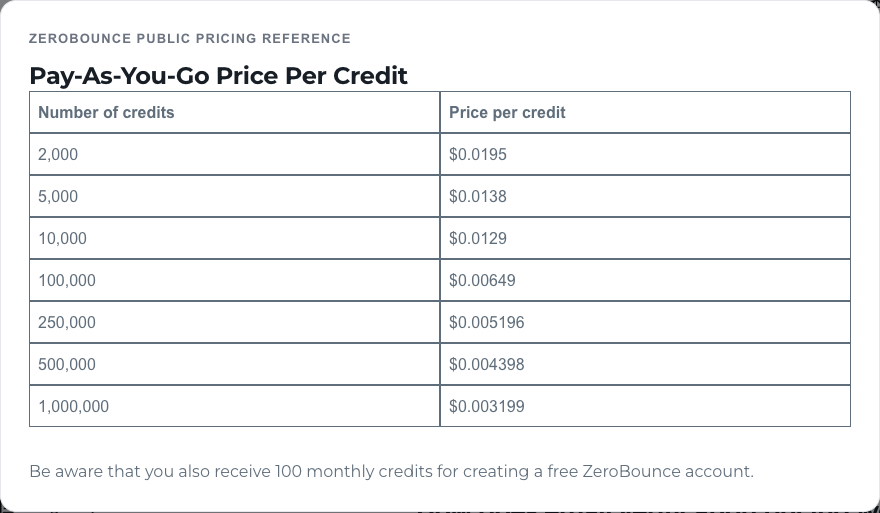
ZeroBounce credit-pack pricing is $0.0129 per credit for 10,000 credits and $0.00649 per credit for 100,000 credits, which works out to $129 and $649 at those list sizes. Credit-pack balances do not expire, and ZeroBounce also sells the broader ZeroBounce ONE subscription. It is one of the more expensive options per email, with the price reflecting its extra data and deliverability products.
NeverBounce
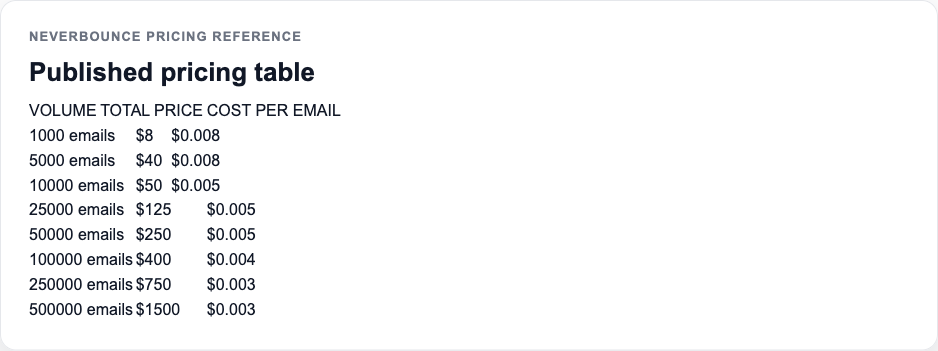
NeverBounce credit pricing is roughly $0.008 per email at entry volume, $50 for 10,000 credits, and $400 for 100,000 credits. A point worth budgeting around is that NeverBounce credits expire after 12 months, so a large pack only makes sense if you will use it within the year.
Kickbox, Bouncer, and Emailable
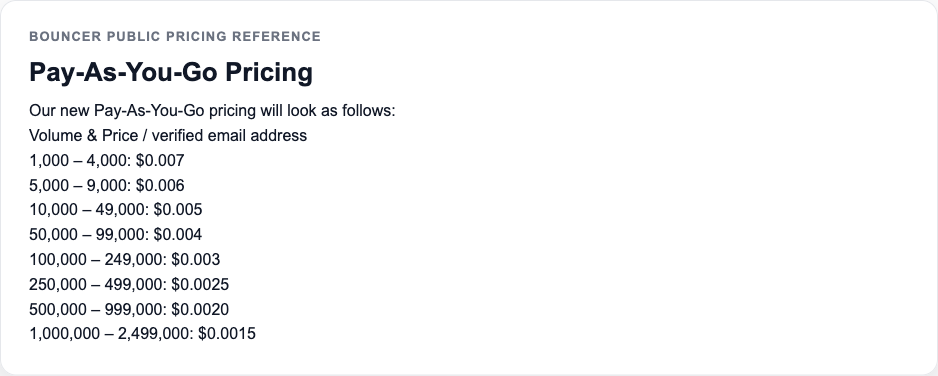
Kickbox credit pricing is roughly $0.01 per email on small volumes, with a monthly plan around $159 for up to 50,000 verifications, and credits that expire after 12 months. Bouncer credit pricing is $60 for 10,000 emails and $400 for 100,000 emails, with credits that do not expire. Emailable starts near $32 for 5,000 credits with subscription options, placing it among the lower-cost mainstream tools.
MillionVerifier and EmailListVerify
MillionVerifier is consistently among the cheapest at scale, at roughly $19 for 10,000 credits and around $389 for 1 million, with credits that never expire and no charge for catch-all or unknown results. EmailListVerify starts around $4 to $5 per 1,000 credits on small volumes, scaling toward $0.0019 per email at large volume, also with credits that do not expire.
Credit packs versus subscription
Choosing between the two models comes down to how predictable your verification volume is.
When credit packs win
If you verify occasionally, in seasonal bursts, or in unpredictable amounts, credit packs are usually the better choice. You buy a pack, use it as needed, and never pay in a month where you verify nothing. The one caveat is credit expiry. With a tool where credits expire after 12 months, a large pack bought during a busy quarter can partly go to waste during a slow stretch. VeriMails credit-pack balances never expire, so you can buy ahead at a lower per-email rate without that risk. For workflow cost, compare this with API vs bulk email verification.
When a subscription wins
If you verify on a steady monthly cadence, for example cleaning new signups every month or refreshing a CRM on a schedule, a subscription usually shaves a little off the per-email rate and makes budgeting predictable. VeriMails annual subscriptions start at $12.50/month when billed yearly and go up to $250/month for the Agency plan with 1.5 million credits, which fits teams running verification continuously rather than in one-off jobs.
The hidden costs that change your real price
The advertised per-email rate is only part of the picture. Three policies quietly move your real cost.
Credit expiry
Tools where credits expire after 12 months effectively put a deadline on every pack you buy. If your volume is uneven, you can pay for credits you never use. Tools where credits never expire, including VeriMails, MillionVerifier, EmailListVerify, and ZeroBounce credit packs, remove that pressure entirely.
How catch-all and unknown results are billed
On B2B lists, a meaningful share of addresses sit on catch-all domains, where the mail server accepts mail for any local part and a definitive yes-or-no answer is not possible. Some tools charge full price for these results, and for an unknown verdict, even though the verifier could not give you a clear answer. A tool that does not charge for catch-all or unknown results costs less than its headline rate suggests on real B2B data. VeriMails treats catch-all as a detection signal returned with the result, so you always know which addresses are on catch-all domains.
API and seat surcharges
A few tools price the API separately from bulk verification, or add per-seat fees. If you plan to verify through an API, confirm whether real-time calls cost the same as bulk credits. The VeriMails per-email rate applies whether you use the REST API or bulk CSV upload.
5 pricing checks before you buy
- Model your real volume. Price the tool at 10,000, 100,000, and your likely high-volume month instead of trusting the entry plan.
- Check credit expiry. Non-expiring credits matter if you clean lists in bursts rather than on a fixed schedule.
- Confirm API parity. Make sure API verification and CSV verification draw from the same balance.
- Look at uncertain results. Catch-all, unknown, duplicate, and risky results can change the effective cost of a B2B list.
- Test the workflow. A cheap verifier still needs clear CSV upload, download, API, and billing flows before it is useful at scale. Use the free email verification tools guide to plan that first sample.
The bottom line
Email verification pricing in 2026 spans a wide range. Established tools such as ZeroBounce, NeverBounce, Bouncer, and Kickbox typically sit between about $0.005 and $0.013 per email at common lower-volume packs, with the price reflecting brand, volume tier, and bundled extras. Value-focused tools such as MillionVerifier and EmailListVerify compete hard at scale. VeriMails starts at $0.0019 per email, which is at the low end of the market, with credits that never expire and no surcharge for catch-all or unknown results. To find your true cost, take your real monthly volume, apply each tool's per-email rate at that volume, and add the effect of credit expiry and result billing. The cheapest headline rate is not always the cheapest invoice.
Frequently Asked Questions
Start with Clean Data
100 free credits on signup. No credit card required. Put the advice into practice today.
Start Free