Best ZeroBounce Alternatives in 2026
ZeroBounce is one of the most recognized names in email verification, and it earns that reputation with solid accuracy and a wide set of extra data products. But it is also one of the more expensive options per email, and for many teams the bundled extras are not worth the premium. This guide compares the best ZeroBounce alternatives in 2026 so you can find a verifier that does the core job for less.
VeriMails is the better fit if you want lower-cost verification with non-expiring credits and do not need ZeroBounce's broader deliverability suite. Keep ZeroBounce on the shortlist if you rely on its activity data, AI scoring, or email deliverability extras.
Why teams look for a ZeroBounce alternative
ZeroBounce is a genuinely capable tool. It runs a thorough verification process, offers AI-based scoring and activity data, and has a long track record. None of that is in dispute. The reason teams look elsewhere usually comes down to two things: price and fit.
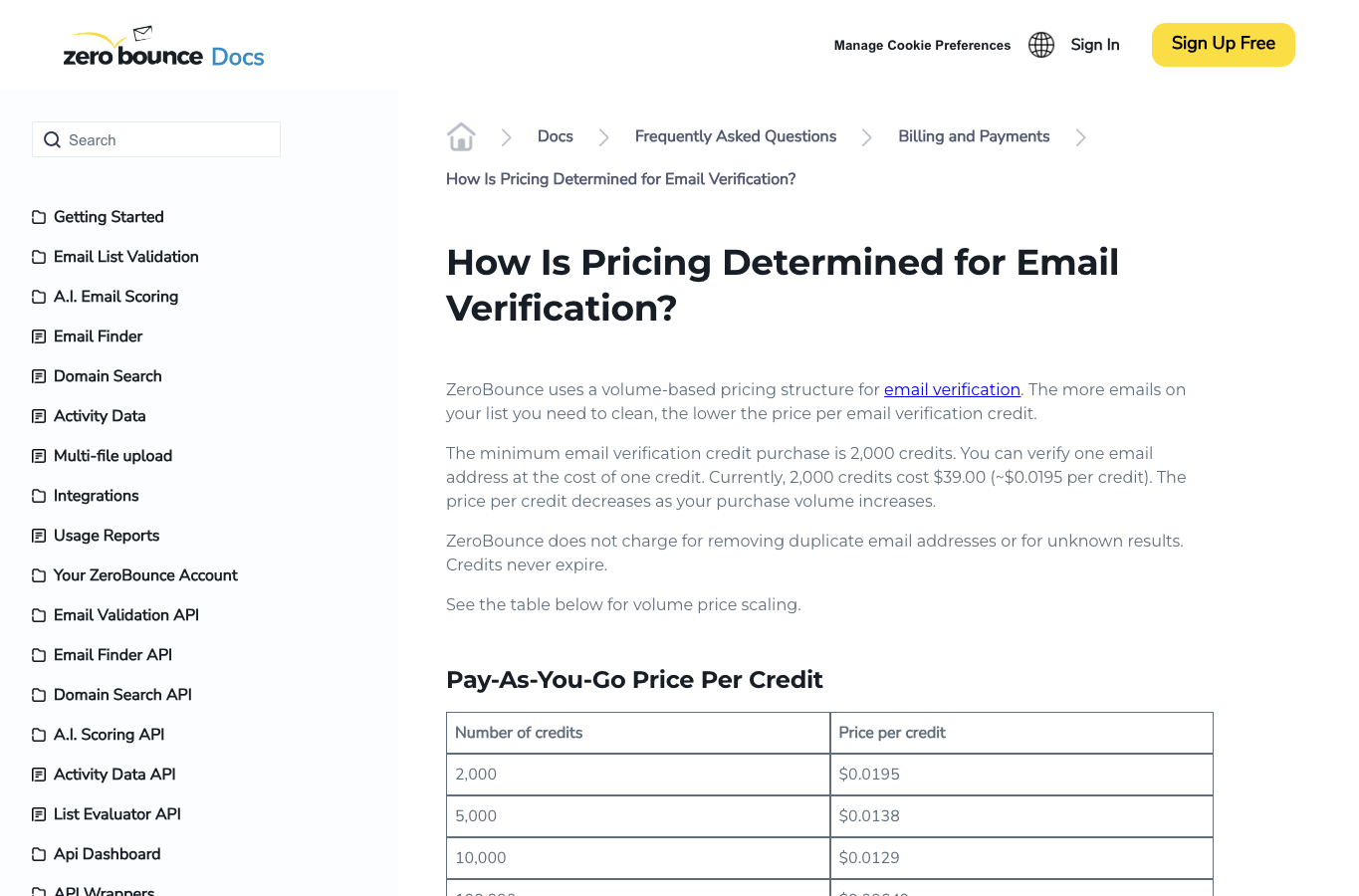
On price, ZeroBounce lists $39 for 2,000 credits, $129 for 10,000, $649 for 100,000, and $3,199 for 1,000,000. VeriMails lists $19 for 10,000 credits and $99 for 100,000 credits, so the difference becomes meaningful as soon as you clean real campaign lists instead of tiny samples.
On fit, ZeroBounce bundles a lot of extra products into its platform. If you use the AI scoring and activity data, that is value. If you mainly need to know whether an address is deliverable, you are paying for capability you do not use. A focused, lower-cost verifier often makes more sense in that case.
The best ZeroBounce alternatives in 2026
Start with the buying job: lower cost, API fit, bulk workflow, or extra deliverability data. The table below compares the tools buyers usually evaluate against ZeroBounce.
| Tool | Best fit | 10k price | 100k or 1M price | Credit policy | Main tradeoff |
|---|---|---|---|---|---|
| VeriMails | Low-cost API and bulk CSV verification | $19 | $99 for 100k; $1,499 for 5M | Credits never expire | More focused on verification than broad deliverability tooling |
| ZeroBounce | Premium suite with extra data and deliverability products | $129 | $649 for 100k; $3,199 for 1M | Credits do not expire | Higher cost if you only need verification |
| MillionVerifier | Low-cost bulk list cleaning | $39 | $149 for 100k; $449 for 1M | Credits do not expire | Less broad than a premium suite |
| EmailListVerify | Budget bulk verification | $27 | $186 for 100k | Credits do not expire | Simple product, fewer extras |
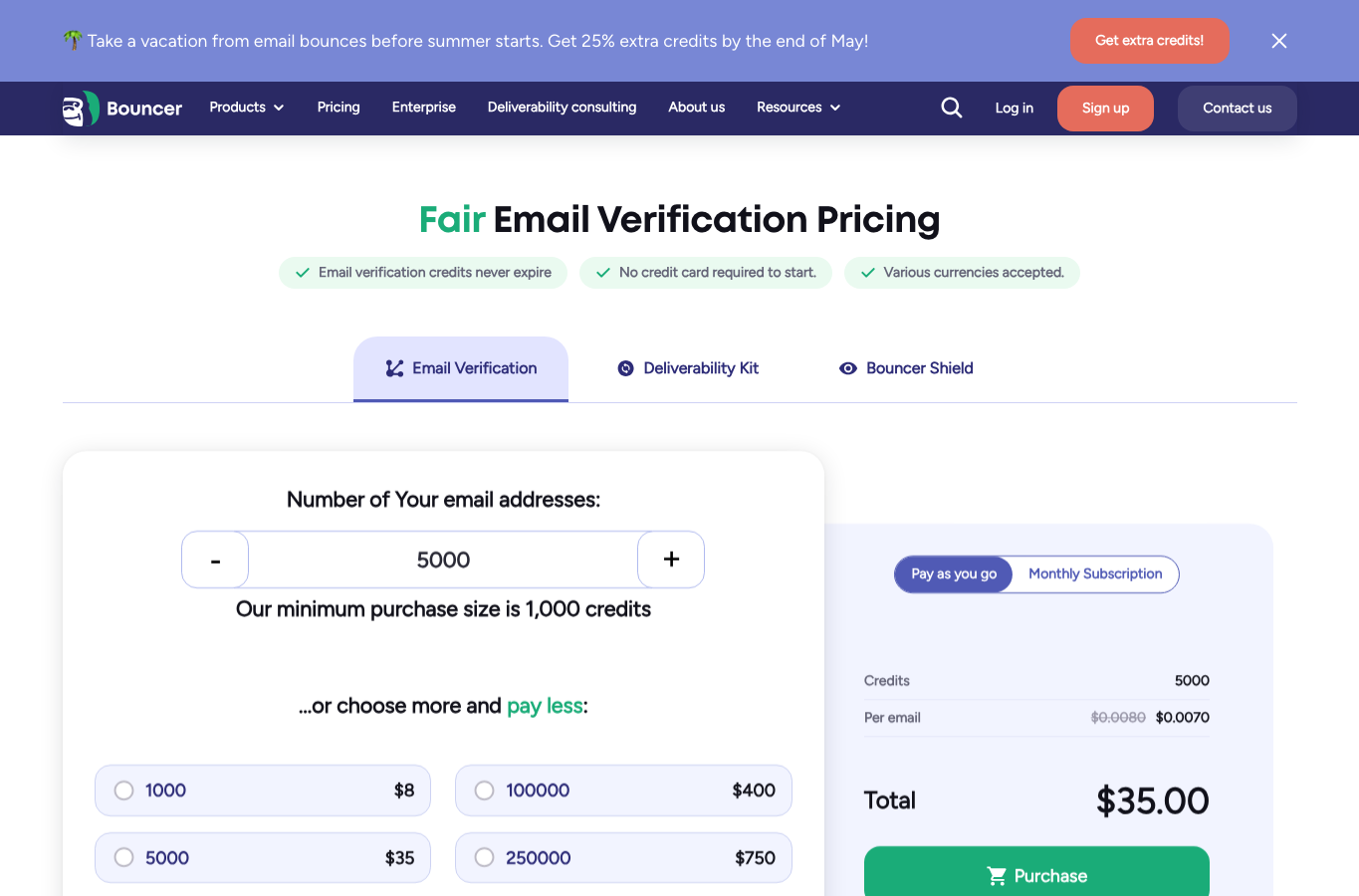
| Bouncer | EU-friendly polished verification workflow | $60 | $400 for 100k; $2,000 for 1M | Credits do not expire | Costs more than the budget tools |
Pricing changes. Treat this as a buying comparison, then confirm the current checkout price before purchasing.
VeriMails
VeriMails is a strong fit for teams that want the core verification checks buyers evaluate without the premium price. It checks syntax, MX, DNS, SMTP-level mailbox signals where the receiving server allows it, catch-all behavior, disposable domains, and role-based addresses. Pricing starts at $0.0019 per email, with a 10,000 credit pack at $19 and volume pricing down to 5 million credits for $1,499. Credits never expire, and monthly plans are available for predictable volume. There is a REST API and bulk CSV upload, so teams can verify addresses at capture or clean campaign lists before sending. New accounts get 100 free credits with no card.
MillionVerifier
MillionVerifier is the natural alternative for teams whose top priority is cost at scale. Listed pricing includes $39 for 10,000 credits, $149 for 100,000, and $449 for 1 million, with credits that never expire. It does not include the data-enrichment extras ZeroBounce offers, so it suits teams that mainly want low-cost verification.
EmailListVerify
EmailListVerify is another well-established value option. Listed credit packs include $5 for 1,000, $27 for 10,000, and $186 for 100,000, with credits that do not expire. It is a dependable choice for teams that want a long-running bulk verifier at a low rate.
Bouncer
Bouncer is a well-regarded European verifier and a good ZeroBounce alternative for teams that value EU data handling. Bouncer sits around the mainstream small-volume price range, drops steeply at high volume, and offers credits that do not expire with no charge for duplicate or unknown results. It is similar to ZeroBounce on small-volume price but more competitive at the top.
NeverBounce and Kickbox
NeverBounce and Kickbox are both mainstream alternatives in roughly the same price band as ZeroBounce. NeverBounce sits around the mainstream entry-volume price range, though its credits expire after 12 months. Kickbox is also in the mainstream small-volume price range, with credits that expire after 12 months. Both are credible, but neither is a clear cost win over ZeroBounce, so they suit teams switching for product-fit reasons rather than price.
Pricing and billing details
When comparing ZeroBounce alternatives, look at the tiers and the credit policy together. The headline per-email price only matters if the credits fit your actual buying pattern.
How to choose your ZeroBounce alternative
Match the tool to why you are leaving ZeroBounce.
If price is the reason
If you are switching to spend less, focus on the per-email rate at your real volume and on credit expiry. VeriMails at $0.0019 per email, MillionVerifier, and EmailListVerify are the strongest cost cases, and all three have credits that never expire, so you can buy in bulk safely. VeriMails also keeps mailbox-level checks plus catch-all, disposable, and role-based detection, so you are not trading accuracy for the lower price.
If you need an API or bulk upload
Confirm the alternative offers what you used in ZeroBounce. If you verified emails in real time through an API, you need a tool with a comparable REST API and predictable response format. If you cleaned lists in batches, you need reliable bulk CSV upload and export. VeriMails offers both.
If you used the extra data products
If you genuinely relied on ZeroBounce AI scoring or activity data, weigh that honestly. Most focused alternatives do not replicate those features. The trade is a lower price and a cleaner product against a narrower feature set. For teams that mainly need deliverability answers, that trade is usually worth it.
What you should not compromise on when you switch
Saving money on verification is only a win if the alternative still does the job properly. A few capabilities are worth treating as non-negotiable, whatever tool you move to.
Mailbox-level checks where servers allow them
The single most important quality signal is whether the tool checks beyond syntax and domain records to mailbox-level behavior where the receiving server allows it. Some receiving servers limit what can be confirmed, so no verifier should pretend every address can be proven with certainty. Tools that rely only on syntax checks, MX lookups, and historical data produce more false positives, because a domain can have valid MX records while a particular mailbox does not exist.
Catch-all, disposable, and role-based detection
Beyond mailbox existence, a verifier should tell you which addresses sit on catch-all domains, which are disposable addresses from temporary inbox services, and which are role-based addresses such as info@ or sales@. These signals change how you should treat an address even when it is technically deliverable. Make sure your alternative flags all three. VeriMails returns catch-all as a detection signal alongside disposable and role-based flags on every result.
A real API and bulk upload
If you used ZeroBounce through its API or for bulk list cleaning, the alternative needs to cover the same ground. Confirm there is a REST API with predictable responses and reliable CSV upload. VeriMails offers both at the same per-email rate whether you call the API or upload in bulk. Hold the line on these three things, and a cheaper tool is a genuine upgrade rather than a downgrade dressed up as a saving.
ZeroBounce switching checklist
Before you move a live workflow, use a small checklist so the switch is based on cost, result quality, and operational fit.
- Export a known sample: include valid, bounced, catch-all, role-based, disposable, and unknown-prone addresses.
- Map result labels: make sure your new verifier separates valid, invalid, catch-all, disposable, role-based, and unknown results in a way your team can act on.
- Test API behavior: check latency, response fields, and CSV exports against the workflow described in the email verification API comparison.
- Recalculate cost at real volume: compare 10,000, 100,000, and quarterly demand with the cheapest verification services guide.
The bottom line
ZeroBounce is a capable, well-established email verifier, and if you use its full set of data products it can justify its price. But if you mainly need accurate verification at lower cost, VeriMails is the most direct alternative: core verification checks, API access, bulk CSV upload, credits that never expire, and a free tier to test. MillionVerifier and EmailListVerify are strong low-cost alternatives at scale, and Bouncer is a solid European option. Switching is straightforward, since most tools share the same CSV format and offer a comparable API. Verify a sample list with one or two alternatives and let your own results decide.
Frequently Asked Questions
Start with Clean Data
100 free credits on signup. No credit card required. Put the advice into practice today.
Start Free