Email Verification API Comparison for 2026
An email verification API lets your application confirm an address is likely deliverable before it enters your database or your sending tool. This comparison looks at how the leading APIs differ on check depth, pricing model, result categories, and workflow fit, so you can pick the right option for your volume.
- Shortlist APIs by check depth, result clarity, credit policy, and whether bulk jobs use the same result model as real-time checks.
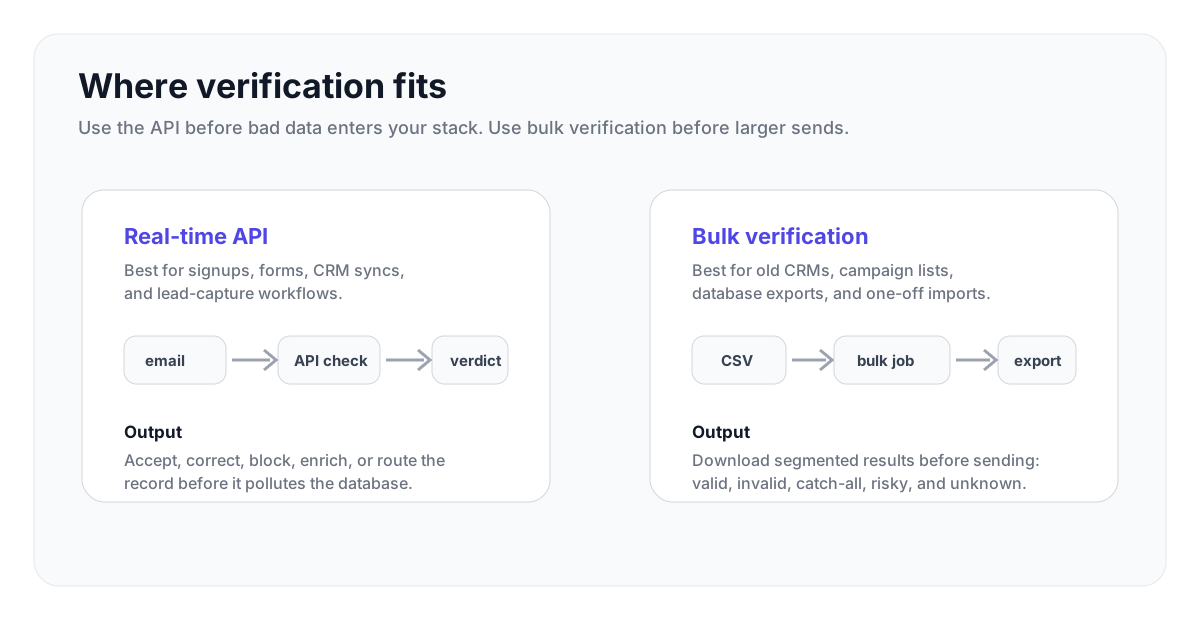
- Use real-time API verification at signup or lead capture, then use bulk CSV verification before imports and campaigns.
- VeriMails is the low-cost API-first option here: syntax, DNS, MX, SMTP-level checks where possible, catch-all detection, and non-expiring credits starting at $19 for 10,000 credits.
What a verification API is for
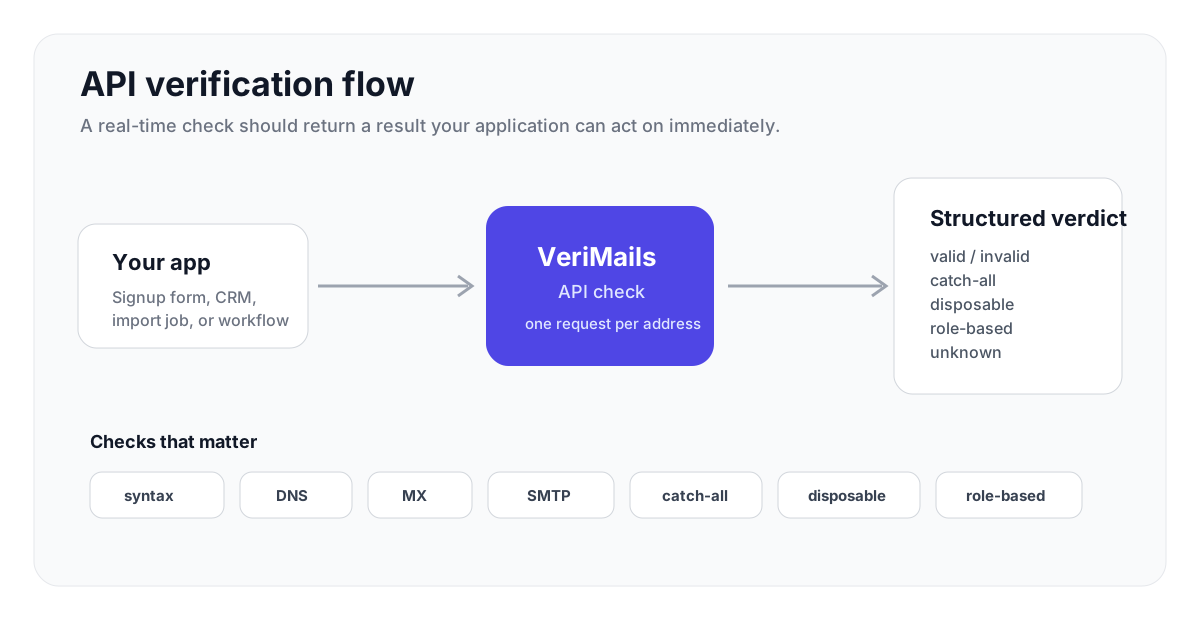
A verification API takes an email address and estimates whether the address is likely deliverable. You call it from your own code: a signup form, a CRM sync job, or a lead import pipeline. The API inspects the address, checks the domain and mail server signals, then returns a structured result your application can act on.
There are two common shapes. Real-time verification handles single addresses on demand, typically over a REST endpoint, and is ideal at the point of capture. Bulk verification handles whole lists, usually through a file upload, and is ideal for cleaning data before a campaign. The best providers offer both with a consistent result model, so one-off API checks and large CSV jobs are easy to compare.
Quick API comparison
At API level, the cheapest call is not always the best call. Compare response categories, ambiguous-result policy, bulk support, and credit terms before you wire a provider into a signup flow or import pipeline.
| API | Best for | Checks and categories | Pricing basis | Credit policy | Integration note |
|---|---|---|---|---|---|
| VeriMails | Low-cost real-time and bulk verification | Syntax, DNS, MX, SMTP-level checks, catch-all, disposable, and role-based detection. | $19 for 10,000 credits; $99 for 100,000 credits. | Credit-pack balances never expire. | Use the same account for API checks and CSV list cleaning. |
| ZeroBounce | Verification plus deliverability suite | Verification, scoring, status codes, and broader deliverability monitoring products. | Prepaid credits start at $39 for 2,000 credits; subscription bundles are also available. | Credit-pack terms describe non-expiring validation credits and no charge for duplicates or unknown results; confirm current account terms. | Strong if you also use inbox placement, blacklist monitoring, or deliverability diagnostics. |
| NeverBounce | Existing CRM and marketing workflows | Single checks, list jobs, valid, invalid, catch-all, disposable, unknown, and role-account style flags. | Usage is credit-based; price the current checkout tier at the list size you expect to verify. | Review expiry and billing terms before buying a large pack. | Fits teams comfortable with list-job polling and CRM-oriented verification workflows. |
| Bouncer | Transparent credit-pack verification | Real-time, batch, and hybrid API modes with clear result handling. | $60 for 10,000, $400 for 100,000, $2,000 for 1 million. | Credits never expire; duplicates and unknowns are not charged. | Clean choice when transparent API billing matters more than lowest price. |
| Kickbox | Developer-friendly verification with quality scoring | Deliverable, undeliverable, risky, unknown, disposable, role-based, and Sendex-style quality signals. | Prepaid credit tiers are commonly higher at low volume; confirm the current tier before purchase. | Review unknown/risky billing and expiry terms before a large import. | Good fit when your app needs a clear API response plus quality scoring. |
| MillionVerifier | High-volume bulk API cleaning | Single and bulk API options with good, risky, bad, and unknown style buckets. | Low-cost credit packs; confirm current tiers in checkout for the volume you need. | Budget-focused bulk credit model. | Good API shortlist entry for large imports and nightly cleaning jobs. |
| EmailListVerify | Budget verification with API included | Syntax, domain, MX, disposable, role-based, spam-trap, catch-all, and JSON metadata checks. | Prepaid packs and monthly subscriptions; API access is included. | Review pack terms and subscription reset rules before buying. | Useful if you want a simple budget API and bulk upload workflow. |
| Hunter | Email finding plus verification | Verifier uses score/status output and is part of Hunter's broader prospecting workflow. | Finder, verifier, and API usage draw from Hunter plan terms. | Best reviewed alongside the finder credits you expect to use. | Not verification-first; compare it when finder data is also part of the workflow. |
API flow and bulk job workflow
A useful verification API needs to be predictable in two places: the single-address request your application calls in real time, and the bulk workflow your operations team uses before a larger campaign.
The checks that separate full verification from format screening
Every verification API validates format, but depth decides whether it can protect a list. Syntax and MX checks catch malformed addresses and dead domains; SMTP-level checks, when the receiving server allows them, move the result toward mailbox-level confidence.
Checks that matter
A serious API should combine syntax, DNS/MX, SMTP-level checks, disposable and role-based detection, and explicit catch-all labeling. Catch-all domains can accept many local parts, so a simple valid/invalid result can be misleading. Segment those results instead of treating them as confirmed mailboxes; the catch-all verification guide explains the handling.
Premium APIs: ZeroBounce, NeverBounce, Kickbox
ZeroBounce, NeverBounce, and Kickbox are mature, well-documented options with wide integration coverage and generally higher low-volume pricing.
ZeroBounce leans into a broader deliverability suite, Kickbox is known for clean developer responses and quality scoring, and NeverBounce has single-check and list-job workflows. Before buying, confirm credit expiry and unknown-result billing because uneven volume can turn unused balance into real cost.
Budget APIs
Budget APIs compete mainly on price and can be much cheaper at high volume. The tradeoff to test is check depth: low cost only helps if the API still performs SMTP-level checks where possible and returns catch-all, disposable, and role-based labels you can act on. Run a known sample before trusting any low-cost provider at scale.
Where VeriMails fits
VeriMails sits between those groups: premium-style check depth at a budget-tier price. It supports syntax, MX, DNS, SMTP-level checks where possible, catch-all detection, disposable detection, and role-based detection for signup forms, CRM imports, lead routing, and campaign preflight. Developers can start with the getting started guide; operations teams can use bulk verification for one-off list cleaning.
Pricing starts at $0.0019 per email, with 10,000 credits for $19 and volume packs up to 5 million credits for $1,499. Credits never expire, monthly plans are available for predictable spend, and new accounts receive 100 free credits with no card required. The same account supports REST API checks and bulk CSV upload.
How applications should use result categories
The API response is only useful if your application knows what to do with it. Treat the categories as routing decisions, not just labels.
| Result | Meaning | Typical application action |
|---|---|---|
| Valid | The address appears deliverable based on available checks. | Accept the signup, keep the CRM record active, or allow the campaign send. |
| Invalid | The address fails syntax, domain, or mailbox-level checks. | Block entry, ask for correction, or suppress from outbound lists. |
| Catch-all | The domain accepts many or all mailbox names, so the individual inbox cannot be confirmed with certainty. | Use caution. Keep for lower-risk workflows, but segment separately for cold outreach. |
| Disposable | The address belongs to a temporary inbox provider. | Block signups where account quality matters; suppress from paid campaigns. |
| Role-based | The address reaches a group or function, such as info@ or support@. | Keep for support or vendor workflows, but avoid person-level sales personalization. |
| Unknown | The server timed out, blocked checks, or could not provide a reliable answer. | Retry later, enrich with another source, or route into a cautious segment. |
How to compare APIs for your use case
Do not pick on the per-email headline alone. Run the comparison against your actual situation.
Compare at your real volume
Per-email rates change across tiers, so the cheapest provider at 10,000 emails may not be the cheapest at 500,000. Take your true monthly verification volume and price each API at exactly that number. Then factor in credit expiry: a slightly higher rate with no expiry can beat a lower rate that forces you to use credits within a year.
Test accuracy on known data
Build a small test set of addresses where you already know the answer, a mix of valid, invalid, catch-all, and disposable, and run it through each candidate API. The verdict that matters is whether the API correctly identifies the addresses you know are bad. A broad accuracy claim is only meaningful if it holds on your data.
Check the integration fit
Look at the response format, the available SDKs, the rate limits, and whether bulk and real-time share one account. An API that returns a clear, structured verdict and slots into your stack with minimal glue code usually saves more time than you gain from a slightly lower per-call price.
Verification is a high-return integration because bounce rates quickly affect filtering and sender reputation. The right API in 2026 runs deep checks, prices fairly at your volume, and returns categories your app can trust. For implementation tradeoffs, read API vs bulk email verification next.
Frequently Asked Questions
Start with Clean Data
100 free credits on signup. No credit card required. Put the advice into practice today.
Start Free