Free Email Verification Tools That Actually Work
Plenty of tools advertise free email verification. The useful question is simple: what can you actually verify for free, and is the free tier a real sample of the product you would trust for a larger list?
- Use free credits to test a real verification product on a known sample before you upload a full list.
- A useful free verifier should check syntax, DNS, MX, SMTP where possible, disposable addresses, role-based addresses, and catch-all domains.
- If the free allowance does not cover the whole list, use one provider for the paid pass so result labels stay consistent.
Actual free email verification options
The phrase free email verification covers recurring quotas, one-time signup credits, and public single-address checkers. Use the free tier to test a mixed sample first, then decide whether the same provider is worth using for the full file.
| Tool | Free allowance | Best use | Watch before scaling |
|---|---|---|---|
| VeriMails | 100 signup credits, no card required. | Testing full verification on a small list or known sample before buying credits. | Use one account for API and bulk work so labels stay consistent. |
| ZeroBounce | 100 validation credits each month on a free account. | Recurring sample checks and testing API or list workflows. | The free monthly allowance is small, so price paid credits at your real list size. |
| Bouncer | Public checker for 5 emails per day, plus 100 signup credits. | Manual spot checks and small tests before a credit purchase. | Good for samples, not a full legacy list. |
| Emailable | 250 free credits when you start. | Testing bulk, single, API, or widget verification. | Model the next paid pack before a large import. |
| EmailListVerify | 100 signup verifications. | One-off sample lists and basic bulk testing. | Keep the same result labels if you continue with a paid run. |
| Hunter | 50 shared credits per month across finder, verifier, and domain search. | Teams also testing email finding. | It is not a verification-only quota; verification uses shared plan credits. |
For a larger list, use the free tier to test a mixed sample, then compare the paid step in the email verification pricing comparison before you run the full file.
What a free verifier still needs to check
A useful free tier should run the same core checks as the paid product: syntax, DNS and MX records, SMTP-level mailbox checks where server behavior allows, disposable and role-based detection, and catch-all detection. If a page only confirms format or domain existence, keep it for typo screening rather than campaign or signup decisions.
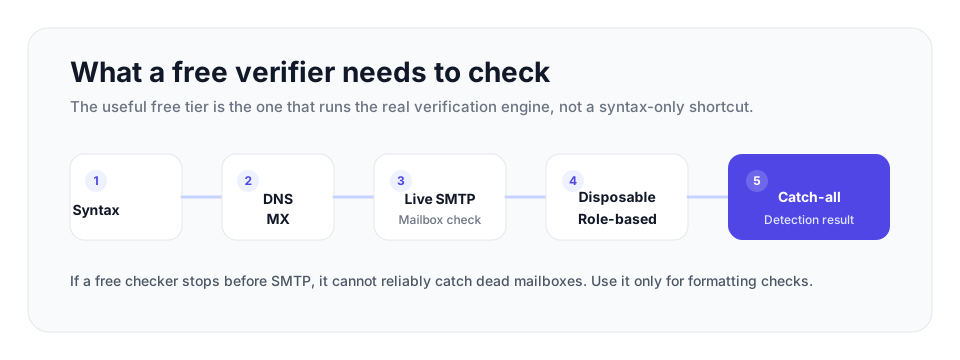
The most important split is mailbox confidence versus format screening. SMTP-level checks help distinguish a real inbox from a well-formed dead address; catch-all, disposable, and role-based labels tell you which addresses need segmentation. The VeriMails API runs these checks in real time for signup and lead forms.
Match the free allowance to the task
The useful question is not only how many free credits you get, but whether the reset pattern fits your task. A monthly quota is good for ongoing trickle checks; one-time credits are better for a sample or small list you can finish at your own pace.
| Task | Best free-tier shape | Best next step |
|---|---|---|
| One spreadsheet under the allowance | One-time credits that do not expire quickly. | Clean the whole file, export results, and suppress failures before any send. |
| Daily lead capture | Small recurring quota or API-ready trial. | Verify each new address at capture so bad data never enters the CRM. |
| Provider evaluation | Enough credits for a known mixed sample. | Include valid, invalid, catch-all, disposable, and role-based examples. |
| Large legacy list | Free sample plus transparent paid credits. | Test a sample first, then buy enough credits for one consistent full-list pass. |
Free tool traps to avoid
The safest free workflow is simple: evaluate one provider on a representative sample, keep the exported result labels, and only scale after you trust the verdicts. Problems usually appear when the free check is too shallow or when teams stitch together several tools and lose a consistent status model.
- Format-only checks. Syntax and domain checks catch obvious typos, but they do not tell you whether an individual mailbox is likely reachable.
- Mixed result labels. One provider's "risky" can mean something different from another provider's "unknown," which makes the final suppression policy harder to defend.
- Unclear data handling. Use account-based tools with clear exports and privacy controls when the list contains customers, donors, or prospects.
- No paid path. A free checker is less useful if the next paid step is unclear, expensive at your volume, or separated from the API and bulk workflow you will use later.
Where free verification stops
Free verification is sized for evaluation and genuinely small jobs. If your list has thousands of rows, using several free accounts or mixing engines can create inconsistent labels.
Use a single provider for the full paid pass after the sample, and be careful with anonymous CSV upload pages. A real account, clear privacy policy, and export or delete controls matter when you are handing over customer or prospect data.
How VeriMails handles the free tier
VeriMails gives 100 free credits on signup. There is no credit card required, and the credits never expire, so you can spend them whenever a task arrives rather than racing a monthly reset. Those credits run the full verification engine, including syntax, MX and DNS records, SMTP-level checks where server behavior allows, catch-all detection, disposable detection, and role-based detection.
The free credits are designed to let you verify a small list outright or test a known sample before deciding to buy. When you need more, verification starts at $0.0019 per email, with credit packs from 10,000 credits at $19 up to 5 million credits at $1,499, and monthly annual plans from $12.50/month when billed yearly. If you are comparing APIs as well as free tools, read the email verification API comparison next.
A simple free-first plan
Pick a verification service with a genuine free tier and run a mixed sample first. Include addresses you already know are good or bad, then check whether the verdicts match reality before you buy credits for the rest.
- Prepare a mixed sample. Include fresh addresses, older records, catch-all business domains, role-based inboxes, and known bad addresses.
- Run the free verification pass. Export the result labels instead of copying only the final valid count.
- Build segments from the labels. Keep valid addresses active, suppress invalid and disposable addresses, and hold catch-all results separately.
- Decide whether the remaining list needs paid credits. If the free allowance does not cover the full file, use one provider for the full run so result labels stay consistent.
- Save the suppression list. Never let addresses that failed verification re-enter through a later import.
If your full list fits inside the free allowance, finish the job at no cost. If it does not, you now know whether this provider is accurate enough to buy credits for the full run. The free tools that actually work are the ones that do the full job at small scale.
Frequently Asked Questions
Start with Clean Data
100 free credits on signup. No credit card required. Put the advice into practice today.
Start Free