Best Email Verification Tools in 2026
Email verification tools all promise clean lists, fewer bounces, and better sender reputation. The hard part is choosing one when every vendor claims near-perfect accuracy. This 2026 list compares the strongest options on pricing, verification depth, API fit, credit policy, and the tradeoffs that matter before a campaign goes out.
For most teams, the best email verification tool is the one that gives you accurate enough results, clear categories, a usable API, and pricing that does not punish uneven volume. VeriMails is the best value pick because it starts at $19 for 10,000 credits, includes bulk and API verification, and credits never expire. ZeroBounce is the premium deliverability-suite pick, Bouncer is a strong credit-pack alternative, MillionVerifier and EmailListVerify are budget bulk options, and NeverBounce or Kickbox make sense when their integrations or existing workflows already fit your stack.
Quick comparison of the best email verification tools
Use the table below to shortlist tools by budget, workflow fit, API needs, and how much tolerance your team has for uncertain results such as catch-all or unknown addresses.
| Tool | Best for | Pricing snapshot | Policy and feature notes | Short verdict |
|---|---|---|---|---|
| VeriMails | Low-cost bulk and API verification | $19 for 10,000 credits and $99 for 100,000 credits. | Credits never expire. Includes CSV bulk verification, API access, catch-all, disposable, and role-based detection. New accounts get 100 free credits. | Best value for teams that want full checks without premium pricing. |
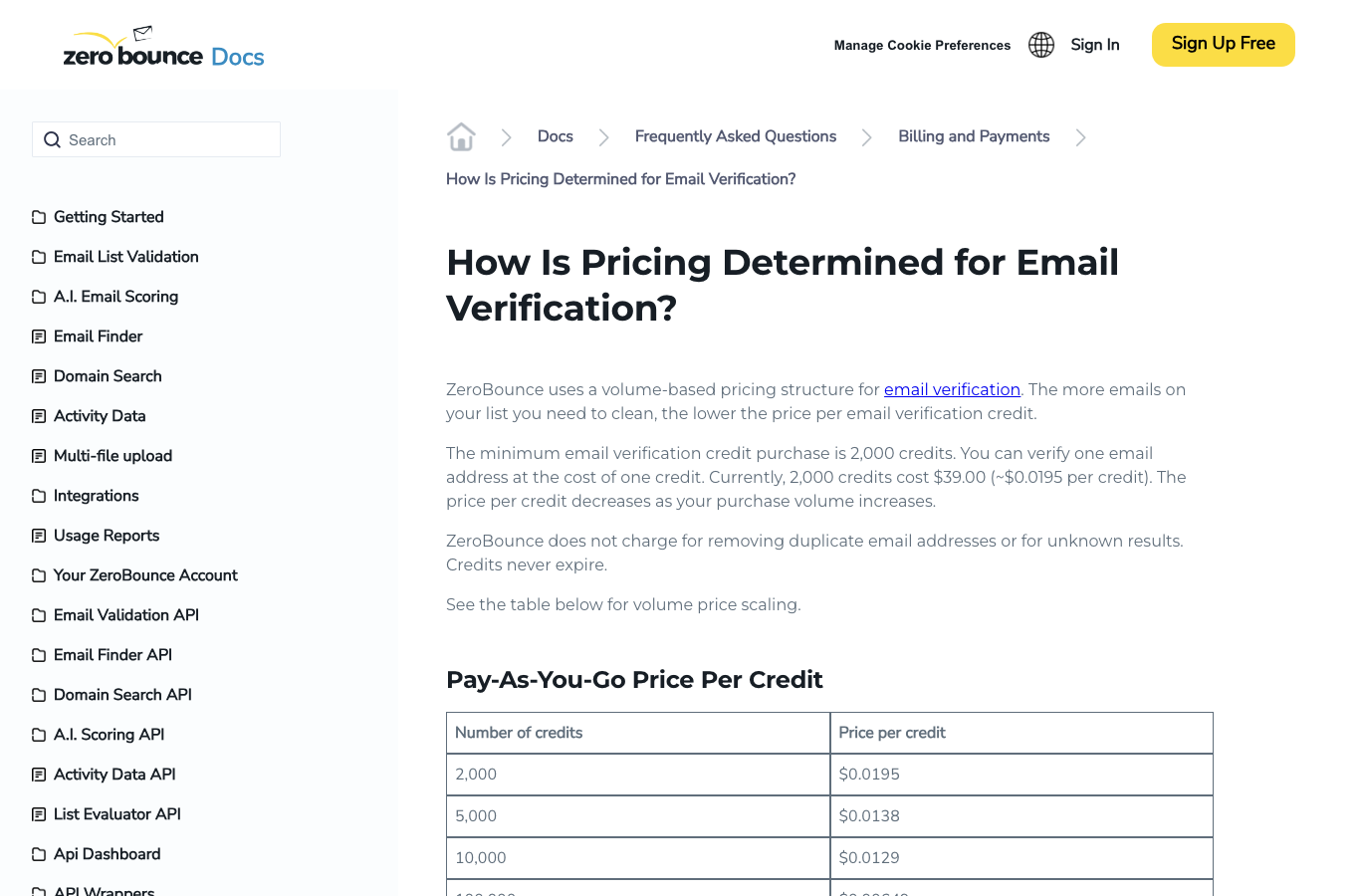
| ZeroBounce | Premium suite with deliverability extras | $129 for 10,000 and $649 for 100,000 pay-as-you-go credits; ZeroBounce ONE is $99/month for 10,000 monthly validation credits. | One credit per verification; duplicates and unknown results are not charged; credit-pack balances do not expire. | Strong if you want verification plus a broader email-deliverability suite. |
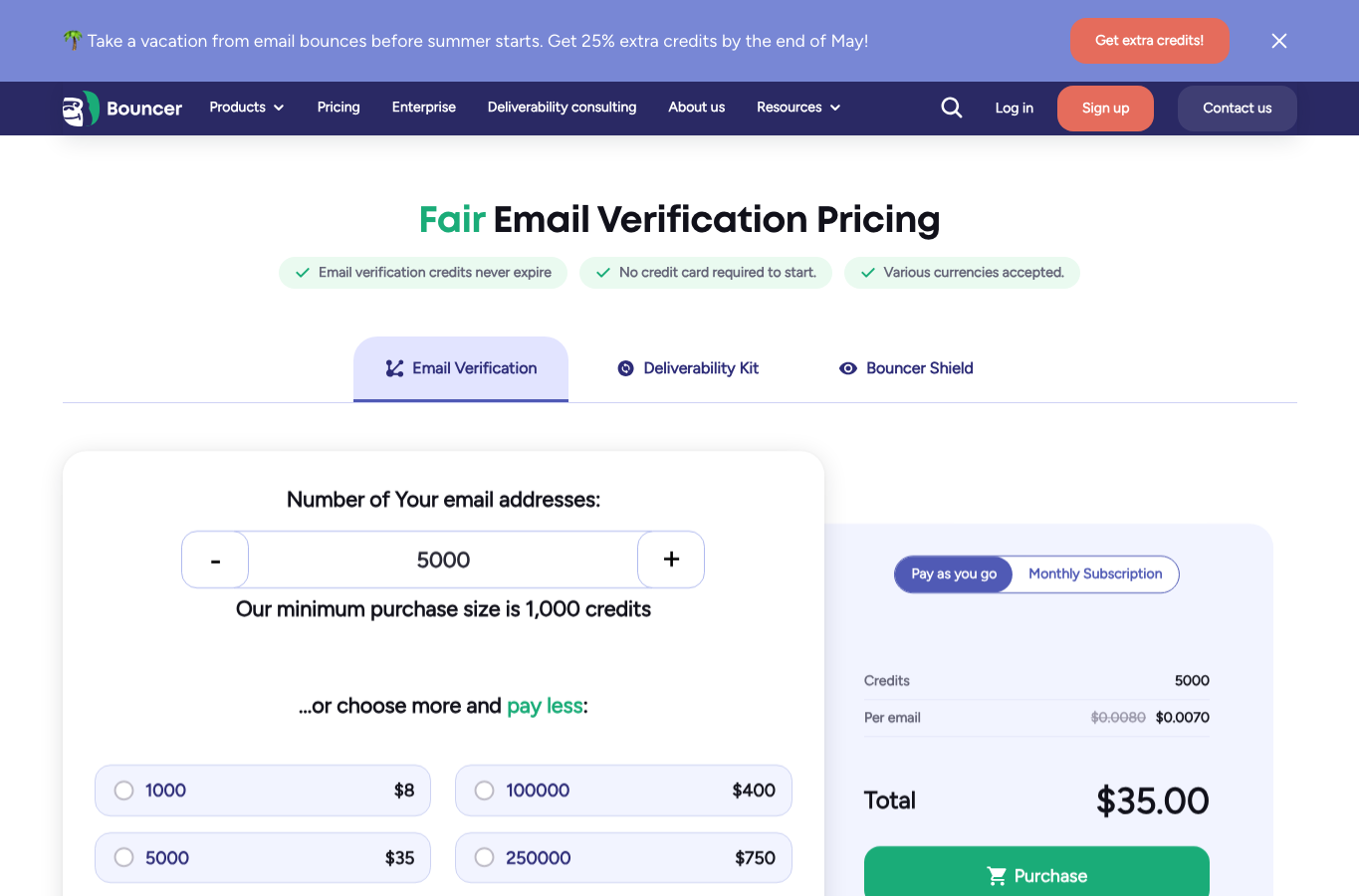
| Bouncer | Simple credit-pack verification | $60 for 10,000 and $400 for 100,000 credits. | Credits do not expire. No credit card is required to start. Deliverability products are priced separately. | Polished and transparent, though pricier than value-first tools at these volumes. |
| MillionVerifier | Budget bulk list cleaning | $39 for 10,000 and $149 for 100,000 credits. | One-time bulk credit packs; confirm the current result-billing and expiry rules in checkout. | Competitive at larger volumes, but test status mapping and catch-all behavior on your own frozen sample. |
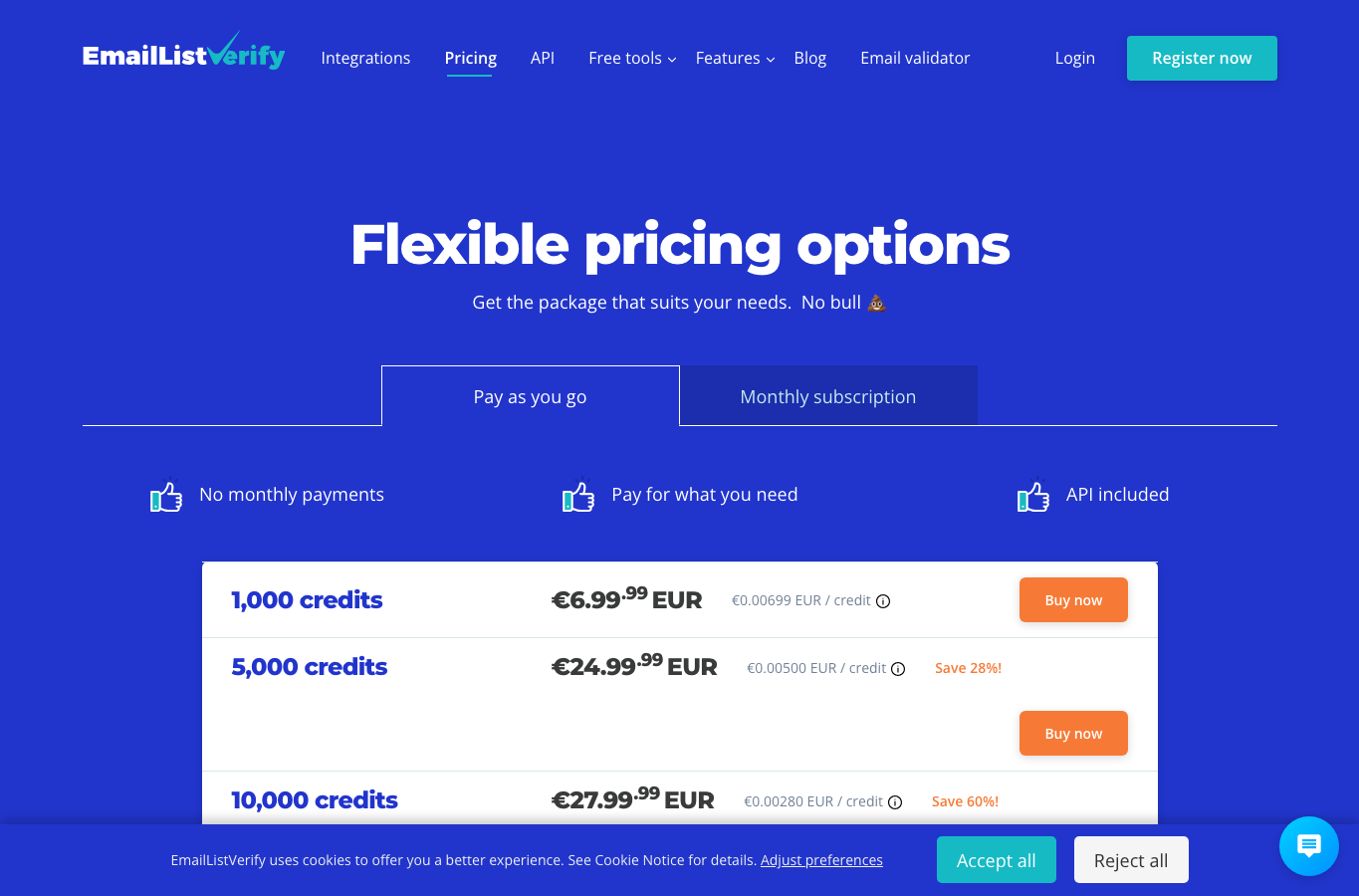
| EmailListVerify | Budget bulk verification with simple workflows | The live pricing page displayed about $28 for 10,000 and $199 for 100,000 credits on August 20, 2026. | Pay-as-you-go credits do not expire and API access is included; high-quality verification can consume two credits. | Good budget option when status depth and workflow fit survive a sample test. |
| NeverBounce | CRM and marketing-platform workflows | Common buyer estimates put it above VeriMails at typical 10,000 and 100,000 email volumes. | Often chosen for existing integrations and automated list cleaning. Confirm current dashboard pricing before purchase. | Useful mainstream pick if your stack already depends on it, less compelling if price is the main criterion. |
| Kickbox | Straightforward API and result categories | Small trial allowance and mid-market pricing that can become expensive for high-volume lists. | The product positioning covers bulk verification, real-time API access, credit-pack pricing, and privacy-readiness. | A clean developer-friendly option, but not the lowest-cost choice for high-volume lists. |
| Emailable | Flexible credit use across verification and deliverability | Credit-pack and monthly modes, a larger free-credit allowance, and one credit per standard verification. | Credits can support verification plus deliverability extras such as inbox reports and blacklist monitoring. | Worth considering when you want verification plus lightweight deliverability checks in one credit pool. |
Pricing changes often. For any serious purchase, confirm the exact checkout tier and test a representative sample list before buying a large credit pack.
Pricing and Billing Notes
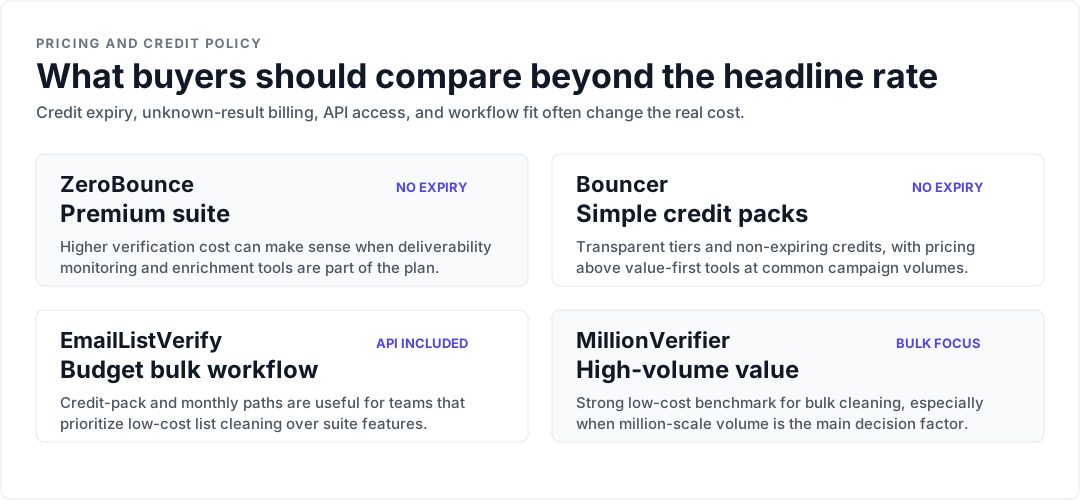
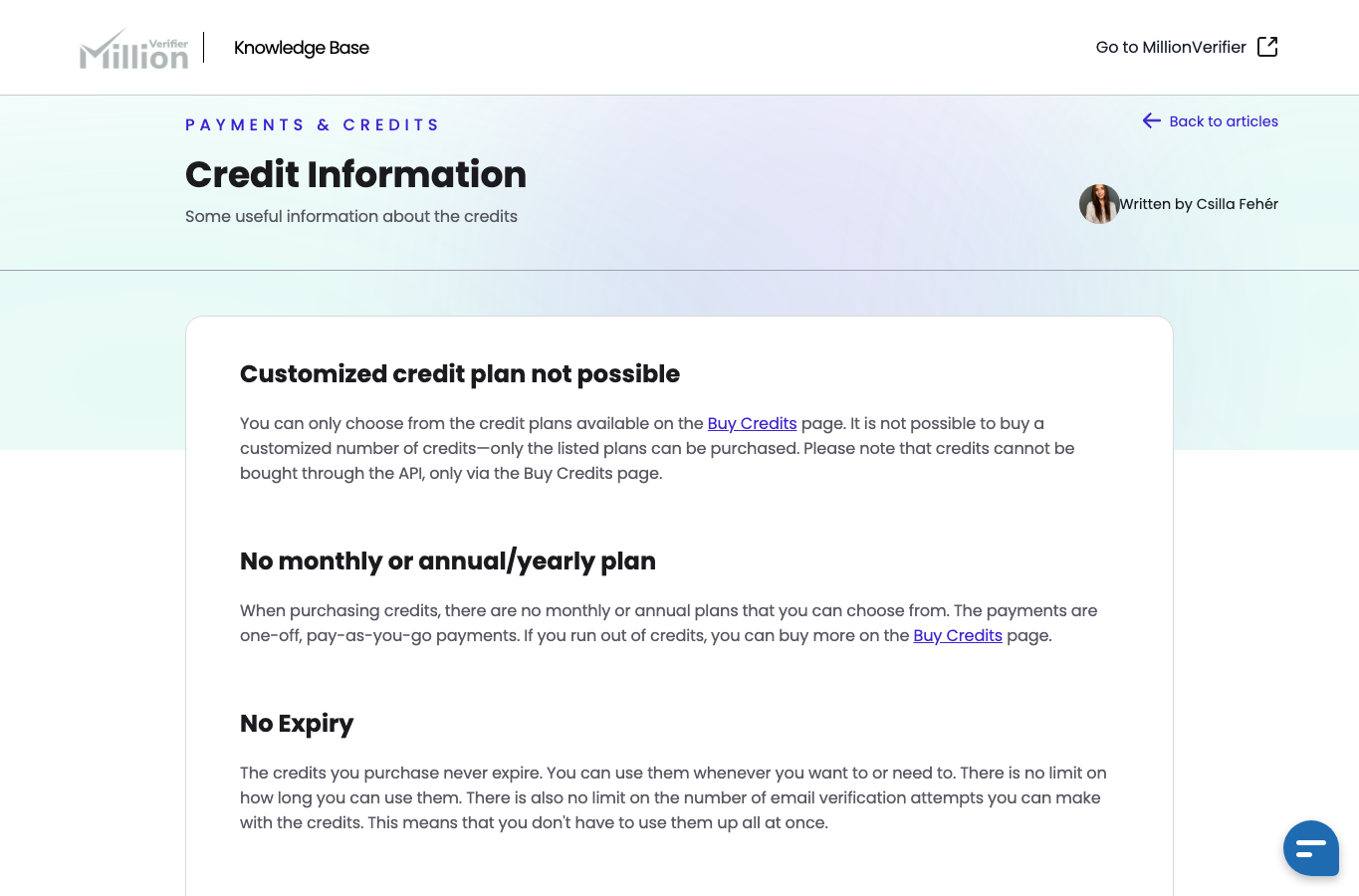
This visual highlights the pricing and credit-policy details buyers usually need before choosing a provider.
Competitor pricing screenshots
Before choosing a provider, look beyond the headline rate and compare minimum pack size, expiry policy, API access, and whether the checkout model fits your real list volume.
How to compare the tools
Published accuracy claims are not enough because each vendor measures a different list under different conditions. A better evaluation starts with the checks performed, the result categories returned, workflow quality, and the real cost at the list sizes you actually clean.
- Verification depth: syntax, domain, MX, SMTP, catch-all, disposable, role-based, and unknown handling.
- Billing clarity: credit expiry, minimums, duplicate billing, and unknown-result refunds.
- Workflow fit: CSV upload, API latency, integrations, exports, and actionable labels.
- Buying confidence: transparent pricing, clear result categories, and enough workflow detail to forecast real campaign cost.
The 2026 shortlist
1. VeriMails
VeriMails is the best value pick for teams that want verification to behave like infrastructure: predictable, inexpensive, and usable from both a dashboard and an API. It checks syntax, MX and DNS records, mailbox signals where receiving servers allow them, catch-all behavior, disposable domains, and role-based addresses. The pricing is the clearest advantage: $19 for 10,000 credits and $99 for 100,000, with no expiry pressure.
2. ZeroBounce
ZeroBounce is the premium-suite pick. Its buyer-facing materials emphasize volume pricing, 100 monthly free credits, and no expiry for credit-pack balances. It costs more than value-first tools, but the broader suite can justify the price if you also use deliverability monitoring, scoring, or ZeroBounce ONE.
3. Bouncer
Bouncer is a polished credit-pack verifier with transparent tiers and credits that never expire. Its advantage is clarity: pricing is easy to understand, the workflow is straightforward, and deliverability testing products are available separately. The downside is price at common list sizes compared with lower-cost tools.
4. MillionVerifier
MillionVerifier is built for price-sensitive bulk cleaning. Its current public page lists $39 for 10,000 credits, $149 for 100,000, and $449 for 1 million. Price alone does not establish result quality: test the same frozen sample, preserve every status category, and compare downstream outcomes before using any verifier for cold outreach.
5. EmailListVerify
EmailListVerify is another budget-oriented option with a long track record. It offers credit-pack and monthly modes, API access, non-expiring credits, and high-volume batch processing. It fits straightforward bulk cleaning better than advanced deliverability diagnostics.
6. NeverBounce
NeverBounce remains a mainstream name, especially for teams that care about marketing-platform and CRM workflows. At small volumes, it is usually evaluated in the higher-cost mainstream tier, so confirm current pricing before buying.
7. Kickbox
Kickbox is a developer-friendly verifier with simple categories and positioning around bulk verification, real-time API access, credit-pack pricing, and GDPR/CCPA readiness. It is not the cheapest choice for large lists, but it can be a good fit when API clarity matters most.
8. Emailable
Emailable sits between pure verification tools and broader deliverability platforms. It offers credit-pack and monthly options, a free-credit allowance, and one-credit standard verification across bulk upload, verifier, API, and widget checks. The same credit pool can also support inbox reports and blacklist monitoring.
Best tool by use case
VeriMails for low pricing, bulk upload, API verification, and credits that never expire.
ZeroBounce when you need verification plus deliverability and monitoring products.
Bouncer for transparent public pricing and a no-expiry credit policy.
MillionVerifier or EmailListVerify after a representative sample test.
NeverBounce when it is already wired into your CRM or marketing stack.
Kickbox when developers prefer its result model and list sizes are moderate.
What checks actually matter?
A good email verification tool should do more than say "valid" or "invalid." At minimum, it should reject malformed syntax, confirm the domain, check MX records, and attempt mailbox-level verification where the receiving server allows it. For B2B lists, catch-all handling is critical because a catch-all server response does not prove a real person owns the mailbox.
Disposable, role-based, and unknown handling also matter. Temporary inboxes can pollute signups, role addresses often perform poorly in outreach, and unknown results are common when servers time out or block verification traffic. The key question is whether the vendor gives you usable categories and whether it charges for results you cannot confidently use.
How to test before you buy
Do not choose an email verifier from a comparison table alone. Take a sample of 500 to 2,000 addresses that resembles your real data. Include known-good customers, old CRM records, cold outreach leads, catch-all domains, role-based addresses, and intentionally invalid emails. Run that exact file through two or three tools and compare the results.
- Check whether obvious invalid addresses are caught.
- Look at how each tool labels catch-all and unknown results.
- Compare how many addresses are marked safe enough to send.
- Calculate the real invoice at your monthly or quarterly volume, including credits that might expire.
If you are testing VeriMails, the 100 free credits are enough for a quick first check, and the email verification pricing comparison gives a deeper look at cost modeling.
How to score the sample test
After the sample run, do not only compare valid counts. Give each tool a simple score across accuracy, actionability, workflow fit, and cost. That keeps the winner tied to your sending risk rather than to a vendor claim.
- Accuracy on known records: did the tool catch hard-bounced addresses without rejecting customers you know are active?
- Catch-all clarity: did it label catch-all and unknown results separately enough for your catch-all sending rules?
- Operational fit: could your team use the CSV export or API response without extra cleanup? Developers can compare result models in the email verification API comparison.
- Effective cost: divide the invoice by the usable results you would actually send to, not by the number of uploaded rows.
Bottom line
The best email verification tool in 2026 depends on your operating model. VeriMails is the strongest value default for large lists because its price is low, credits never expire, and both bulk and API workflows are included. Compare ZeroBounce for a premium suite, Bouncer for a polished credit-pack alternative, and MillionVerifier or EmailListVerify when budget matters above all. The practical answer is to shortlist two or three tools, run the same sample file through each, and pick the one that returns trustworthy results at the volume and workflow your team actually runs.
Frequently Asked Questions
Start with Clean Data
100 free credits on signup. No credit card required. Put the advice into practice today.
Start Free