VeriMails vs XVerify
XVerify is a real-time data verification provider that covers email, phone, and postal address validation, with form-builder integrations aimed at lead-capture workflows. Its email verification is fast and usage-based, though it sits at a higher per-email price and its real-world accuracy has drawn mixed reviews. This comparison looks at how XVerify stacks up against VeriMails on cost, accuracy, catch-all handling, and developer experience.
Updated May 24, 2026
At a Glance
| Feature | VeriMails | XVerify |
|---|---|---|
| Price per email | from $0.0019, down to $0.00099 | from $0.01, down to about $0.005 |
| Free tier | 100 credits on signup, never expire | Small free trial allowance |
| Catch-all handling | Catch-all detection on live SMTP | Catch-all identification |
| API | REST single + bulk, webhooks, fast responses | API plus JavaScript validation |
| Bulk verification | CSV auto-mapping, ~10K under 5 min | Batch upload, ~15-30 min per 10K |
| Speed | Fast single checks | Real-time, under 1 second |

Decision point
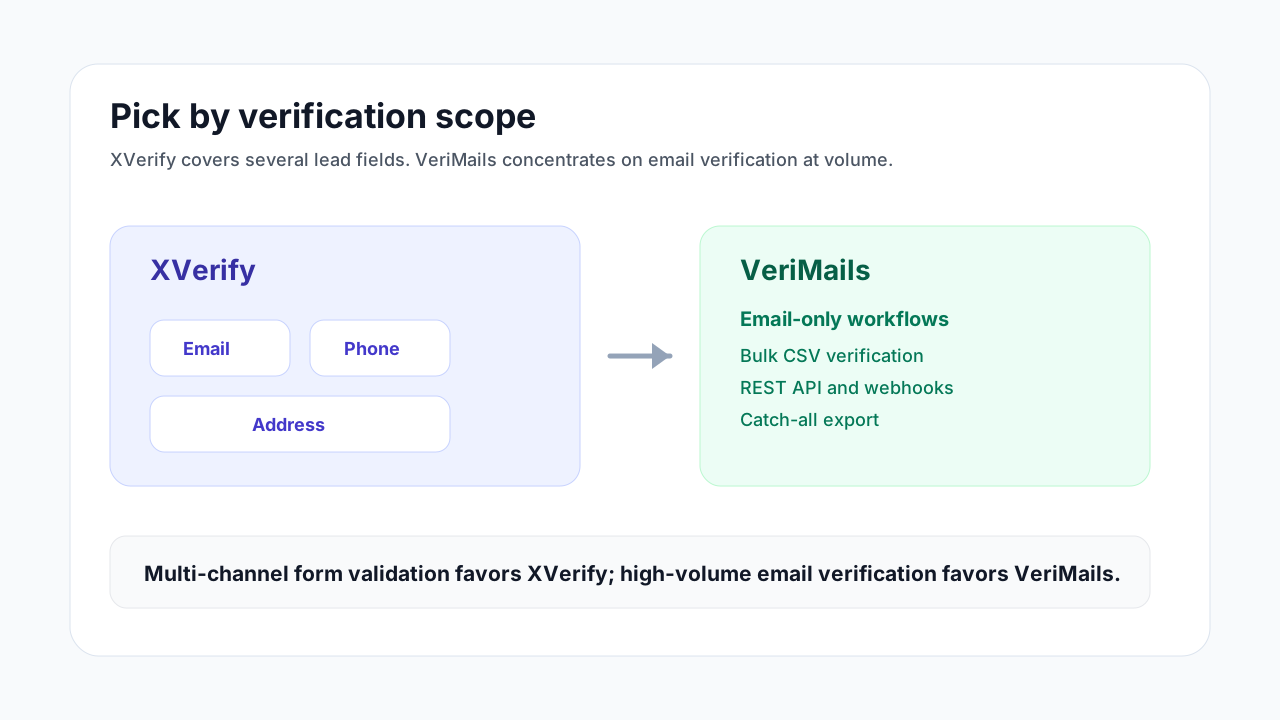
Choose by data type: XVerify covers more fields in a lead form, while VeriMails keeps the email verification path focused on list volume and per-address status.
Email-Only or Multi-Channel Validation?
Verification Accuracy
XVerify verifies an address by connecting directly to the mail server to confirm whether the username exists at the domain, and it supports the major consumer providers including Gmail, Yahoo, AOL, and Hotmail. It publishes a 98% accuracy figure and does not cache results, so each check is run fresh. To be fair to XVerify, that direct-connection method is the same fundamental approach the category relies on, and many users report dependable validation. It is also fair to note that reviews are mixed, with some users reporting higher-than-expected failure rates when validating standard US addresses. Accuracy outcomes vary with list composition, so this is a tool worth testing on your own data.
VeriMails runs syntax, MX, DNS, live SMTP validation, catch-all detection, disposable detection, and role-based detection on every address, then returns a structured result for list segmentation. Like XVerify, VeriMails runs a fresh check rather than serving cached verdicts. The most reliable comparison for any team is to verify a sample of a real list through both services and compare the results against actual send outcomes.
Catch-all Handling
A catch-all domain accepts mail for any local part, which means a direct SMTP connection cannot tell whether one specific mailbox is real. XVerify's API status list includes accept_all for domains that do not support mailbox-level checks, along with valid, invalid, risky, and unknown status values.
VeriMails runs catch-all detection during its live SMTP handshake. When a domain answers as catch-all, VeriMails flags the address clearly and groups it into its own segment, kept separate from confirmed-valid and confirmed-invalid results. In a bulk job you can download the catch-all segment on its own and choose how to treat it: send, hold for a later re-check, or exclude it from a high-stakes campaign. Both VeriMails and XVerify can flag the catch-all condition. The practical advantage with VeriMails is the clean, separate segmentation, so catch-all addresses are never quietly mixed in with confirmed results when you act on a list.
API and Developer Experience
XVerify is built for real-time use and markets validation results in under a second. For developers it offers an API, JavaScript validation that can be embedded in a form, batch and CSV upload, and direct integrations with form builders such as Formstack and Jotform. That form-builder support is a genuine convenience for teams whose lead capture already runs through those tools. XVerify also extends beyond email into phone and address verification, so a single integration can cover several data types.
VeriMails is built API-first for email verification specifically. The REST API exposes single and bulk endpoints, returns clean JSON, and supports webhooks so batch jobs can call your system back when they finish rather than being polled. Single verifications returns a clear result. API access is included on every plan with no separate API tier, and VeriMails ships 55+ direct integrations across CRM, marketing, and outreach platforms. If your need is multi-channel data verification, XVerify covers more ground. If your need is email verification with a broad email-focused integration catalog and fast bulk processing, VeriMails is the more specialized fit.
Pricing and Value
XVerify uses one-time credit pricing with no minimums and no setup fees, which keeps it flexible. Its email verification rate is tiered by volume: roughly $0.01 per email for the first few thousand, easing down through about $0.008, $0.007, and $0.006 per email, and reaching around $0.005 per email in the 50,000 to 100,000 band. At very large volumes the rate drops further. Entry pricing starts near $5 for 500 verifications, and a small free trial allowance is available. The honest summary is that XVerify is flexible but priced at a premium compared with verification-focused competitors.
VeriMails uses a transparent credit ladder. Verification starts at $0.0019 per email for 10,000 credits and the per-email rate falls with each larger pack, reaching $0.00099 per email at 100,000 credits and lower beyond that. Every plan includes the API, bulk verification, catch-all detection, and all verification checks. Signup includes 100 free credits with no credit card required, and credits never expire.
VeriMails Credit Pricing
| Credits | VeriMails Price | Price per Email |
|---|---|---|
| 10,000 | $19 | $0.0019 |
| 25,000 | $39 | $0.00156 |
| 50,000 | $59 | $0.00118 |
| 100,000 | $99 | $0.00099 |
| 250,000 | $199 | $0.000796 |
| 500,000 | $349 | $0.000698 |
| 1,000,000 | $499 | $0.000499 |
| 2,500,000 | $999 | $0.0004 |
| 5,000,000 | $1,499 | $0.0003 |
Email Finder costs 20 credits only when VeriMails returns a verified person-level email. At the 10,000-credit pack, that is $0.038 per found email. Monthly plans start at $12.50/mo when billed yearly.
Credits never expire. Annual plans from $12.50/month when billed yearly. 100 free credits on signup.
Cost Comparison
| Volume | VeriMails | XVerify |
|---|---|---|
| 10,000 emails | $19 ($0.0019/email) | around $70 to $80 at tiered rates |
| 100,000 emails | $99 ($0.00099/email) | around $500 at about $0.005/email |
XVerify figures are estimates from its published per-email tiers; confirm current pricing with XVerify. VeriMails is substantially lower per email at the volumes most teams verify.
Who VeriMails Is Best For
Teams whose priority is email verification at the lowest per-email cost, since VeriMails is far cheaper across common volumes. Marketers and sales teams that verify lists of tens of thousands of addresses and want fast bulk turnaround. Developers who want webhooks, fast API responses, and a wide catalog of email-focused integrations. Buyers who want a single, predictable credit ladder rather than estimating cost across many per-email tiers.
Who XVerify Is Best For
Teams that need email, phone, and postal address verification from one vendor rather than stitching together separate tools. Businesses whose lead capture runs through form builders such as Formstack or Jotform, where XVerify's direct integrations save setup work. Companies focused on real-time form validation that want sub-second responses at the point of signup. Buyers who value usage-based flexibility with no minimums and accept a higher per-email price for that multi-channel breadth.
Frequently Asked Questions
Why teams switch to VeriMails
“Our deliverability was tanking because 6% of our list was bouncing. One bulk upload to VeriMails, removed the bad addresses, and inbox placement recovered within a week.”
— Sam R. — Growth Lead at Venture-Backed Fintech, United Kingdom
“We verified our entire ActiveCampaign list before a product launch. Removed 9K bad addresses from 85K total. Open rate on the launch email was our highest ever.”
— Julia S. — Campaign Manager at Health Tech Company, Denmark
Related Comparisons
Try VeriMails Free
100 free credits on signup. No credit card required. See why teams switch to VeriMails.
Start Free