VeriMails vs MyEmailVerifier
MyEmailVerifier is a long-running, budget-focused email verification service known for its recurring 100 free daily credits and low per-request API pricing. It covers the core checks well, but it leans on Zapier for most CRM connections and skips advanced deliverability features. This comparison looks at how it stacks up against VeriMails on price, accuracy, catch-all handling, and developer experience.
Updated May 24, 2026
At a Glance
| Feature | VeriMails | MyEmailVerifier |
|---|---|---|
| Price per email | from $0.0019, down to $0.00099 | around $0.0025 at higher tiers |
| Free tier | 100 credits on signup, never expire | 100 free credits per day |
| Catch-all handling | Catch-all detection on live SMTP | Catch-all detection and flag |
| API | REST single + bulk, webhooks | REST API, single endpoint rate limited |
| Bulk verification | CSV auto-mapping and filtered export | CSV upload, up to 100K per file |
| Speed | Fast single-check responses | Around 50 minutes for 10K |
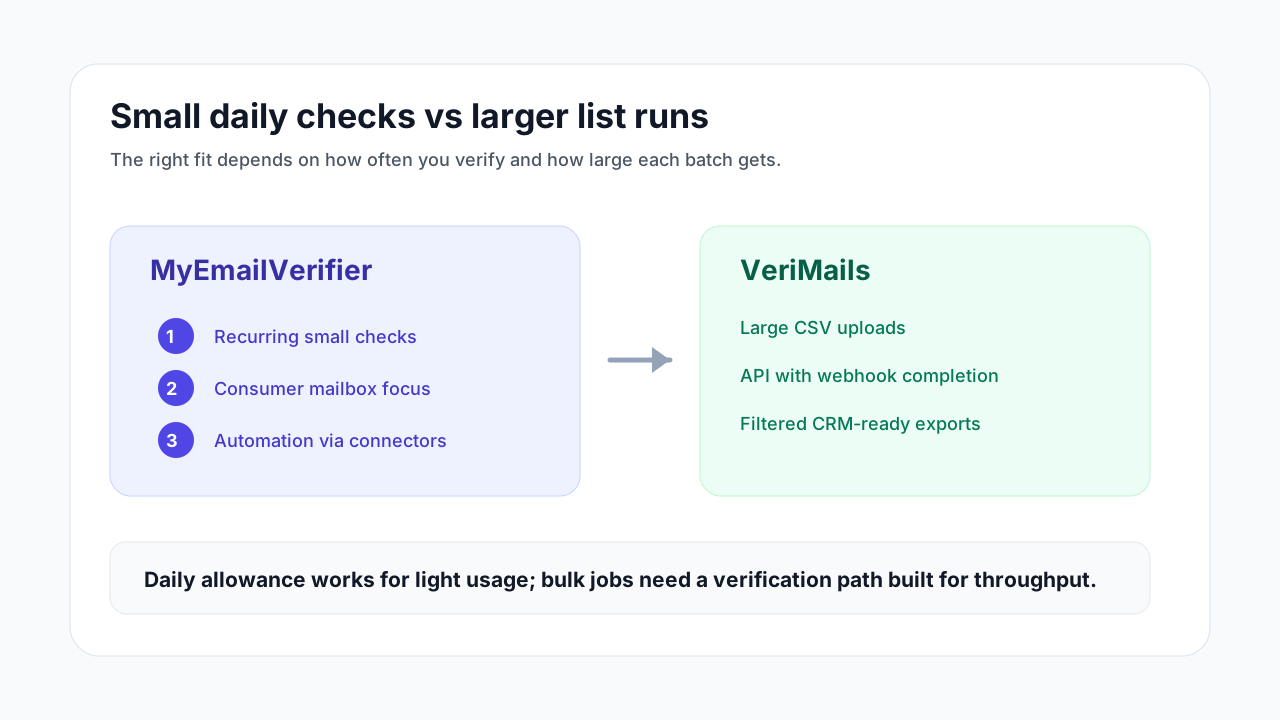
Volume split
Use the daily-credit model for light maintenance. Use VeriMails when list size, turnaround time, or native integrations become the deciding factor.
Verification Accuracy
MyEmailVerifier has a solid reputation for accuracy on standard mailboxes. It runs the expected verification chain of syntax, domain, MX, and SMTP checks, and it references a 98% accuracy claim. In independent testing it has performed well, and one frequently cited result is its ability to flag disabled Yahoo and AOL accounts that some competitors miss. That is a genuine strength worth acknowledging if a large share of your list sits on consumer mailbox providers.
VeriMails runs the same fundamental checks and adds a live SMTP handshake on every verification, returning clear deliverability categories for each address. The verification chain covers syntax, MX, DNS, the SMTP handshake, catch-all detection, disposable detection, and role-based detection. Where the two services differ most is not the raw check, it is the surrounding tooling. MyEmailVerifier focuses tightly on the verification result itself and does not include spam trap detection or broader deliverability insights, which its own reviews note as a gap. If you only need a clean valid or invalid verdict, both services deliver. If you want richer signal around each address, VeriMails returns more detail in a single response.
Catch-all Handling
Catch-all domains accept mail for any address at the domain, which makes individual mailboxes impossible to confirm with a standard SMTP check. Both services handle this the same way at a conceptual level: they perform catch-all detection and flag the domain so you know the result is uncertain. MyEmailVerifier marks an address as catch-all when the domain accepts mail for any local part, and one of its more useful features is the ability to download valid, invalid, unknown, and catch-all addresses as separate segments.
VeriMails also runs catch-all detection during the live SMTP handshake. When a domain responds as catch-all, VeriMails flags it clearly so the address never gets silently grouped with confirmed-valid results. Catch-all addresses are then available as their own filtered segment in your bulk results, so you can choose whether to send, hold, or drop them based on your own risk tolerance. Neither service can promise that a specific mailbox behind a catch-all domain is real, because the domain itself hides that information. The honest comparison here is that both tools identify the catch-all segment cleanly and leave the final call to you.
API and Developer Experience
Both VeriMails and MyEmailVerifier offer a REST API with real-time single verification and bulk processing. MyEmailVerifier is competitively priced on the API at roughly $0.0025 per request with no subscription required and credits that never expire, and developers can start with the 100 free daily requests. The main constraints to plan around are throughput and integrations: the single-email API endpoint is rate limited to around 30 emails per minute, and direct CRM integrations are limited, so many teams connect it through Zapier or Pabbly rather than a native connector.
VeriMails was built API-first. The REST API exposes single and bulk endpoints, returns clean JSON, and supports webhooks so batch jobs can call back when they finish rather than forcing you to poll. Single verifications returns a clear result, and the same endpoints that power the dashboard are available to your code. VeriMails also ships 55+ direct integrations covering common CRM, marketing, and outreach platforms, which reduces the number of cases where you need a third-party automation layer. For real-time signup validation and high-throughput batch workflows, VeriMails gives you fewer rate-limit edges to design around.
Pricing and Value
MyEmailVerifier and VeriMails both use credit-based pricing with credits that never expire, and both offer one-time credit packs and monthly subscription options. MyEmailVerifier's one-time credit pricing has a 1,000 credit minimum and works out to roughly $0.0025 per email at higher volumes, while its smaller monthly subscriptions carry a higher effective per-email rate. The recurring 100 free daily credits are a genuine advantage for teams that only ever verify small batches.
VeriMails uses a transparent credit ladder. Verification starts at $0.0019 per email for the 10,000 credit pack and the per-email rate falls steadily with volume, reaching $0.00099 per email at 100,000 credits and lower beyond that. Every plan includes the API, bulk verification, catch-all detection, and all verification checks at no extra cost, and signup includes 100 free credits with no credit card required.
VeriMails Credit Pricing
| Credits | VeriMails Price | Price per Email |
|---|---|---|
| 10,000 | $19 | $0.0019 |
| 25,000 | $39 | $0.00156 |
| 50,000 | $59 | $0.00118 |
| 100,000 | $99 | $0.00099 |
| 250,000 | $199 | $0.000796 |
| 500,000 | $349 | $0.000698 |
| 1,000,000 | $499 | $0.000499 |
| 2,500,000 | $999 | $0.0004 |
| 5,000,000 | $1,499 | $0.0003 |
Email Finder costs 20 credits only when VeriMails returns a verified person-level email. At the 10,000-credit pack, that is $0.038 per found email. Monthly plans start at $12.50/mo when billed yearly.
Credits never expire. Annual plans from $12.50/month when billed yearly. 100 free credits on signup.
Cost Comparison
| Volume | VeriMails | MyEmailVerifier |
|---|---|---|
| 10,000 emails | $19 ($0.0019/email) | roughly $25 to $30 at this tier |
| 100,000 emails | $99 ($0.00099/email) | roughly $250 at around $0.0025/email |
MyEmailVerifier figures are estimates from its published per-request rate; confirm current pricing on its pricing page. At 100K, VeriMails' lower per-email rate produces a meaningful gap.
Who VeriMails Is Best For
Teams that verify mid-size or large lists where the lower per-email rate compounds into real savings. Developers who want webhooks, fast API responses, and single plus bulk endpoints without tight throughput limits. Businesses that prefer 55+ direct integrations over routing verification through a third-party automation tool. Anyone who wants the API, bulk CSV verification, and catch-all detection included on every plan with no add-on fees.
Who MyEmailVerifier Is Best For
Small teams and solo users whose volume is fully covered by the recurring 100 free daily credits. Marketers sending mainly to consumer mailbox providers, where MyEmailVerifier's strong handling of disabled Yahoo and AOL accounts is a real plus. Buyers who want a no-subscription no-subscription credit option with credits that never expire. Teams already comfortable connecting tools through Zapier or Pabbly, since direct CRM connectors are limited.
Frequently Asked Questions
Why teams switch to VeriMails
“Our Shopify store collects 2K new emails a week from popups and checkout. Monthly verification keeps the list healthy and our Mailchimp sender score above 95.”
— Claire M. — Marketing Lead at Beauty Brand, United States
“Integrated into our signup flow in about an hour. API docs are clear, response times are under 2 seconds, and credits don't expire. Perfect for variable volume.”
— Ana S. — Backend Developer at Fintech Platform, Spain
Related Comparisons
Try VeriMails Free
100 free credits on signup. No credit card required. See why teams switch to VeriMails.
Start Free