VeriMails vs Proofy
Proofy is an established email verification service with a multi-layer validation engine, a flexible credit model, and a developer toolkit that includes single, bulk, and batch APIs plus a JavaScript widget. It is a capable tool with a generous free allowance, though its feature set is narrower than some rivals and pricing climbs at lower volumes. Here is how Proofy compares to VeriMails on cost, accuracy, catch-all handling, and developer experience.
Updated May 24, 2026
At a Glance
| Feature | VeriMails | Proofy |
|---|---|---|
| Price per email | from $0.0019, down to $0.00099 | $0.008 down to about $0.001 by tier |
| Free tier | 100 credits on signup, never expire | 500 free verifications |
| Catch-all handling | Catch-all detection on live SMTP | Accept-all (catch-all) detection |
| API | REST single + bulk, webhooks | Single, bulk, batch API plus JS widget |
| Bulk verification | CSV auto-mapping and filtered export | .txt and.csv upload, up to 65MB |
| Speed | Fast single-check responses | Around 45 minutes for 100K |
Workflow fit
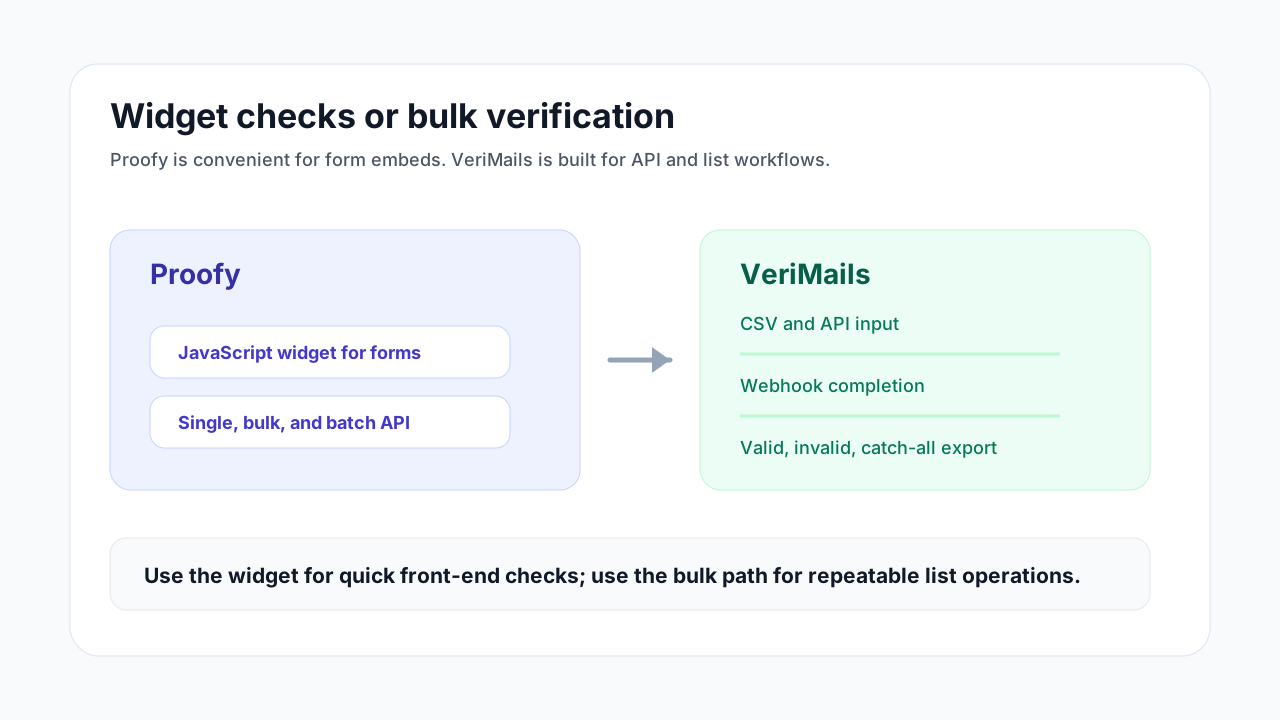
For embedded form checks, Proofy has a convenient widget. For repeated list cleaning and API-first pipelines, VeriMails keeps the verification result model simpler to operate.
Verification Accuracy
Proofy uses a multi-layer validation approach and claims accuracy close to 99% without sending mail to the addresses it checks. Its engine covers syntax validation, domain validation, MX record checks, SMTP verification, disposable and temporary email detection, ISP detection, mailbox-full detection, and duplicate removal. That is a sound verification stack, and for standard valid or invalid addresses Proofy returns dependable results. A nice touch is that Proofy does not charge for unknown or duplicate addresses, so you only spend credits on conclusive checks.
VeriMails runs a comparable verification chain and adds a live SMTP handshake on every verification, returning clear deliverability categories for each address. The checks include syntax, MX, DNS, the SMTP handshake, catch-all detection, disposable detection, and role-based detection. Both services can be useful on conclusive addresses, so the practical difference is less about the verdict and more about price per check, workflow fit, and API access, which the pricing and developer sections below cover in detail.
Catch-all Handling
A catch-all domain, which Proofy and many providers label accept-all, is configured to accept mail addressed to any local part. That makes it impossible for any verification service to confirm an individual mailbox using a standard SMTP check, because the server says yes to everything. Proofy performs accept-all detection and flags those addresses so you know the result is uncertain rather than a confirmed valid.
VeriMails handles this the same way, running catch-all detection as part of the live SMTP handshake. When VeriMails encounters a catch-all domain, it flags the address clearly and groups it into its own segment, separate from confirmed-valid and confirmed-invalid results. In a bulk job you can download the catch-all segment on its own and decide how to treat it: send to it, hold it for a later re-check, or exclude it from a high-stakes campaign. Both VeriMails and Proofy are honest about the limits here, neither claims to magically resolve a catch-all mailbox, and both put the segment in front of you so you can make the call.
API and Developer Experience
Proofy has a genuinely solid developer offering. It provides a single-verification API for real-time form checks, a bulk API, and a batch API, along with webhook support and a JavaScript widget that can be dropped into a signup form without much custom code. The single-verification path checks disposable domains and MX records and returns results in real time. For teams that want a ready-made widget rather than building their own form integration, that is a real convenience.
VeriMails is built API-first. The REST API exposes single and bulk endpoints, returns clean JSON, and supports webhooks so long-running batch jobs can notify your system when they complete instead of being polled. Single verifications returns a clear result. API access is included on every VeriMails plan with no separate API tier or extra fee, and VeriMails ships 55+ direct integrations for common CRM, marketing, and outreach tools. The two services are close on raw API capability. Proofy's JavaScript widget is the standout convenience on its side, while VeriMails leans on fast, included API access and a wide native integration catalog.
Pricing and Value
Proofy uses tiered, volume-based pricing where the per-email cost falls as volume grows, running from around $0.008 per email at the smallest tier down to about $0.001 per email at the largest. One-time pricing sits near $0.003 per email, and a monthly subscription adds a 15% discount that brings the subscription rate to roughly $0.0026 per email. Credits never expire on either plan type, and Proofy is GDPR compliant with automatic data deletion after 60 days. The 500-credit free allowance and the optional $4 trial pack of 1,000 credits make it easy to test before committing.
VeriMails uses a straightforward credit ladder. Verification starts at $0.0019 per email for 10,000 credits and the per-email rate drops with each larger pack, reaching $0.00099 per email at 100,000 credits and lower beyond that. Every plan includes the API, bulk verification, catch-all detection, and all verification checks. Signup includes 100 free credits with no credit card required, and credits never expire.
VeriMails Credit Pricing
| Credits | VeriMails Price | Price per Email |
|---|---|---|
| 10,000 | $19 | $0.0019 |
| 25,000 | $39 | $0.00156 |
| 50,000 | $59 | $0.00118 |
| 100,000 | $99 | $0.00099 |
| 250,000 | $199 | $0.000796 |
| 500,000 | $349 | $0.000698 |
| 1,000,000 | $499 | $0.000499 |
| 2,500,000 | $999 | $0.0004 |
| 5,000,000 | $1,499 | $0.0003 |
Email Finder costs 20 credits only when VeriMails returns a verified person-level email. At the 10,000-credit pack, that is $0.038 per found email. Monthly plans start at $12.50/mo when billed yearly.
Credits never expire. Annual plans from $12.50/month when billed yearly. 100 free credits on signup.
Cost Comparison
| Volume | VeriMails | Proofy |
|---|---|---|
| 10,000 emails | $19 ($0.0019/email) | around $30 at one-time credit rates |
| 100,000 emails | $99 ($0.00099/email) | around $150 at Proofy's listed tier range |
Proofy figures are estimates from its published tier range; confirm current pricing on its pricing page. VeriMails is the lower per-email price at small and mid-size volume.
Who VeriMails Is Best For
Teams that want the lowest per-email price at small and mid-size volume, where Proofy's tiered pricing still sits higher. Marketers and sales teams who need fast bulk turnaround on lists of tens of thousands of addresses. Developers who want webhooks, fast responses, and API access included on every plan with no API-specific tier. Businesses that prefer a wide catalog of direct integrations over building form connections themselves.
Who Proofy Is Best For
Teams that want a larger free allowance up front, since Proofy's 500 free verifications plus the low-cost trial pack allow a fuller real-list test. Developers who want a ready-made JavaScript widget to embed verification into forms without custom code. Organizations with GDPR-driven data handling needs, given Proofy's automatic 60-day data deletion. Buyers who like that Proofy does not charge for unknown or duplicate addresses.
Frequently Asked Questions
Why teams switch to VeriMails
“We verify candidate emails in bulk before every placement campaign. VeriMails is cheaper than the recruiter time wasted chasing invalid addresses.”
— Michael K. — Director at Recruitment Agency, Australia
“Our webhook pipeline processes enriched contacts in real-time. VeriMails API slots in between enrichment and CRM push. Sub-second response, reliable every time.”
— Patrick O. — Product Lead at Email Platform, Ireland
Related Comparisons
Try VeriMails Free
100 free credits on signup. No credit card required. See why teams switch to VeriMails.
Start Free