VeriMails vs DataValidation
DataValidation is one of the oldest names in email verification, founded in 2007 and known for its free list quality reports and its letter-grade Email Assurance scoring. It was acquired by Emailable in 2021, and the two platforms have since been consolidated. This comparison looks at how DataValidation, as it stands today, measures up against VeriMails on price, accuracy, catch-all handling, and developer experience.
Updated May 2026
At a Glance
| Feature | VeriMails | DataValidation |
|---|---|---|
| Price per email | from $0.0019, down to $0.00099 | Current buying path routes to Emailable pricing |
| Free tier | 100 credits on signup, never expire | Emailable page lists 250 free credits |
| Catch-all handling | Catch-all detection on live SMTP | Accepts-all graded as B |
| API | REST single + bulk, webhooks, fast responses | API with per-address deliverability reports |
| Bulk verification | CSV auto-mapping, ~10K under 5 min | List upload with grade breakdown |
| Speed | Fast single checks | Batch-oriented processing |
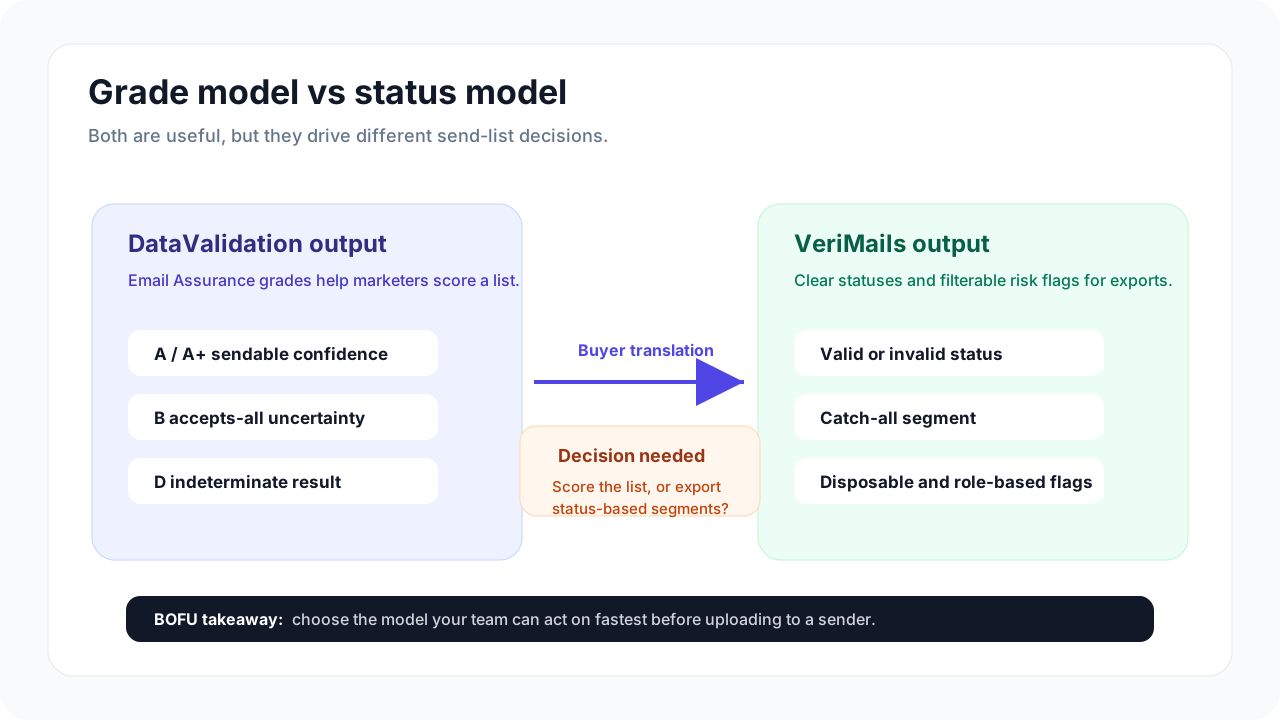
Choose the output model
Need an interpreted score? Compare Emailable as the related platform. Need filterable exports? Review catch-all detection, bulk verification, API documentation, and credit pricing.
Verification Accuracy
DataValidation built its reputation on deliverability scoring rather than a simple pass or fail verdict. Instead of returning only valid or invalid, it assigns each address an Email Assurance grade on a letter scale and pairs it with a deliverability code from 1 to 4, where 4 is the most deliverable. An A or A+ grade marks an address as safe to send to, an A+ also reflects recent engagement activity, a B grade marks an accepts-all domain that may include a spam trap, and a D grade marks an indeterminate result where the mail server appeared to be running but could not be reached. That graded model is genuinely useful for marketers who want a confidence level rather than a binary answer, and it is a fair strength to credit DataValidation for.
VeriMails takes a more direct approach. Each verification runs syntax, MX, DNS, a live SMTP handshake, catch-all detection, disposable detection, and role-based detection, and returns a clear status alongside those specific flags. VeriMails returns a clear status alongside the checks that explain it. Where DataValidation hands you a grade to interpret, VeriMails hands you an explicit status plus the individual signals that explain it. Both are valid models; the right one depends on whether your team prefers an interpreted score or a direct verdict with supporting flags.
Catch-all Handling
A catch-all domain, which DataValidation refers to as accepts-all, accepts mail addressed to any local part, so no SMTP-based check can confirm whether a single mailbox is real. DataValidation handles this clearly within its grading system: accepts-all domains receive a B grade, and DataValidation explicitly notes that an address on such a domain may turn out to be a spam trap. That is a sensible, transparent way to communicate the risk inside a graded model.
VeriMails runs catch-all detection during its live SMTP handshake. When a domain responds as catch-all, VeriMails flags the address and groups it into its own segment, separate from confirmed-valid and confirmed-invalid results. In a bulk job you can export the catch-all segment on its own and decide how to treat it: send, hold for a later re-check, or exclude it from a sensitive campaign. Both services are honest that a catch-all domain hides individual mailbox status. DataValidation expresses that uncertainty as a B grade, while VeriMails expresses it as a clearly flagged, separately filterable segment. Either way, the address is never silently treated as confirmed-valid.
API and Developer Experience
DataValidation was an early mover in API-based verification, and its API returns the same deliverability reporting that the web app provides, with a per-address grade and deliverability code for every email on a list. It also offers a Mailchimp integration, which suits marketers who clean lists directly inside that platform. Because DataValidation is now consolidated with Emailable, teams evaluating its developer tooling today should also review Emailable's current API documentation, since the underlying platform is shared.
VeriMails is built API-first. The REST API exposes single and bulk endpoints, returns clean JSON, and supports webhooks so batch jobs can call your system back when they finish instead of being polled. Single verifications returns a clear result. API access is included on every VeriMails plan with no separate API tier, and VeriMails ships 55+ direct integrations across CRM, marketing, and outreach platforms. For real-time signup validation and high-throughput batch workflows, VeriMails' fast responses and webhook callbacks give developers a fast, predictable foundation, and the wider integration catalog reduces custom connector work.
Pricing and Value
DataValidation no longer presents a separate self-serve checkout flow. The DataValidation domain routes into Emailable, and Emailable's pricing page lists selectable credit volumes from 5,000 to 1,000,000, 250 free credits, credits that never expire, and 15 percent savings for subscriptions. That means buyers evaluating DataValidation today should compare VeriMails against Emailable's current pricing rather than older DataValidation pricing tiers.
VeriMails uses a transparent credit ladder. Verification starts at $0.0019 per email for 10,000 credits and the per-email rate falls with each larger pack, reaching $0.00099 per email at 100,000 credits and lower beyond that. Every plan includes the API, bulk verification, catch-all detection, and all verification checks. Signup includes 100 free credits with no credit card required, and credits never expire.
VeriMails Credit Pricing
| Credits | VeriMails Price | Price per Email |
|---|---|---|
| 10,000 | $19 | $0.0019 |
| 25,000 | $39 | $0.00156 |
| 50,000 | $59 | $0.00118 |
| 100,000 | $99 | $0.00099 |
| 250,000 | $199 | $0.000796 |
| 500,000 | $349 | $0.000698 |
| 1,000,000 | $499 | $0.000499 |
| 2,500,000 | $999 | $0.0004 |
| 5,000,000 | $1,499 | $0.0003 |
Email Finder costs 20 credits only when VeriMails returns a verified person-level email. At the 10,000-credit pack, that is $0.038 per found email. Monthly plans start at $12.50/mo when billed yearly.
Credits never expire. Annual plans from $12.50/month when billed yearly. 100 free credits on signup.
Cost Comparison
| Volume | VeriMails | DataValidation |
|---|---|---|
| 10,000 emails | $19 ($0.0019/email) | around $50 to $70 in this range |
| 100,000 emails | $99 ($0.00099/email) | around $300 ($0.003/email) |
DataValidation now routes into Emailable, so use Emailable's current pricing page for live checkout terms. VeriMails keeps verification pricing direct and lower at common list-cleaning volumes.
Who VeriMails Is Best For
Teams that want the lowest per-email price, since VeriMails is markedly cheaper at small and mid-size volume. Developers who want webhooks, fast API responses, and a wide native integration catalog. Marketers and sales teams that need fast bulk turnaround on lists of tens of thousands of addresses. Buyers who prefer an explicit verification status with catch-all, disposable, and role-based flags rather than interpreting a letter grade.
Who DataValidation Is Best For
Long-time DataValidation customers who already rely on its Email Assurance grading and Mailchimp workflow. Marketers who prefer a graded confidence model, with letter grades and 1 to 4 deliverability codes, over a binary valid or invalid result. Buyers comfortable with the service being part of the Emailable platform following the 2021 acquisition and the current redirect into Emailable.
Frequently Asked Questions
Related Comparisons
Try VeriMails Free
100 free credits on signup. No credit card required. See why teams switch to VeriMails.
Start Free