VeriMails vs RocketReach
RocketReach is a contact intelligence platform built on a very large database of professional profiles, used mainly to find work emails and phone numbers. It also offers RocketReach Verify, a separate email verification product. VeriMails is a dedicated email verification service with a live SMTP check, catch-all detection, and API access at a low cost per email. Here is the verification difference that matters.
At a Glance
| Feature | VeriMails | RocketReach |
|---|---|---|
| Price per email | from $0.0019 per verification | RocketReach Verify: 1 credit per email, bulk-purchase pricing |
| Free tier | 100 credits on signup, never expire | 10 free RocketReach Verify credits, one-time |
| Catch-all handling | Catch-all detection, flagged on every check | Validity result with an Unknown status |
| Verification API | REST, single and bulk, webhooks | Check RocketReach's current docs; this page last found Verify as web-interface based |
| Bulk verification | CSV upload and filtered export | Bulk CSV upload in the web interface |
| Speed | Fast API responses | Web interface focused |
RocketReach API and Verification Workflow
Verification Accuracy
RocketReach's core strength is contact discovery. It draws on a database of hundreds of millions of professional profiles to surface work emails and phone numbers, and it is widely used for exactly that. Alongside the finder, RocketReach offers RocketReach Verify, a dedicated verification product that tests each submitted address for validity and returns a result. When RocketReach Verify cannot confirm an address, it returns an Unknown status, and importantly it does not charge a credit for an Unknown result, which is a fair billing choice.
VeriMails is built around verification as its only product. Every check runs syntax validation, MX and DNS lookups, a live SMTP handshake, catch-all detection, disposable detection, and role-based detection. VeriMails returns a clear status alongside the checks that explain it. The practical difference is depth and surface area. RocketReach Verify gives you a solid validity check inside a platform whose main job is finding people. VeriMails gives you a verification engine with detailed per-address status, catch-all flagging, and a full API, because verification is the whole product rather than an add-on.
If you already rely on RocketReach for prospecting, RocketReach Verify is a reasonable way to clean what you find. If verification itself is the workload, a dedicated verifier gives you more detail and an API to automate it.
Catch-all Handling
Catch-all domains accept mail for any address at the domain, so an SMTP probe alone cannot confirm a specific mailbox. RocketReach Verify returns a validity result and uses an Unknown status for addresses it cannot definitively confirm. Uncertain catch-all addresses can fall into that Unknown bucket, and RocketReach does not charge for an Unknown result, so you are not billed for the ambiguity. What you do not always get is an explicit signal that the reason for the uncertainty is a catch-all domain configuration specifically.
VeriMails performs catch-all detection on every verification and treats it as a distinct, visible result. During the live SMTP handshake it identifies domains configured to accept all recipients and flags them clearly, kept separate from both a clean valid and a generic unknown. On B2B lists, where many company domains run catch-all, that explicit flag tells you why an address is uncertain and lets you act on it: send carefully, hold, or route to a slower track. Neither tool can guarantee delivery to a catch-all mailbox, because that is not possible from outside the server, but VeriMails names the cause rather than leaving it as a blanket unknown.
API and Developer Experience
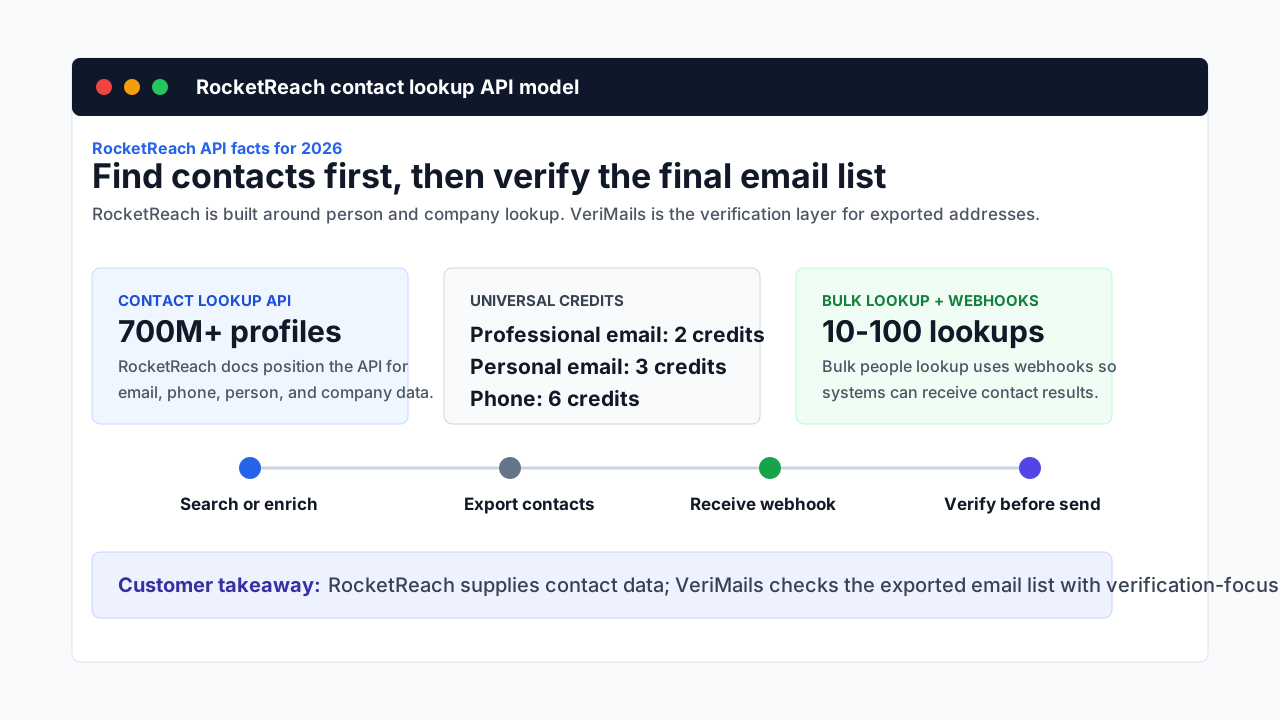
RocketReach offers an API for contact enrichment and bulk person lookups, including a bulk endpoint that accepts up to 100 profiles per batch and returns results via webhook. It is a capable data API. At the May 2026 update, RocketReach Verify appeared to run through the web interface and bulk CSV upload rather than as a programmable verification endpoint. Check RocketReach's current API docs before buying if API-based verification is required.
VeriMails provides a REST API built entirely around verification. It has a single-email endpoint and a bulk endpoint, returns clean JSON, supports webhooks for batch jobs, and typically returns real-time-friendly responses on single calls. That makes it practical for real-time checks on signup and lead capture forms, as well as for automated list cleaning on a schedule. Every verification draws from one credit pool at one flat rate, and catch-all detection is included in every API response. For any team that needs verification inside its own software today, this is the clearest difference between the two.
Pricing and Value
RocketReach sells prospecting subscriptions and verification separately. At the May 2026 update, prospecting plans were shown around $33 per month for email-only lookups, $83 per month adding phone numbers, and $207 per month with the highest lookup limits and API access, on annual billing. RocketReach Verify is its own product: verification credits are bought in bulk starting from 1,000 credits, with discounts as quantity rises, and those credits never expire. Each email verified costs one credit, with no charge on an Unknown result, and every RocketReach customer gets 10 free Verify credits once. Check RocketReach's current pricing before buying.
VeriMails uses a single credit model dedicated to verification. Buy a pack, verify against it, and the credits never expire, the same never-expire principle RocketReach Verify applies. Pricing is published transparently and starts at $19 for 10,000 verifications, with the per-email rate falling as volume rises. Annual plans start at $12.50/month when billed yearly for teams that prefer a recurring allowance. Catch-all detection, the API, and bulk CSV processing are included at every tier.
VeriMails Credit Pricing
| Credits | VeriMails Price | Price per Email |
|---|---|---|
| 10,000 | $19 | $0.0019 |
| 25,000 | $39 | $0.00156 |
| 50,000 | $59 | $0.00118 |
| 100,000 | $99 | $0.00099 |
| 250,000 | $199 | $0.000796 |
| 500,000 | $349 | $0.000698 |
| 1,000,000 | $499 | $0.000499 |
| 2,500,000 | $999 | $0.0004 |
| 5,000,000 | $1,499 | $0.0003 |
Email Finder costs 20 credits only when VeriMails returns a verified person-level email. At the 10,000-credit pack, that is $0.038 per found email. Monthly plans start at $12.50/mo when billed yearly.
Credits never expire. No subscriptions required. 100 free credits on signup.
Cost Comparison for Verification
| Volume | VeriMails | RocketReach Verify |
|---|---|---|
| 10,000 emails | $19 (one-time credit pack) | 10,000 Verify credits at bulk-purchase rates; credits never expire, no charge on Unknown results |
| 100,000 emails | $99 (one-time credit pack) | 100,000 Verify credits at bulk-discounted rates; verification runs in the web interface, not via API |
RocketReach Verify cost can depend on the bulk tier you buy, so check RocketReach's current pricing before buying. VeriMails publishes its per-email rate openly.
Who VeriMails Is Best For
Teams that need verification inside their own software and want a dedicated verification API available today. Cold email operators who want detailed per-address status and explicit catch-all flagging before a send. Developers who want one flat verification rate across single and bulk API calls. Anyone verifying lists from any source who wants a published, transparent price per email.
Who RocketReach Is Best For
Sales and recruiting teams that need to find work emails and phone numbers across a very large profile database. Users who value RocketReach's contact discovery and browser extension for sourcing new people. Teams that want a single platform for finding contacts and can verify what they find through RocketReach Verify in the web interface. Buyers who like that RocketReach Verify credits are standalone and never expire.
Frequently Asked Questions
Why teams switch to VeriMails
“We run outbound for a B2B marketplace. VeriMails is the only verifier where the API response is fast enough to verify in real-time during our enrichment pipeline.”
— Hugo P. — Technical Lead at B2B Marketplace, France
“We hit the API 50K times a day for real-time form validation. Haven't had a single outage in four months. JSON response is clean and easy to parse.”
— Kevin C. — Engineering Lead at SaaS Platform, Canada
Related Comparisons
Try VeriMails Free
100 free credits on signup. No credit card required. See why teams switch to VeriMails.
Start Free