VeriMails vs Hunter.io
Hunter is best understood as an all-in-one cold outreach platform: it helps teams discover companies, find professional email addresses, verify those emails, manage leads, and send sequences. VeriMails is narrower by design: dedicated email verification, bulk list cleaning, API checks, and clear catch-all segmentation at a low per-email price.
Updated May 24, 2026
At a Glance
| Decision point | VeriMails | Hunter.io |
|---|---|---|
| Best fit | Verification-first list cleaning and API checks | Prospecting, lead discovery, enrichment, sequences, and verification in one platform |
| Core product | Dedicated email verification | Cold outreach platform originally founded as an email finder |
| Email verification | Dedicated verification credits from $0.0019 per email at 10,000 credits | Available inside Hunter, with usage tied to the Hunter credit system |
| Finder pricing | Email Finder is separate from bulk verification | 1 shared credit for each email found via Domain Search or Email Finder |
| Credit expiration | Credit packs never expire | Monthly plan credits last 1 month; annual plan credits last to the 12-month cycle; all-in-one add-on packs last 3 months |
| API | REST API for real-time and bulk verification | Email Verifier API plus Domain Search, Email Finder, enrichment, leads, and sequence APIs |
| Catch-all handling | Catch-all detection returned as a verification signal | Accept-all status and accept_all API field; confidence scores are most useful for accept-all emails |
Hunter Pricing and Credit Notes
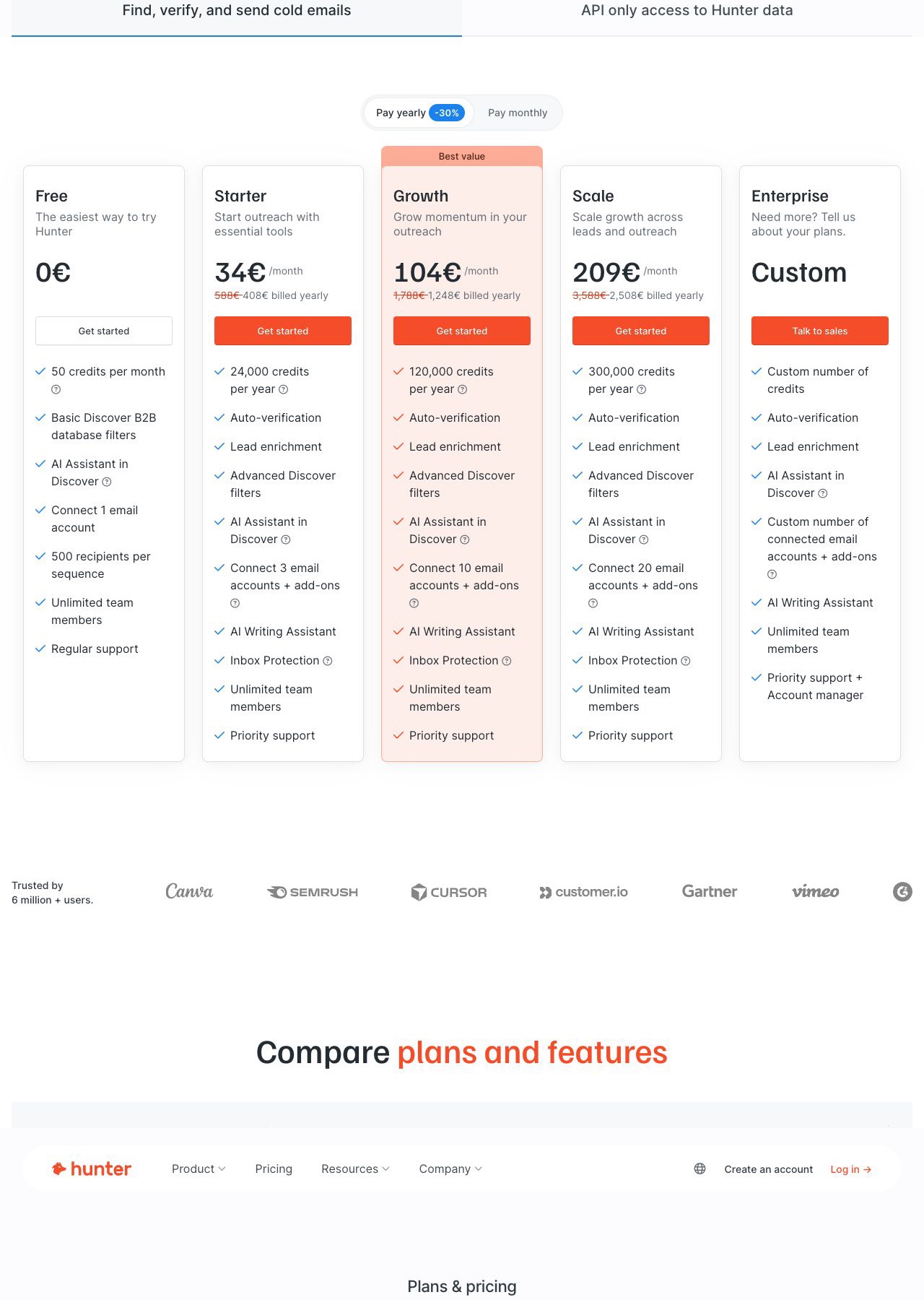
Hunter combines prospecting products with its Email Verifier, so the comparison needs to separate finder credits from verification credits. The cost math below uses Hunter's published credit model and credit-expiration rules.
Hunter Pricing and API Visuals
Use these visuals to compare Hunter's bundled credit model with the verifier fields developers rely on during list cleanup.
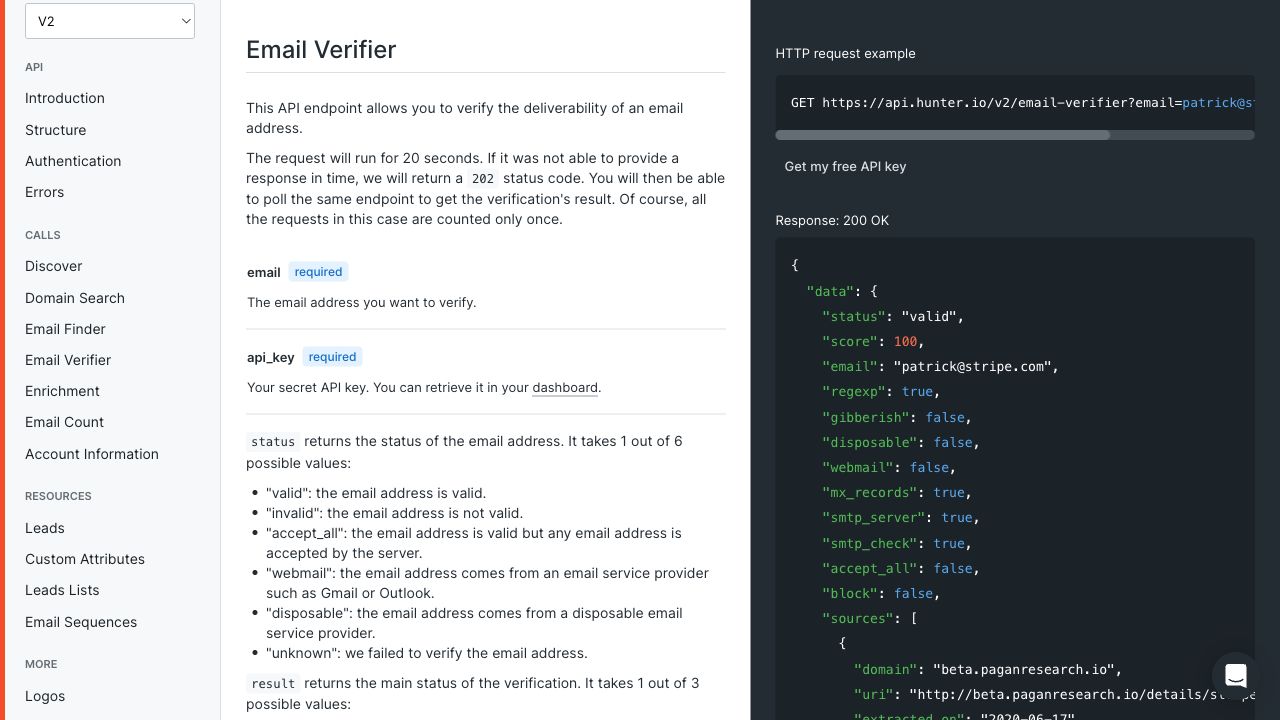
score, smtp_check, and accept_all are the practical API details for teams segmenting risk before outreach.Finder vs Verifier: The Main Product Difference
Hunter's help center describes the product as an all-in-one cold outreach platform and notes that it was originally founded as an email finder using publicly available web data. Its Domain Search finds email addresses for a company or domain, and Email Finder looks for a specific contact email for a specific contact. Those are discovery workflows.
Hunter's Email Verifier is a separate workflow inside that platform. It checks whether a known email address is valid, risky, or invalid before you send. Hunter also says emails found through its Email Finder and Bulk Email Finder are already verified, so teams using Hunter for discovery may not need to re-verify those particular found emails inside Hunter.
VeriMails is built for the next operational step: verifying addresses you already have from exports, CRMs, lead vendors, forms, scraping, or prospecting tools. If your buying priority is building new prospect lists and sending sequences in one app, Hunter does more. If your priority is checking a list before it reaches a sender, VeriMails is the cleaner fit.
Hunter Pricing and Credit Policy
Hunter's pricing page lists shared credits across Email Finder, Email Verifier, Domain Search, and related prospecting workflows. That structure is useful when a team wants discovery and outreach in one platform, but it makes verification-only cost harder to read than a dedicated per-email verification credit.
Credit duration depends on how you buy. Hunter's help center says monthly plan credits are available for 1 month and expire at the end of the monthly billing cycle. Annual plan credits do not expire monthly, but they expire at the end of the 12-month billing cycle. Add-on credit packs have a separate expiry window, and some buyers use Data Platform plans when they mainly need Search or Verification credits.
Hunter credit rules
| Hunter action | Credit rule | Operational note |
|---|---|---|
| Email Finder / Domain Search | 1 credit per email found | No credit used if no email is found |
| Bulk Domain Search | 1 credit for up to 10 emails found | Useful when the job is company-domain prospecting |
| Email Verifier / Bulk Email Verifier | Uses the shared Hunter credit pool | Verification usage competes with finder and prospecting usage |
| Unknown or disposable verification results | No verification credit counted | Hunter says these are skipped automatically |
| Repeated searches or verifications | Counted once per billing period | Helpful for duplicate checks inside the same cycle |
Hunter pricing can render in local currency. The plan prices used below are the listed USD monthly prices: Free $0, Starter $49/month, Growth $149/month, and Scale $299/month when paying monthly; annual billing is shown as roughly 30% lower monthly equivalents.
Verification-only math from Hunter monthly plans
| Hunter monthly plan | Included credits | Max verifications if used only for verifier | Effective verifier-only cost |
|---|---|---|---|
| Free | 50 credits/month | 100 verifications/month | $0 |
| Starter | 2,000 credits/month | 4,000 verifications/month | $0.01225/email at $49/month |
| Growth | 10,000 credits/month | 20,000 verifications/month | $0.00745/email at $149/month |
| Scale | 25,000 credits/month | 50,000 verifications/month | $0.00598/email at $299/month |
This table assumes every Hunter credit is spent on verification. In normal Hunter use, the same credit pool may also be spent on finding emails and prospecting.
VeriMails credit pricing
| Credits | VeriMails Price | Price per Email |
|---|---|---|
| 10,000 | $19 | $0.0019 |
| 25,000 | $39 | $0.00156 |
| 50,000 | $59 | $0.00118 |
| 100,000 | $99 | $0.00099 |
| 250,000 | $199 | $0.000796 |
| 500,000 | $349 | $0.000698 |
| 1,000,000 | $499 | $0.000499 |
| 2,500,000 | $999 | $0.0004 |
| 5,000,000 | $1,499 | $0.0003 |
Email Finder costs 20 credits only when VeriMails returns a verified person-level email. At the 10,000-credit pack, that is $0.038 per found email. Monthly plans start at $12.50/mo when billed yearly.
VeriMails credits never expire. No subscription is required for credit packs, and new accounts receive 100 free credits on signup.
Common verification volumes
| Volume | VeriMails | Hunter credit requirement | Hunter all-in-one plan fit |
|---|---|---|---|
| 10,000 emails | $19 one-time credit pack | 5,000 Hunter credits | First monthly all-in-one plan with enough credits is Growth at $149/month |
| 100,000 emails | $99 one-time credit pack | 50,000 Hunter credits | More than one Scale monthly quota; use multiple cycles, add-ons, annual credits, or a Data Platform plan |
| 500,000 emails | $349 one-time credit pack | 250,000 Hunter credits | Verification-only bulk job; Hunter Data Platform or sales-assisted buying is the more relevant path |
Hunter may still be the better value when the same subscription is also used for prospecting, enrichment, lead management, and sequences. VeriMails is priced for verification as the primary job.
API and Verifier Behavior
Hunter's Email Verifier API is documented at GET https://api.hunter.io/v2/email-verifier. The request can run for 20 seconds; if Hunter cannot provide a final result in that time, it returns a 202 status so the caller can poll the same endpoint, and Hunter says those polling requests count only once until the response is returned.
The API response exposes useful verification details: status, score, regexp, gibberish, disposable, webmail, mx_records, smtp_server, smtp_check, accept_all, and block. The Email Verifier endpoint is rate limited to 10 requests per second and 300 requests per minute.
| Developer question | VeriMails | Hunter.io |
|---|---|---|
| Real-time verification | REST verification API | Listed /v2/email-verifier endpoint |
| Bulk verification | CSV and bulk verification workflows | Bulk Email Verifier in product; API docs cover real-time verifier endpoint |
| Verifier status language | Deliverability and catch-all signals | valid, invalid, accept_all, webmail, disposable, unknown |
| Accept-all API field | Catch-all flag returned for segmentation | accept_all is true when Hunter detects broad domain-level acceptance |
| Rate limit | Plan/API dependent | 10 requests/second and 300 requests/minute for Email Verifier |
Accept-all and Catch-all Handling
Hunter calls catch-all domains "accept-all." Its help center explains that accept-all policy prevents full deliverability certainty because the receiving domain may accept mail broadly without confirming whether a specific mailbox exists. Hunter's API reference defines accept_all as broad domain-level acceptance, which can make address-level certainty harder.
Hunter provides confidence scores and says those scores are most useful for accept-all emails; for valid or invalid statuses, it recommends relying on the status. VeriMails keeps the same operational risk explicit by flagging catch-all addresses during verification so teams can suppress, segment, or test those addresses separately before a campaign.
Who Should Choose Which?
Choose VeriMails if
You mainly need to verify known email lists, keep catch-all risk visible, run CSV cleanup, integrate a verification API, and avoid expiring monthly verification credits when volume is uneven.
Choose Hunter if
You need to discover net-new contacts with Domain Search, Email Finder, or Discover, manage leads, enrich contacts, and run outreach sequences from the same platform that verifies addresses.
Run the Next Check in VeriMails
After comparing pricing, credits, API behavior, and catch-all handling, the practical next step is to verify a real sample from your own list.
Verification Accuracy
Accuracy depends on when the address is checked and what job the tool is built for. Hunter.io is strongest when you need new contact data or enrichment. VeriMails is strongest after you already have a list and need a fresh deliverability result before you send.
Run the list through syntax, domain, MX, SMTP, disposable, role-based, and catch-all detection checks close to the campaign date. That gives you current valid, invalid, catch-all, and risky buckets instead of trusting an older discovery label.
Who VeriMails Is Best For
Choose VeriMails when verification is the job and you want the result before the send.
- You already sourced contacts and now need to check which addresses are safe to send.
- You want prepaid verification credits that never expire.
- You need API and CSV verification without paying for a larger sales platform.
Frequently Asked Questions
Why teams switch to VeriMails
“Recruiting outreach is cold email with higher stakes. One bounced email to a passive candidate is a missed hire. Verification before every outreach batch is non-negotiable now.”
— Lisa R. — Sourcing Lead at Executive Search Firm, United States
“Evaluated five verification APIs. VeriMails had the simplest auth, the fastest response, and the cheapest price per call. Decision took ten minutes.”
— Oscar T. — Senior Developer at E-Commerce Platform, Sweden
Related Comparisons
Try VeriMails Free
100 free credits on signup. No credit card required. Verify exported Hunter lists or any CSV before sending.
Start Free