VeriMails vs Clearout
Clearout is a mature data-quality suite with email verification, finder, prospecting, Form Guard, add-ons, and enterprise compliance messaging. VeriMails is narrower by design: bulk email verification, catch-all segmentation, and API checks at a lower listed credit cost. Here is the buying decision, not just the feature list.
TLDR: Quick Verdict
At a Glance
Clearout is not a thin verifier. It is closer to a GTM data-quality suite. That makes it stronger for teams that want multiple contact-data products in one account, but it also means buyers should compare credits, add-ons, and API limits before treating the headline verifier price as the whole cost.
| Feature | VeriMails | Clearout |
|---|---|---|
| Best fit | Lean verification for bulk cleanup, API checks, and catch-all segmentation | Broader suite for verification, finder, Form Guard, prospecting, and enterprise teams |
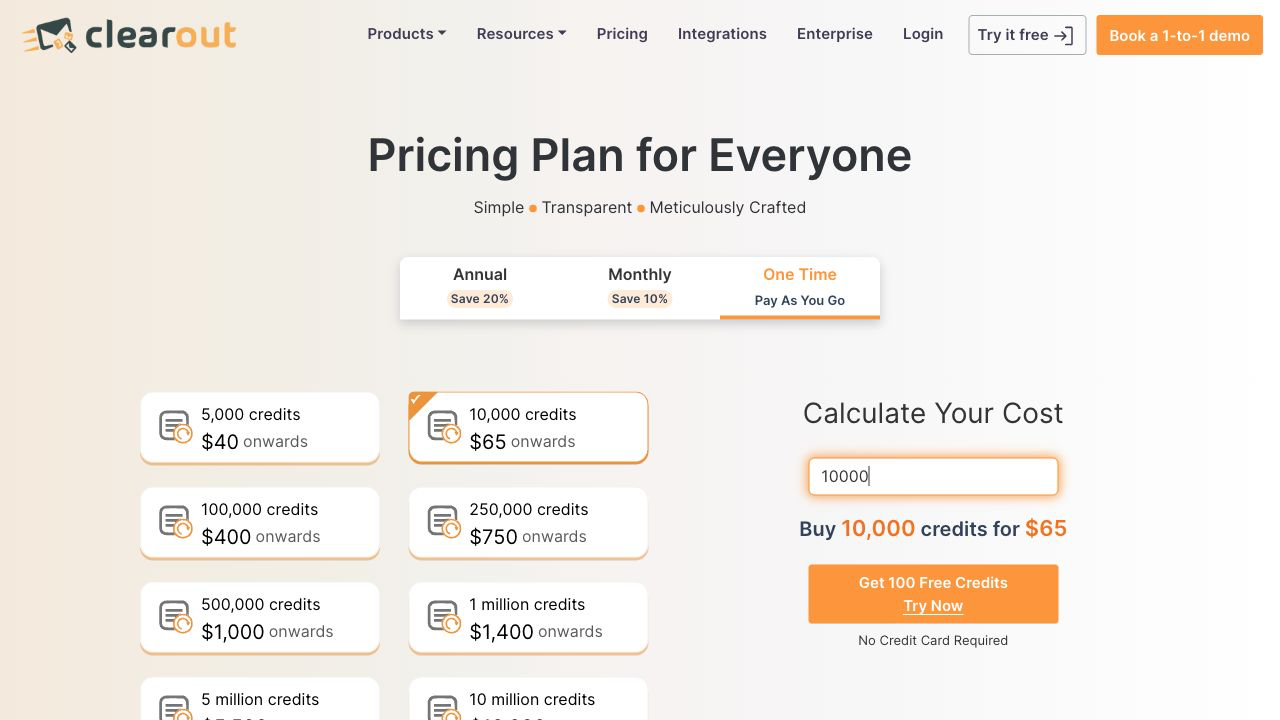
| 10,000 one-time credits | $19 | $65 shown on the pricing calculator |
| 100,000 one-time credits | $99 | $400 shown on the pricing calculator |
| Free start | 100 signup credits, no credit card required | 100 free credits, no credit card required |
| Credit charging | Simple verification credits | 1 verifier credit for valid, invalid, or catch-all; unknown and same-list duplicates are not charged |
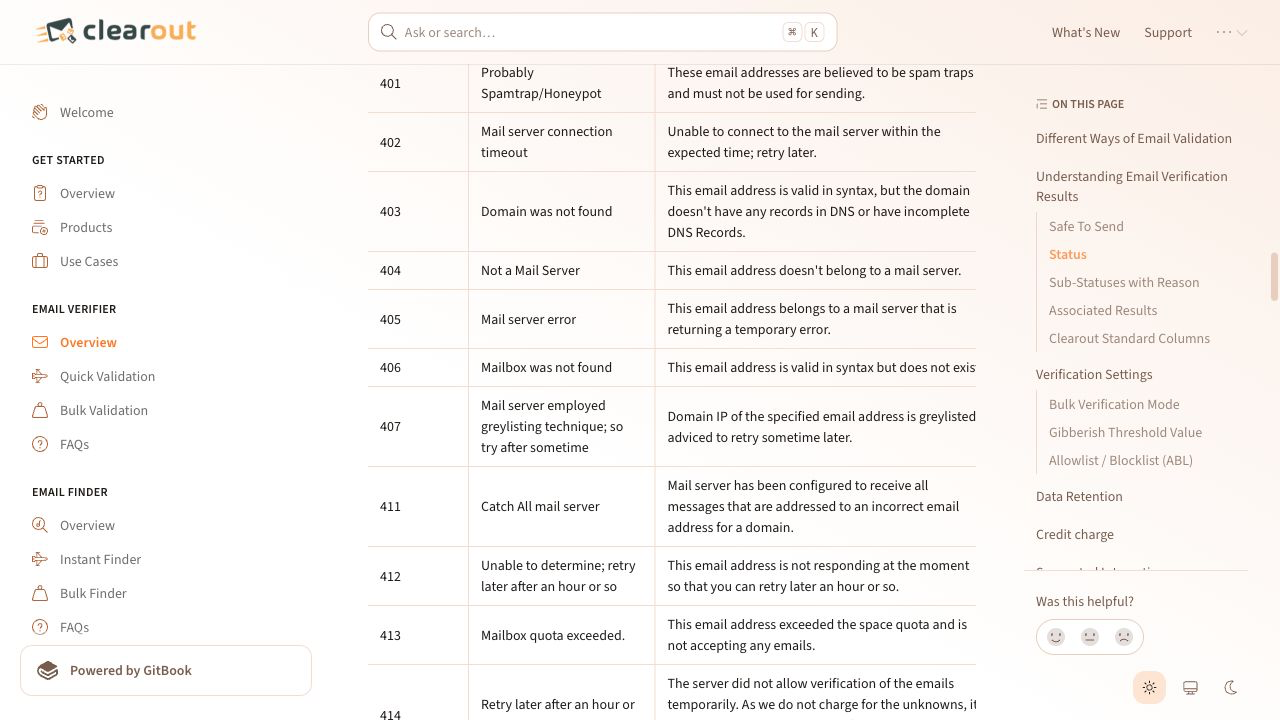
| Catch-all handling | Catch-all results are separated from confirmed deliverable emails | Catch All is a primary status and safe-to-send is marked Risky |
| API shape | Focused REST API for single and bulk verification | REST and JSON APIs across verification and discovery, with plan-based RPM limits |
Pricing and Credit Model
Clearout's pricing has two separate buying paths. Its subscription cards position recurring plans with rollover credits, while its one-time credit calculator shows one-time credit purchases. On May 19, 2026, the Clearout calculator showed 10,000 credits for $65, 100,000 credits for $400, 1,000,000 credits for $1,400, 5,000,000 credits for $5,500, and 10,000,000 credits for $10,000.
Clearout's credit rules are more nuanced than a flat "one row equals one credit" model. Its pricing guide says Email Verifier uses 1 credit for valid, invalid, or catch-all results. Unknown results are free, and duplicates within the same uploaded list are not charged. Email Finder and prospecting use higher credit amounts, so buyers comparing total cost should separate verification volume from enrichment or prospecting volume.
| Volume | VeriMails credit packs | Clearout one-time credits | Buyer note |
|---|---|---|---|
| 10,000 credits | $19 | $65 | Clearout's recurring 10K plan was shown separately at $58/month or $32/month annually. |
| 100,000 credits | $99 | $400 | The spread matters quickly for recurring list hygiene. |
| 1,000,000 credits | $499 | $1,400 | Clearout becomes more competitive at high volume, but remains higher on these public tiers. |
Clearout also offers subscription rollover, auto credit replenishment, and add-ons such as extra API rate limits. VeriMails is simpler when the buying job is only email verification.
What Buyers Compare
Verification Workflow
Both products support the core verification loop: accept an address or list, check syntax and domain health, test mailbox reachability where possible, flag risky categories, and return or export the result. The difference is how much surrounding GTM tooling you want wrapped around that workflow.
Catch-All Handling
Clearout handles catch-all addresses clearly. Its Email Verifier reference lists Valid, Invalid, Catch All, and Unknown as primary statuses. It also explains that catch-all is a domain-level setting that can accept messages to many addresses, including invalid ones, so its safe-to-send status is Risky. That is a useful buyer-facing treatment because it avoids mixing catch-all results into the same bucket as confirmed deliverable mailboxes.
VeriMails takes the same conservative view. Catch-all domains are segmented so sales and marketing teams can choose a policy before sending: suppress all catch-all, send only to high-value accounts, or test them separately. No verifier can guarantee a specific mailbox behind a true catch-all server from SMTP behavior alone, so the practical value is clean segmentation and cost control.
API and Developer Experience
Clearout's developer reference describes REST and JSON APIs for verification and discovery. It also says the base URL can vary by account host region and should be checked in the Clearout app under Developer -> Reference. That is workable for backend teams, but it is a more account-specific setup than a single public base URL.
Clearout rate limits depend on the credit tier or plan. The public API overview lists one-time credit tiers with increasing RPM, and the pricing UI also sells add-ons for extra API throughput. VeriMails is better when the product requirement is a focused verification API that is easy to budget. Clearout is better if API verification is only one part of a broader Clearout workflow.
VeriMails Pricing Reference
For buyers doing raw verification math, these VeriMails credit packs tiers are the easiest comparison point:
| Credits | Price | Per email |
|---|---|---|
| 10,000 | $19 | $0.0019 |
| 25,000 | $39 | $0.00156 |
| 50,000 | $59 | $0.00118 |
| 100,000 | $99 | $0.00099 |
| 250,000 | $199 | $0.000796 |
| 500,000 | $349 | $0.000698 |
| 1,000,000 | $499 | $0.000499 |
| 2,500,000 | $999 | $0.0004 |
| 5,000,000 | $1,499 | $0.0003 |
Email Finder costs 20 credits only when VeriMails returns a verified person-level email. At the 10,000-credit pack, that is $0.038 per found email. Monthly plans start at $12.50/mo when billed yearly.
If you prefer predictable recurring cleanup, annual plans start at $12.50/month when billed yearly. Monthly billing is also available inside the dashboard.
Best-Fit Decision
Choose VeriMails if..
- Your main job is bulk email verification, not prospecting or enrichment.
- You verify lists often enough that 10K, 100K, or 1M pricing materially affects budget.
- You want catch-all addresses separated cleanly before sending campaigns.
- You prefer a focused tool that is easier for operators to understand.
Choose Clearout if..
- You want verification, email finder, Form Guard, prospecting, and add-ons in one account.
- You value rollover subscription credits and auto replenishment more than the lowest one-time credit price.
- You need Clearout's plan-specific API throughput, team features, or enterprise controls.
- Your buying team wants ISO, SOC 2 Type II, GDPR, and trust-center positioning in the vendor story.
Verification Accuracy
Both VeriMails and Clearout can help reduce bad addresses before a campaign. The difference is how clearly the result fits your next send: VeriMails keeps valid, invalid, disposable, role-based, catch-all, and unknown rows separate for decision-making.
Use a recent sample from your own CRM, not a perfect test list. The addresses that matter are the ones you plan to mail this week: old leads, imported contacts, role inboxes, catch-all domains, and records from mixed sources.
Who VeriMails Is Best For
Choose VeriMails when verification is the job and you want the result before the send.
- You already have a list and need to clean it before a campaign.
- You want prepaid verification credits that never expire.
- You need API and CSV verification without paying for a larger sales platform.
Who Clearout Is Best For
Choose Clearout when its broader product strengths match the job you are buying for.
- Choose Clearout when its existing dashboard, integrations, or deliverability features already fit your workflow.
- Choose it when you value that specific result model or account setup more than lower self-serve verification pricing.
- Choose it when your team has already standardized on its exports, API fields, or support process.
Frequently Asked Questions
Why teams switch to VeriMails
“We used to split verification across three tools depending on volume. Now it's all VeriMails. One dashboard, simpler invoicing for clients, lower cost across the board.”
— Marcus W. — Account Director at Performance Agency, United Kingdom
“We verify 400K emails a month before loading sequences. Bounce rate went from 5.2% to 0.6%. At $99 for 100K credits that pays for itself on the first campaign.”
— Mike T. — Head of Growth at Series A SaaS Platform, United States
Related Comparisons
Try VeriMails Free
100 free credits on signup. No credit card required. See why teams switch to VeriMails.
Start Free