VeriMails vs Lusha
Lusha is a B2B contact data provider known for its browser extension, direct dial phone numbers, and verified business email addresses pulled from its own database. It is a sales prospecting tool, not a standalone list verifier. VeriMails is a dedicated email verification service that runs a live SMTP check and catch-all detection on any list, at a low cost per email. Here is where each product fits.
Updated May 24, 2026
At a Glance
| Feature | VeriMails | Lusha |
|---|---|---|
| Price per email | from $0.0019 per verification | 1 credit to reveal a verified email; seat-based plans |
| Free tier | 100 credits on signup, never expire | Free plan with a small monthly credit allowance |
| Catch-all handling | Catch-all detection, flagged on every check | Not a verification-level feature |
| Standalone list verification | Yes, verify any list you import | Reveals verified records from its database |
| Bulk verification | CSV, ~10K rows in under 5 minutes | Bulk reveal of contacts, not list verification |
| Speed | Fast API response | Extension and platform focused |
Best-fit workflow
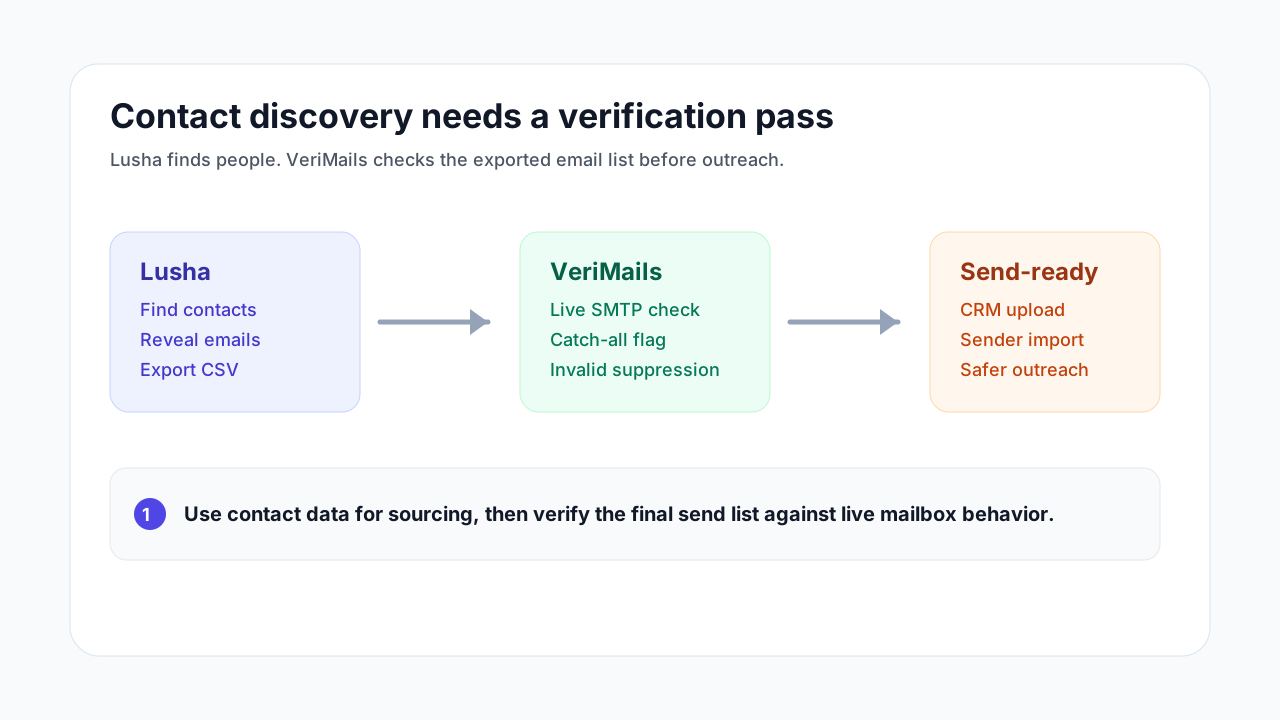
Use Lusha to find contacts, then run the email column through VeriMails when delivery risk matters more than adding another prospecting seat.
How the Workflow Fits Together
Verification Accuracy
Lusha and VeriMails are not the same kind of product, so accuracy means something different for each. Lusha is a contact data provider. When you reveal a contact, Lusha returns details from its database and labels the email as verified within that database. Its job is to give you a plausible, current business email for a named person. That is a real and useful capability, and Lusha is well regarded for the quality of its B2B data, particularly direct dial phone numbers.
VeriMails does not source contacts. It verifies addresses you already have, against the live mail server, at the moment you ask. Every check runs syntax validation, MX and DNS lookups, a live SMTP handshake, catch-all detection, disposable detection, and role-based detection. VeriMails returns a clear status alongside the checks that explain it. The distinction matters because a database label tells you an address looked correct when it was collected, while a live SMTP check tells you whether the receiving server will accept it now. Mailboxes are deactivated, people change jobs, and domains are reconfigured, so the freshest answer comes from verifying at send time.
In practice the two complement each other. Lusha finds the contact; VeriMails confirms the address is still good before you send.
Catch-all Handling
Catch-all domains accept mail addressed to any recipient at the domain, which means no external check can confirm whether a specific mailbox actually exists. For a contact data provider like Lusha, catch-all handling is not a verification-level feature; the platform returns a contact, and the catch-all nature of the domain is not the focus of what it sells.
VeriMails performs catch-all detection on every verification. During the live SMTP handshake it identifies domains configured to accept all recipients and flags them clearly in the result, kept separate from a clean valid. This matters most on B2B lists, where a large share of company domains run catch-all configurations. Without that flag, a catch-all address looks deliverable when it is genuinely uncertain. With it, you can decide to send carefully, hold the address, or route it to a slower nurturing track. No verifier can promise delivery to a catch-all mailbox, but VeriMails makes the uncertainty visible rather than hiding it inside a clean result.
API and Developer Experience
Lusha offers an API for accessing its contact and company data, typically on its higher business and Scale plans, so developers can enrich records and pull verified contact details into their own systems. It is an enrichment and data API, oriented around the database rather than around verification.
VeriMails provides a REST API designed only for verification. It has a single-email endpoint and a bulk endpoint, returns clean JSON, supports webhooks for batch jobs, and typically returns real-time-friendly responses on single calls. That speed makes it practical for real-time checks on registration and lead capture forms, as well as for scheduled list cleaning. Pricing is straightforward for developers: every verification draws from one credit pool at one flat rate, with catch-all detection included in every response, and there is no per-seat licensing to budget around.
Pricing and Value
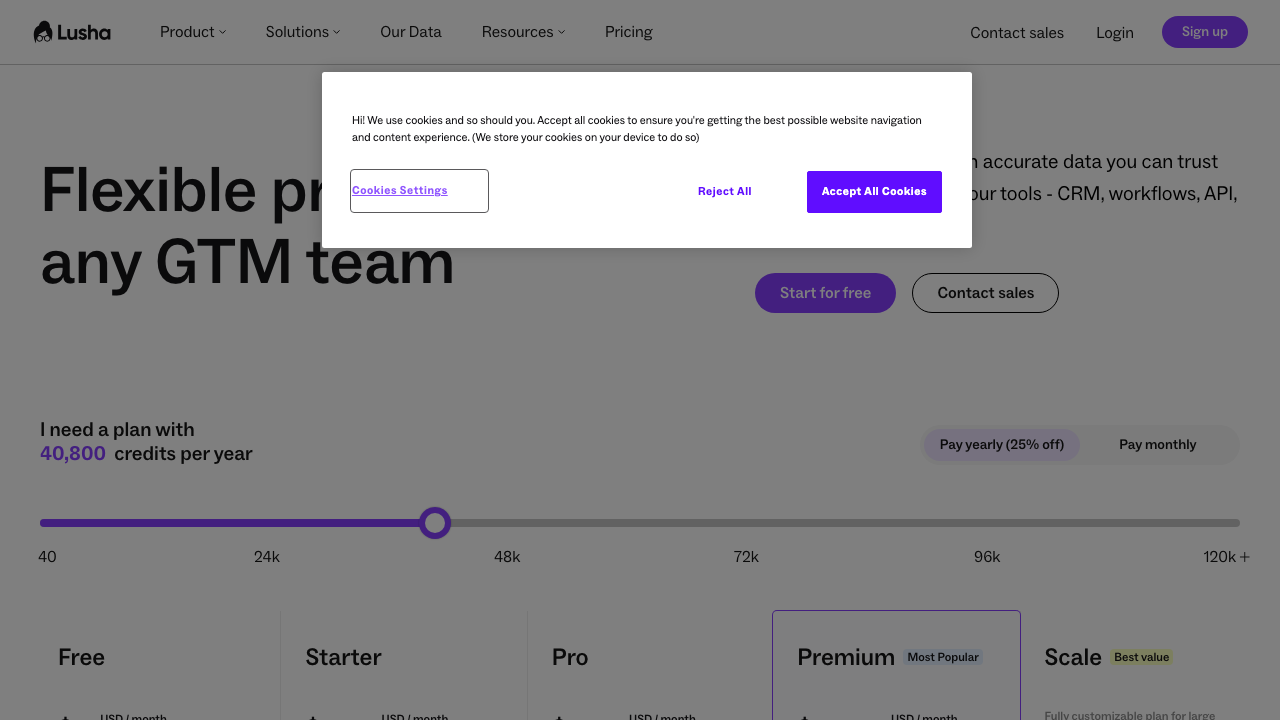
Lusha prices around user seats and contact-data credits. Its pricing page lists up to 40 credits per month on the Free plan, 1 credit to reveal a verified email address, and 10 credits to reveal a phone number. Monthly plan credits can roll over up to twice the plan limit while the subscription remains active; annual credits are issued upfront and reset at the end of the annual cycle. Because the product is built for prospecting, costs scale with seats, credit use, and whether your team reveals emails only or also reveals phone numbers.
VeriMails has no seats and no credit caps. You buy verification credits, you verify, and the credits never expire. Pricing starts at $19 for 10,000 verifications, with the per-email rate falling as volume rises. Annual plans start at $12.50/month when billed yearly for teams that prefer a recurring allowance. Catch-all detection, the API, and bulk CSV processing are included at every tier.
VeriMails Credit Pricing
| Credits | VeriMails Price | Price per Email |
|---|---|---|
| 10,000 | $19 | $0.0019 |
| 25,000 | $39 | $0.00156 |
| 50,000 | $59 | $0.00118 |
| 100,000 | $99 | $0.00099 |
| 250,000 | $199 | $0.000796 |
| 500,000 | $349 | $0.000698 |
| 1,000,000 | $499 | $0.000499 |
| 2,500,000 | $999 | $0.0004 |
| 5,000,000 | $1,499 | $0.0003 |
Email Finder costs 20 credits only when VeriMails returns a verified person-level email. At the 10,000-credit pack, that is $0.038 per found email. Monthly plans start at $12.50/mo when billed yearly.
Credits never expire. No seats, no subscriptions required. 100 free credits on signup.
Cost Comparison for Verification
| Volume | VeriMails | Lusha |
|---|---|---|
| 10,000 emails | $19 (one-time credit pack) | Not sold as standalone list verification; credits reveal contacts from Lusha's database, priced per seat |
| 100,000 emails | $99 (one-time credit pack) | Verifying an imported list at this scale is outside Lusha's model, which is built around revealing database contacts |
Lusha and VeriMails are not direct substitutes on price. Lusha charges to reveal B2B contacts; VeriMails charges per verified email. They are commonly used together.
Who VeriMails Is Best For
Teams that need to verify email lists from any source, including Lusha exports, before sending. Cold email operators who want a live SMTP check at send time rather than a database label. Developers who want flat per-verification pricing with no per-seat fees. Anyone who wants catch-all domains flagged clearly so uncertain addresses are not treated as deliverable.
Who Lusha Is Best For
Sales teams that need B2B contact data, especially direct dial phone numbers, for prospecting. Reps who want a browser extension that surfaces contact details while they research accounts on LinkedIn and company sites. Teams that value Lusha's data coverage and compliance posture for sourcing new contacts. Organizations whose primary need is finding people to contact, with verified emails delivered as part of that data.
Frequently Asked Questions
Why teams switch to VeriMails
“We source candidates from LinkedIn and verify their emails before outreach. Hit rate went from 60% to 93%. Saves hours of wasted follow-up.”
— Sarah J. — Talent Acquisition Lead at Tech Recruiter, United Kingdom
“No SDK needed. We wrote a Python wrapper in 30 minutes. Rate limits are generous and the error handling is straightforward.”
— Raj P. — Full-Stack Developer at Data Enrichment Startup, United Kingdom
Related Comparisons
Try VeriMails Free
100 free credits on signup. No credit card required. See why teams switch to VeriMails.
Start Free