VeriMails vs Dropcontact
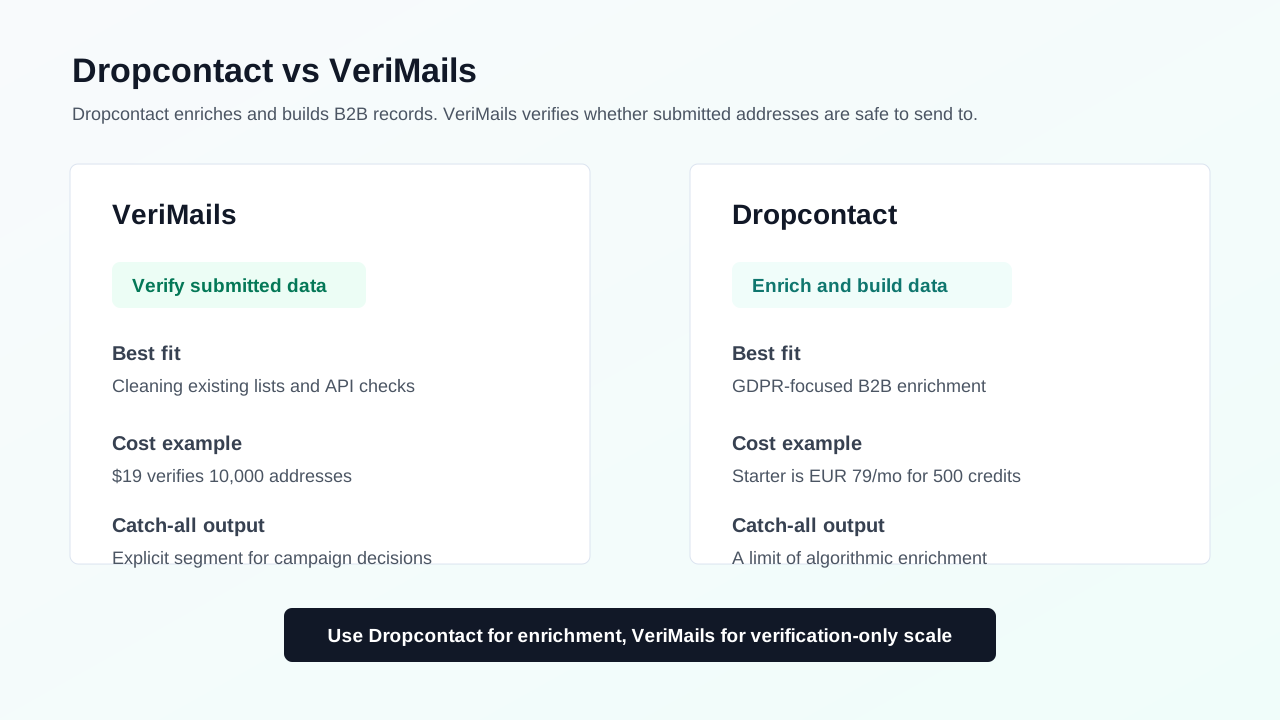
Dropcontact is a French B2B email finder and data enrichment tool with a clear identity: it builds and verifies professional emails algorithmically and is fully GDPR compliant, with no purchased contact database. It is a strong choice for European teams that care about compliance. VeriMails is built for the list-cleaning job: upload the file, remove risky addresses, and send with lower bounce risk.
Updated May 2026
At a Glance
| Feature | VeriMails | Dropcontact |
|---|---|---|
| Price per email | from $0.0019 | €79/mo displayed with 4,000 selected credits |
| Free tier | 100 credits, no card, never expire | 50 free credits on signup |
| Catch-all handling | Dedicated catch-all detection | Catch-all verification; non-standard patterns hard to verify |
| API | REST API, single + bulk + webhooks | REST API and MCP access |
| Bulk verification | CSV, ~10K rows under 5 min | File-based enrichment (CSV, XLS, TXT) |
| Speed | Fast verification | Enrichment processing, batch oriented |
Use the right layer
If Dropcontact enriches the record, use the email verification API comparison or the bulk list cleaning workflow to validate the final address before a campaign.
Verification Accuracy
Dropcontact and VeriMails arrive at accuracy by very different routes. Dropcontact emphasizes that it finds emails, enriches, deduplicates, and updates B2B contacts without using contact databases. Its pricing page lists native email validation, advanced catch-all verification, pay-on-success billing, and 100% GDPR-compliant processing.
VeriMails starts from the finished list. The useful question is whether addresses from a CRM, event list, vendor export, or previous campaign should stay in the list, be suppressed, or be segmented for review. Dropcontact is the broader enrichment layer; VeriMails is the dedicated verification layer after the data is assembled.
Catch-all Handling
Catch-all domains accept mail broadly, which makes specific mailbox confidence harder. Dropcontact explicitly lists advanced catch-all verification in its Starter plan, so this is part of the enrichment product rather than a bolt-on.
VeriMails treats catch-all outcomes as a list-cleaning decision point. The goal is not to hide uncertain rows, but to return a clear segment that your team can handle according to campaign policy.
API and Developer Experience
Both tools provide a REST API, and Dropcontact has invested here, offering both a documented API and MCP access for AI-driven workflows along with a native Google Sheets add-on and CRM connectors for HubSpot, Pipedrive, and Salesforce. Its API is oriented around enrichment: you send a contact, you get back an enriched, validated record.
VeriMails offers a REST API built specifically for verification at scale. It provides single-address and bulk endpoints, clean JSON responses, and webhooks and batch processing for larger jobs. Dropcontact's API is the better fit when you want enrichment plus validation in one call; VeriMails is the better fit when verification is the discrete job you need to run reliably.
Pricing and Value
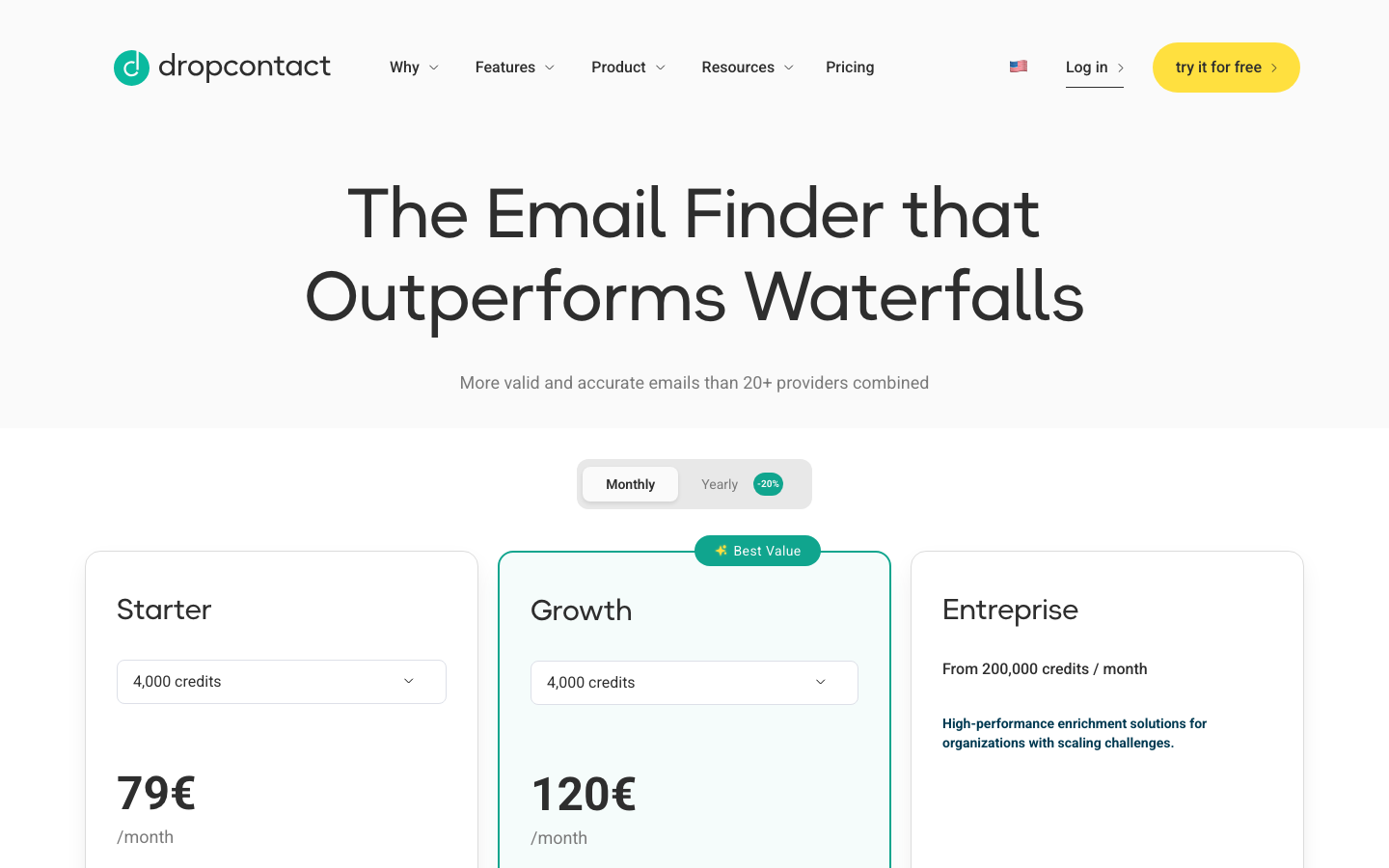
Dropcontact is sold as a monthly or annual subscription priced in euros, with annual billing discounted by 20 percent. On the May 2026 pricing page in May 2026, the Starter and Growth cards displayed 4,000 selected credits at 79 euros and 120 euros per month respectively, while lower quotas were available from the selector. Starter includes native email validation, catch-all verification, file-based enrichment, and API and MCP access. Growth adds credit carryover, LinkedIn enrichment, job classification, and company data. Enterprise pricing is custom from 200,000 credits per month. One credit equals one email found, and unfound emails are re-credited. CRM-integrated enrichment is a separate subscription.
VeriMails sells verification credits outright. You buy a balance, spend it whenever you want, and it never expires. Pricing starts at 19 dollars for 10,000 credits, which is 0.0019 dollars per email, and the per-email rate falls as volume rises. A monthly subscription range also exists for teams with steady volume, but the credit packs below are the simplest way to see verification cost.
| Credits | VeriMails price | Price per email |
|---|---|---|
| 10,000 | $19 | $0.0019 |
| 25,000 | $39 | $0.00156 |
| 50,000 | $59 | $0.00118 |
| 100,000 | $99 | $0.00099 |
| 250,000 | $199 | $0.000796 |
| 500,000 | $349 | $0.000698 |
| 1,000,000 | $499 | $0.000499 |
| 2,500,000 | $999 | $0.0004 |
| 5,000,000 | $1,499 | $0.0003 |
Email Finder costs 20 credits only when VeriMails returns a verified person-level email. At the 10,000-credit pack, that is $0.038 per found email. Monthly plans start at $12.50/mo when billed yearly.
Credits never expire. 100 free credits on signup, no credit card required.
The two pricing models serve different needs, so a like-for-like comparison is rough. Dropcontact bundles enrichment, finding, and validation into its credit. VeriMails charges only for verification. The practical numbers: verifying 10,000 addresses with VeriMails costs 19 dollars from a credit pack with no recurring commitment, and verifying 100,000 addresses costs 99 dollars. Dropcontact's entry point is a 79 euro monthly subscription for 500 credits, which is geared toward enrichment volume rather than bulk verification. If you only need to know which addresses will bounce, VeriMails is far cheaper. If you need GDPR-compliant enrichment as well, Dropcontact's price reflects a broader product.
Who VeriMails Is Best For
Teams that need to verify a complete list rather than build one. Developers who want a verification-focused REST API with single and bulk endpoints and webhooks. Anyone who wants verification credits that never expire. Operators who need a clean list before campaign launch, CRM import, or form capture.
Who Dropcontact Is Best For
European B2B teams for whom GDPR compliance is central to sourcing and enrichment. Sales and marketing teams that want enrichment, job classification, company data, deduplication, and contact updates alongside email finding. Users who rely on file-based enrichment, Google Sheets, API, MCP, or CRM-oriented workflows.
Use enrichment and verification in the right order
Dropcontact can be the right first step when the record is incomplete and you need enrichment. VeriMails is the right next step when the email exists and you need a send decision. Treat those jobs separately. Enrich the contact, deduplicate the record, then verify the final address before it enters an outreach sequence, CRM import, or customer workflow.
That order protects deliverability without asking one tool to solve every data problem. Dropcontact helps you build or complete the record. VeriMails helps you decide whether the address should be used, suppressed, or reviewed. For bulk lists, that separation also makes cost easier to understand because verification credits are spent only on the cleanup job.
Frequently Asked Questions
Why teams switch to VeriMails
“We clean lists for 12 clients. VeriMails processes all of them for less than what one client used to cost us on NeverBounce.”
— Laura K. — Operations Lead at B2B Lead Gen Agency, United Kingdom
“We built verification into our client reporting. The API makes it easy to pull pass/fail rates per campaign and show clients exactly how much list hygiene improved results.”
— Charlotte A. — Data Lead at Growth Agency, Netherlands
Related Comparisons
Try VeriMails Free
100 free credits on signup. No credit card required. See why teams switch to VeriMails.
Start Free