VeriMails vs Antideo
Antideo is an online intelligence API that bundles IP reputation, phone validation, and email validation into one service aimed at detecting fraudulent signups and filtering spam. Its email checks are lightweight by design. VeriMails is a dedicated email verification platform built to confirm that addresses are real and deliverable, with a live SMTP handshake, catch-all detection, and bulk processing.
Updated May 24, 2026
At a Glance
| Feature | VeriMails | Antideo |
|---|---|---|
| Price per email | from $0.0019 per verification | Priced by hourly request rate, not volume |
| Free tier | 100 credits on signup, never expire | Free plan, ~10 requests per hour |
| Catch-all handling | Dedicated catch-all detection | Not a focus of its email checks |
| API | Single and bulk REST endpoints | REST API, hourly rate limits |
| Bulk verification | CSV upload, ~10K rows under 5 min | Not designed for bulk lists |
| Speed | fast responses | Per-request, hourly caps apply |
These products solve different problems. Antideo is a fraud and spam screening API where email is one signal among several. VeriMails is a verification tool whose entire job is confirming that an email address will accept mail.
Verification Workflow Visual

Verification Accuracy
Antideo's email validation is intentionally lightweight. It checks syntax, detects disposable addresses, and screens against spam and blacklist sources, with an MX record check available on paid plans. That combination is genuinely useful for catching obviously fake or throwaway addresses at signup, and it pairs naturally with Antideo's IP reputation checks. What it does not do is open a connection to the receiving mail server to confirm a specific mailbox exists.
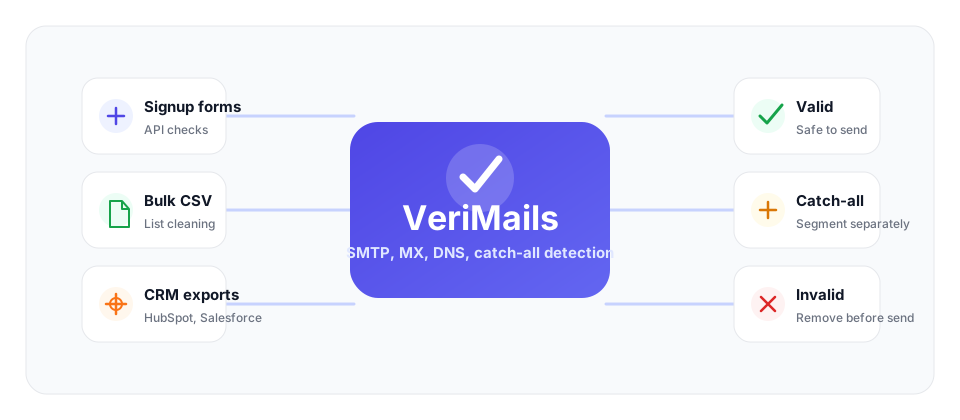
VeriMails runs a deeper chain. It performs syntax, MX, and DNS checks, then completes a live SMTP handshake against the receiving mail server for every address, alongside disposable detection, role-based detection, and catch-all detection. VeriMails focuses on high-volume email verification with a simple API and bulk workflow.
The difference is what the result means. Antideo can tell you an address is well-formed, not disposable, and on a domain with mail records. VeriMails can tell you, with high confidence, whether the actual mailbox will accept a message. For protecting deliverability on a campaign or sales list, that mailbox-level confirmation is the signal that matters.
Catch-all Handling
Catch-all domains accept mail to any local part rather than rejecting unknown mailboxes, which makes confirming a specific mailbox impossible at the protocol level. They are common on B2B corporate domains.
Catch-all classification is not a focus of Antideo's email checks. Because its email validation centers on syntax, disposable detection, and spam or blacklist screening, it does not set out to label which domains are catch-all, and that is consistent with its purpose as a fraud screening API rather than a deliverability tool.
VeriMails performs dedicated catch-all detection and exposes catch-all status as an explicit field in every result. For a B2B outreach list, where catch-all corporate domains are common, knowing precisely which addresses are catch-all lets you segment them, send a smaller test batch, or hold them for a separate pass rather than treating them all the same. That is a core part of what VeriMails is built to do and a clear gap when comparing it with Antideo for list verification.
API and Developer Experience
Both products are API-driven, and Antideo's API is well suited to its job. A single call can return email, IP, and phone signals together, which is convenient when you are scoring a signup for fraud risk in real time. Antideo is delivered purely as an API with no bulk dashboard, and access is governed by hourly request limits, with the free plan around 10 requests per hour and paid tiers raising that ceiling.
VeriMails is API-first for verification specifically. There is a documented REST API with both a single-verification endpoint and a dedicated bulk endpoint, JSON responses, webhook and batch support for asynchronous jobs, and real-time-friendly single-verification responses. VeriMails also includes a bulk CSV workflow that auto-maps the email column and supports asynchronous processing for large CSV jobs, returning downloadable filtered results, which Antideo's rate-limited model is not built for.
VeriMails additionally offers an Email Finder that returns a verified person-level email when available. It costs 20 credits only on a successful, verified find, which is $0.038 at the 10,000-credit pack. Antideo does not provide email discovery, since its email feature is a validation check inside a fraud screening suite.
Pricing and Value
Antideo prices by hourly request rate rather than by verification volume. The free plan is indefinite at roughly 10 requests per hour. Paid tiers run $5 per month for 50 requests per hour, $10 per month for 100, $20 per month for 300, $50 per month for 1000, and $80 per month for 2000, with paid plans adding an MX records check and a soft buffer above the stated limit. That structure suits a steady trickle of real-time signup checks. It is not built for verifying a large list in one session, because an hourly cap throttles bulk work by design.
VeriMails prices per verification with credits that never expire, so cost scales with the work done rather than with a rate ceiling.
VeriMails Credit Pricing
| Credits | VeriMails Price | Price per Email |
|---|---|---|
| 10,000 | $19 | $0.0019 |
| 25,000 | $39 | $0.00156 |
| 50,000 | $59 | $0.00118 |
| 100,000 | $99 | $0.00099 |
| 250,000 | $199 | $0.000796 |
| 500,000 | $349 | $0.000698 |
| 1,000,000 | $499 | $0.000499 |
| 2,500,000 | $999 | $0.0004 |
| 5,000,000 | $1,499 | $0.0003 |
Credits never expire. No subscriptions required. 100 free credits on signup. Monthly plans start at $12.50/mo when billed yearly if you prefer a recurring allowance.
Cost Comparison
| Volume | VeriMails | Antideo |
|---|---|---|
| 10,000 emails | $19, processed in one bulk run | Constrained by hourly request limits |
| 100,000 emails | $99, processed in one bulk run | Not a practical workload for this model |
A direct per-email comparison is not meaningful here, because Antideo does not sell verification by volume. The honest framing is that the two services are priced for different jobs. Antideo's monthly tiers are inexpensive for low-rate real-time screening, while VeriMails is built and priced to verify lists of any size, with a clear per-credit cost.
Who VeriMails Is Best For
Teams that need to confirm email addresses are real and deliverable, not just well-formed. Marketers and sales teams cleaning lists before campaigns or cold outreach. Anyone who needs bulk CSV verification, dedicated catch-all detection, or an Email Finder. Developers who want SMTP-grade verification through single and bulk API endpoints without an hourly rate ceiling.
Who Antideo Is Best For
Teams building fraud and abuse screening at signup, where IP reputation is as important as the email. Developers who want email, IP, and phone signals from a single API call. Products with low, steady real-time check volume that fits comfortably inside an hourly request limit. Budget-conscious users who value an indefinitely free tier for light fraud filtering.
Frequently Asked Questions
Related Comparisons
Try VeriMails Free
100 free credits on signup. No credit card required. See why teams switch to VeriMails.
Start Free