VeriMails vs Truemail
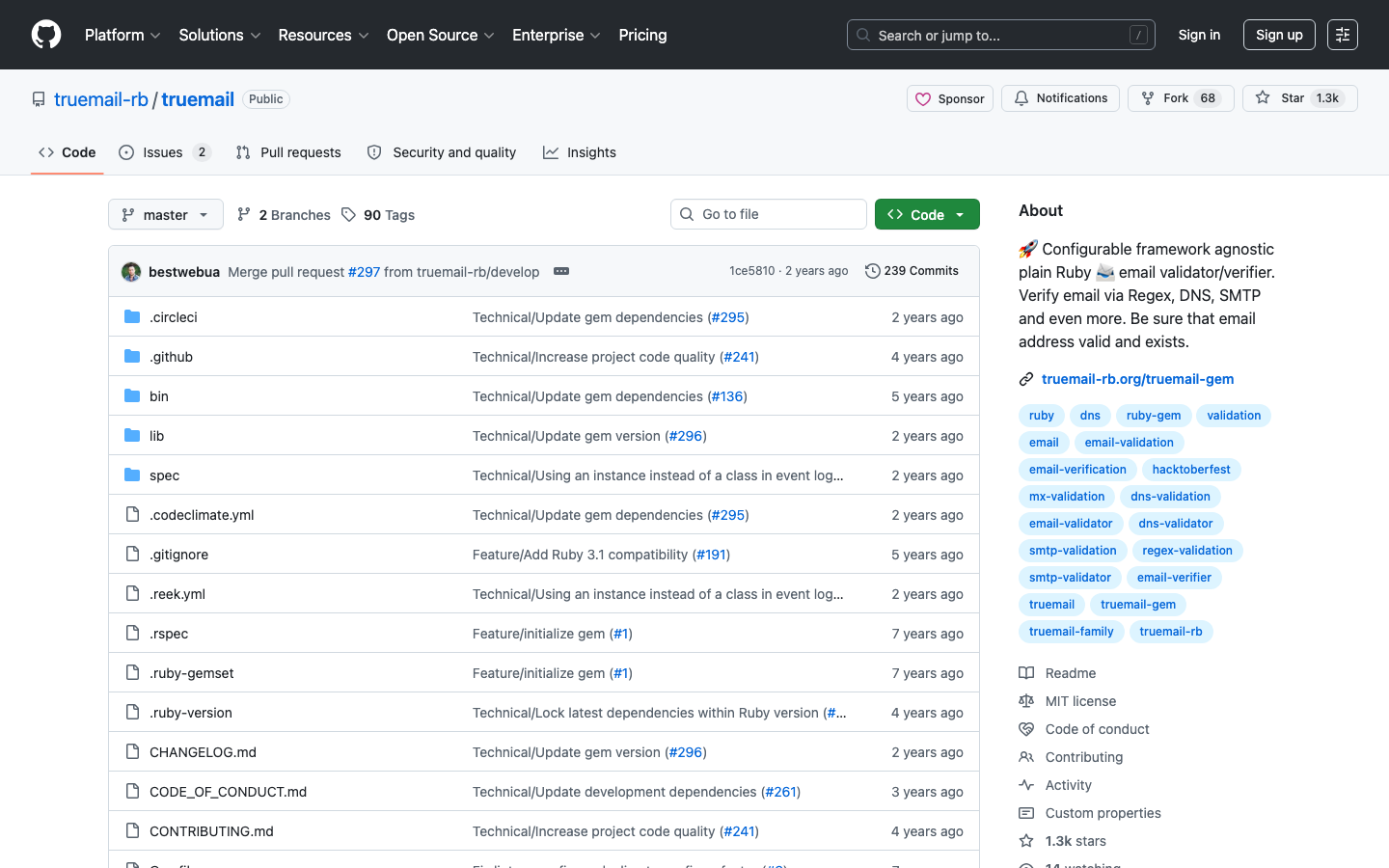
Truemail is an open-source email verification project, best known as a Ruby gem with a Go port and a Docker-packaged web server. It is free under the MIT license and gives developers full control of the verification logic. VeriMails is a managed verification service with a hosted API, a dashboard, and bulk CSV processing, so you get results without operating the verifier yourself.
Updated May 24, 2026
At a Glance
| Feature | VeriMails | Truemail |
|---|---|---|
| Price per email | from $0.0019 | Free software, you pay hosting and ops |
| Free tier | 100 credits on signup, never expire | Fully free and open-source |
| Catch-all handling | Dedicated catch-all detection | Configurable checks, no managed classification |
| API | Hosted REST API, single and bulk | Self-hosted library; web server is DIY |
| Bulk verification | CSV upload and filtered export | Build it yourself around the library |
| Speed | fast hosted responses | Depends on your servers and IPs |
This is not a like-for-like product comparison. Truemail is software you run. VeriMails is a service you call. The right choice depends on whether you want to own the verification stack or simply consume verification results.
Verification Workflow Visual
Verification Accuracy
Truemail implements a clear, layered verification pipeline: regex syntax checks, DNS and MX record lookups, and an SMTP step that connects to the receiving mail server. It also includes host audit features that help diagnose self-hosted SMTP problems. The algorithm itself is solid and transparent, and you can read exactly how each check works in the source.
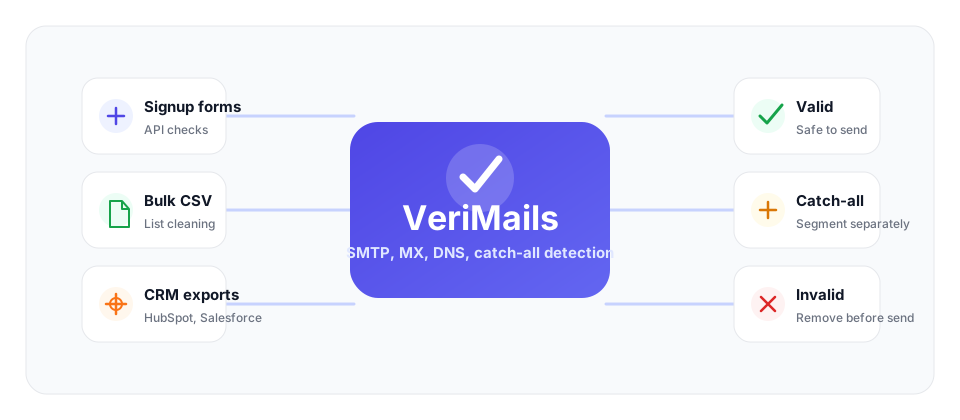
VeriMails runs a comparable chain, syntax, MX, DNS, and a live SMTP handshake, plus disposable and role-based detection and catch-all detection. It returns clear deliverability categories through a hosted verification workflow.
Here is the part that matters most. The quality of SMTP-based verification depends on more than the library call; hosting, monitoring, retries, and operational handling all affect how cleanly checks run. Truemail gives you a transparent algorithm, but you own the surrounding operations. VeriMails packages that work into a hosted verification workflow so teams can use clear deliverability categories without running the verifier themselves.
Catch-all Handling
Catch-all domains accept mail to any local part and never reject unknown mailboxes, so SMTP cannot confirm whether a specific mailbox exists. They are common on corporate domains and are the hardest case in verification.
Truemail is configurable and exposes various validation behaviors, so a developer can build logic around catch-all situations. But it does not ship a managed catch-all classification the way a hosted service does. Any catch-all policy you want is something you design and maintain in your own code.
VeriMails performs dedicated catch-all detection and returns catch-all status as an explicit field in every result, with no configuration needed. For teams that do not want to build and tune catch-all handling themselves, that is a meaningful difference. The address is still not provably deliverable on a catch-all domain, because that is a hard limit of the protocol, but VeriMails labels it clearly so you can route it.
API and Developer Experience
Truemail is, at its core, a library. The main project is a Ruby gem, with truemail-go providing a Go implementation and truemail-rack offering a lightweight web API server, plus an official Docker image and client libraries for several languages. If you work in Ruby or Go and want verification logic embedded directly in your application, Truemail is elegant and well documented. You are also free to fork and modify it, since it is MIT licensed.
The cost is operational. To expose Truemail as a service you deploy the rack server or the Docker image yourself, then handle scaling, monitoring, uptime, and the verification IP reputation. There is no managed dashboard, no bulk CSV upload, and no vendor handling incidents at 3am.
VeriMails gives you a hosted API without the operating work. There is a documented REST API with single and bulk endpoints, JSON responses, webhook and batch support, and fast response times. VeriMails also includes a bulk CSV workflow that auto-maps the email column and supports asynchronous processing for large CSV jobs, plus an Email Finder for teams that need discovery alongside verification. Truemail does not include CSV bulk tooling or email discovery; those would be your build.
Pricing and Value
Truemail is free. There is no license fee and no per-email charge, because it is open-source software under the MIT license. That is genuinely valuable, and for the right team it is the cheapest possible option. The honest accounting, though, includes the costs that do not appear on an invoice: server hosting, the engineering time to deploy and maintain it, monitoring, and either acquiring or maintaining IP addresses with good sending reputation so SMTP checks return accurate results. For low volumes, those costs can quietly exceed what a hosted service would charge.
VeriMails uses a transparent credit model. Credits never expire, there is no monthly reset, and hosted service operations are included in the price.
VeriMails Credit Pricing
| Credits | VeriMails Price | Price per Email |
|---|---|---|
| 10,000 | $19 | $0.0019 |
| 25,000 | $39 | $0.00156 |
| 50,000 | $59 | $0.00118 |
| 100,000 | $99 | $0.00099 |
| 250,000 | $199 | $0.000796 |
| 500,000 | $349 | $0.000698 |
| 1,000,000 | $499 | $0.000499 |
| 2,500,000 | $999 | $0.0004 |
| 5,000,000 | $1,499 | $0.0003 |
Email Finder costs 20 credits only when VeriMails returns a verified person-level email. At the 10,000-credit pack, that is $0.038 per found email. Monthly plans start at $12.50/mo when billed yearly.
Credits never expire. No subscriptions, no monthly fees. 100 free credits on signup. Monthly plans start at $12.50/mo when billed yearly if you prefer a recurring allowance.
Cost Comparison
| Volume | VeriMails | Truemail |
|---|---|---|
| 10,000 emails | $19, fully managed | $0 software plus hosting and engineering time |
| 100,000 emails | $99, fully managed | $0 software plus hosting, IP reputation, and ops |
If you have the engineering capacity, want full control, and run high volume where amortized operating cost beats per-credit pricing, Truemail can be the most economical path. If you would rather not run and monitor the verifier yourself, VeriMails delivers verified results at a fixed, low per-credit price with the operations included.
Who VeriMails Is Best For
Teams that want verified results without operating the verifier themselves. Companies on stacks other than Ruby or Go that do not want to integrate and operate a library. Users who need bulk CSV verification, catch-all detection, and an Email Finder out of the box. Anyone who values a hosted verification workflow over a do-it-yourself deployment.
Who Truemail Is Best For
Ruby and Go teams that want verification logic embedded directly in their application code. Engineering teams that need full control of the verification pipeline and want to read or modify the source. Organizations with strict data-handling rules that require verification to run entirely on their own systems. High-volume users with the operational capacity to host and monitor the service themselves.
Frequently Asked Questions
Why teams switch to VeriMails
“Our abandoned cart emails were bouncing at 8%. After running the list through VeriMails it dropped to under 1%. Klaviyo deliverability scores went up across the board.”
— David L. — Head of E-Commerce at Home Goods Brand, United Kingdom
“We pipe every new lead through VeriMails before it hits our CRM. The API handles bursts of 5K requests without throttling. Clean integration, zero babysitting.”
— Leon B. — DevOps Engineer at MarTech Company, Germany
Related Comparisons
Try VeriMails Free
100 free credits on signup. No credit card required. See why teams switch to VeriMails.
Start Free