VeriMails vs Abstract API
Abstract API is a developer-focused API company that ships a catalog of small utility APIs, including an email validation endpoint. It is easy to integrate and returns clean JSON, but verification is one product among many rather than the core focus. VeriMails is a dedicated email verification platform with real-time and bulk verification, a credit model that never expires, and explicit catch-all detection.
Updated May 24, 2026
At a Glance
| Feature | VeriMails | Abstract API |
|---|---|---|
| Price per email | from $0.0019 | From $0.005 per request |
| Free tier | 100 credits, commercial use allowed | 100 requests/mo, non-commercial only |
| Catch-all handling | Dedicated catch-all detection | Detects, often returns UNKNOWN |
| API | Single and bulk REST endpoints | Single-request REST API |
| Bulk verification | Bulk endpoint and CSV upload | CSV upload on paid plans |
| Speed | Fast responses, no tight rate cap | Fast per request, ~3 req/sec cap |
Abstract API does the basics well for a single real-time lookup. The friction shows up at volume, where rate limits, capped monthly request allowances, and overage fees start to matter.
Developer fit
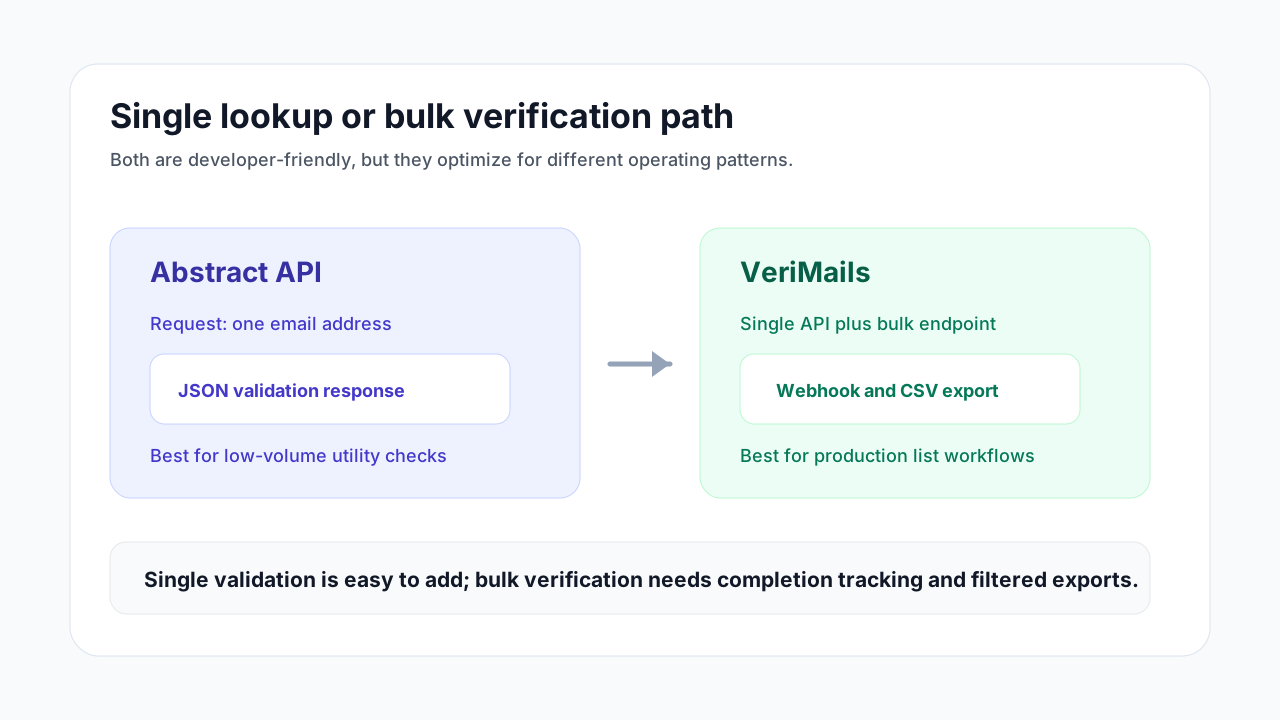
Abstract API suits utility-API stacks with low email volume. VeriMails suits products and operations teams that need the same API model to cover real-time and bulk checks.
Verification Accuracy
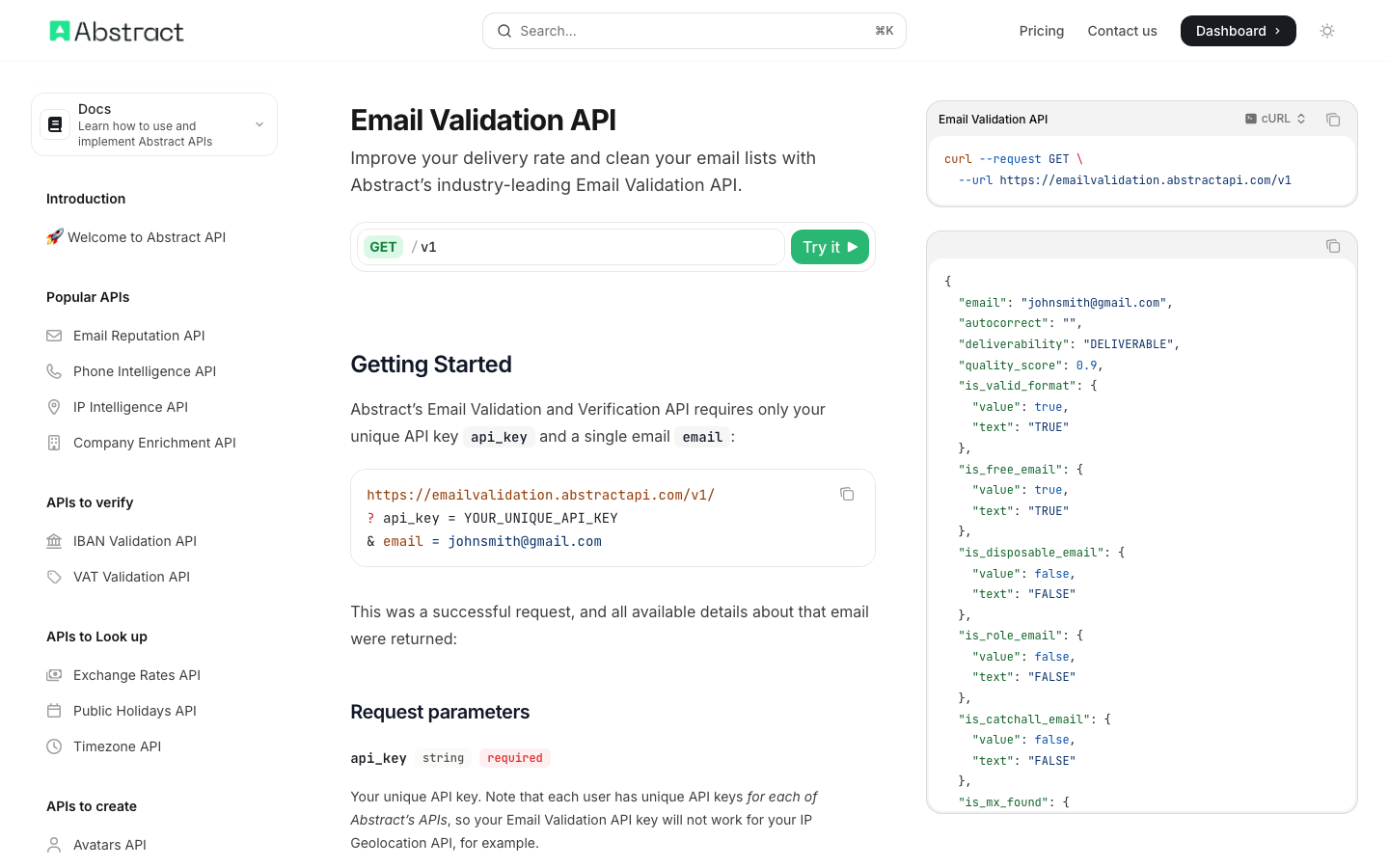
Abstract API's email validation endpoint checks syntax across a wide range of edge cases, evaluates deliverability, performs SMTP verification, checks MX records with daily updates, and flags disposable addresses, free email providers, role-based addresses, and catch-all domains. It also returns a numeric quality score and, on its higher tier, breach data. The SMTP step is fast, with Abstract advertising responses in well under a second.
VeriMails runs syntax, MX, and DNS checks, then completes a live SMTP handshake against the receiving mail server for every address. It flags disposable domains, role-based addresses, and catch-all domains so buyers can segment lists by deliverability category before sending.
One honest caveat applies to Abstract API: independent reviewers note that it tends not to appear in third-party accuracy benchmarks for email verification, which makes its quality harder to compare against verification-first providers. VeriMails treats verification as its single product, so accuracy and the freshness of its verification data are the core of the business rather than a feature in a broad utility suite.
Catch-all Handling
Catch-all domains accept mail addressed to any local part, so the receiving server will not confirm whether a specific mailbox exists. They are common on corporate domains and are the hardest case in email verification.
Abstract API detects catch-all domains, but for addresses on them it commonly returns an UNKNOWN deliverability result. That is an honest answer, but it pushes the decision back to you with little extra signal. If a meaningful slice of a B2B list lands on catch-all domains, a wall of UNKNOWN results is hard to act on.
VeriMails performs dedicated catch-all detection and exposes catch-all status as an explicit field in every result. Knowing precisely which addresses are catch-all lets you segment them, send to them with a smaller test batch, or hold them for a separate pass. The address is still not provably deliverable, because no service can promise that on a catch-all domain, but a clear label is far more useful than an unqualified unknown.
API and Developer Experience
This is the section where the two products are closest, since both are built for developers. Abstract API is genuinely pleasant to integrate. The documentation is clear, code samples sit in the dashboard, and you can test live calls before writing any code. If you already use other Abstract APIs for phone validation, IP geolocation, or similar utilities, adding email validation is a small step.
The constraint is throughput. Abstract API's email endpoint is reported to cap around three requests per second, which makes verifying a large list through the API slow and awkward. Bulk CSV upload is available on paid plans, but the API itself is shaped around one real-time lookup at a time.
VeriMails is also API-first, with a documented REST API, JSON responses, real-time-friendly single-verification responses, plus a separate bulk endpoint and webhook and batch support designed for processing whole lists without fighting a rate limit. CSV upload supports large bulk jobs and returns downloadable filtered results. VeriMails additionally offers an Email Finder for teams that need discovery alongside verification. Abstract API does not provide email discovery in its validation product.
Pricing and Value
Abstract API uses monthly subscriptions with capped request limits. The free tier is 100 requests per month and is limited to non-commercial use. Paid plans start at $17 per month, with Standard at $37 and Professional at $39, and higher tiers add more requests, better data quality, and higher throughput. Exceeding a plan's monthly limit triggers overage fees, and several reviewers report unexpected price changes, so it is worth confirming current terms before committing.
VeriMails uses a credit model. Credits never expire, there is no monthly reset, and there are no overage fees, because you simply buy more credits when you need them. The free 100 credits can be used in production with no commercial-use restriction.
VeriMails Credit Pricing
| Credits | VeriMails Price | Price per Email |
|---|---|---|
| 10,000 | $19 | $0.0019 |
| 25,000 | $39 | $0.00156 |
| 50,000 | $59 | $0.00118 |
| 100,000 | $99 | $0.00099 |
| 250,000 | $199 | $0.000796 |
| 500,000 | $349 | $0.000698 |
| 1,000,000 | $499 | $0.000499 |
| 2,500,000 | $999 | $0.0004 |
| 5,000,000 | $1,499 | $0.0003 |
Email Finder costs 20 credits only when VeriMails returns a verified person-level email. At the 10,000-credit pack, that is $0.038 per found email. Monthly plans start at $12.50/mo when billed yearly.
Credits never expire. No subscriptions, no monthly fees. 100 free credits on signup. Monthly plans start at $12.50/mo when billed yearly if you prefer a recurring allowance.
Cost Comparison
| Volume | VeriMails | Abstract API |
|---|---|---|
| 10,000 emails | $19, credits never expire | Mid-tier monthly plan, capped requests |
| 100,000 emails | $99, credits never expire | Higher monthly plan plus likely overage |
Abstract API does not publish a simple per-credit table, so an exact dollar-for-dollar match at every volume is hard to state. What is clear is the structure: VeriMails charges per verification with credits you keep, while Abstract API charges a recurring fee against a capped allowance with overage on top. For predictable verification spend at volume, the VeriMails model is simpler and usually cheaper.
Who VeriMails Is Best For
Teams that need both real-time and bulk verification without fighting a tight rate limit. Developers who want predictable per-credit pricing and no commercial-use restriction on the free tier. Sales and outreach teams that need explicit catch-all detection rather than UNKNOWN results. Anyone who wants verification from a provider whose only product is verification.
Who Abstract API Is Best For
Developers already standardized on Abstract API's wider suite of utility APIs who want one more endpoint on the same account. Projects with low, real-time-only verification volume that comfortably fits inside a monthly request cap. Teams that value Abstract's clean documentation and in-dashboard live testing. Use cases where a single fast lookup at signup matters more than processing large lists.
Frequently Asked Questions
Related Comparisons
Try VeriMails Free
100 free credits on signup. No credit card required. See why teams switch to VeriMails.
Start Free