VeriMails vs Mailfloss
Mailfloss is an automated list-cleaning tool that connects to your email service provider and quietly removes invalid addresses every day. It is a strong fit for marketers who want hands-off hygiene on one newsletter list. VeriMails takes a different approach: on-demand verification through CSV upload and a REST API, priced per credit, with no requirement to hand over access to your marketing platform.
Updated May 24, 2026
At a Glance
| Feature | VeriMails | Mailfloss |
|---|---|---|
| Price per email | from $0.0019 | $0.001 to $0.005 (plan dependent) |
| Free tier | 100 free credits, no card | 7-day free trial |
| Catch-all handling | Dedicated catch-all detection | Accept-all detection |
| API | Full REST API, single and bulk | Real-time API for connected lists |
| Bulk verification | CSV upload, any list | ESP sync plus prepaid one-off credits |
| Speed | fast responses | Daily scheduled clean |
The headline difference is the model. Mailfloss is a background automation that lives inside your email service provider. VeriMails is a verification engine you point at any list, any time, through the dashboard or the API.
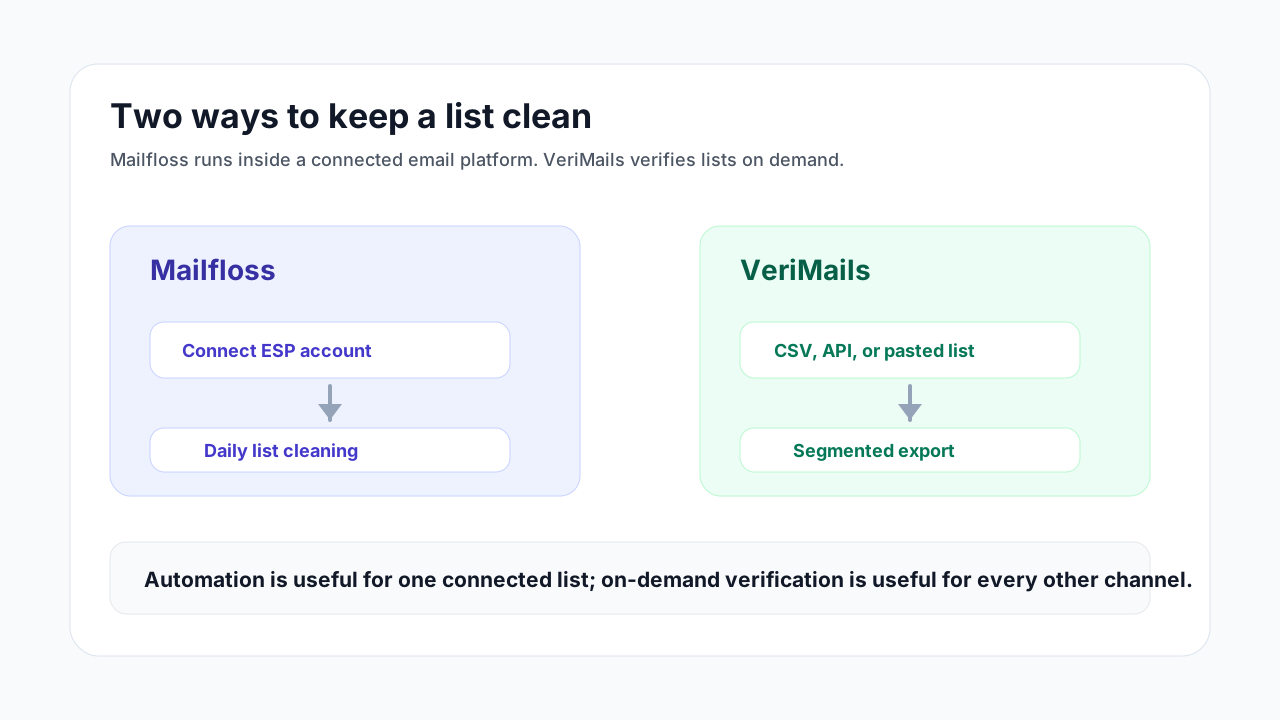
Automation model
Mailfloss is best for ongoing hygiene in one marketing account. VeriMails is better when lists arrive from multiple channels and need verification before each send.
Verification Accuracy
Both products run a similar core verification chain. Mailfloss performs syntax validation, SMTP validation, disposable address detection, role-based detection, spam-trap screening, and accept-all detection, then removes hard bounces and applies automatic typo correction. That last feature is genuinely useful, because a misspelled domain that would otherwise bounce can be corrected and saved rather than discarded.
VeriMails runs syntax, MX, and DNS checks, then completes a live SMTP handshake against the receiving mail server for every address. It also flags disposable domains and role-based addresses, detects catch-all domains, and returns clear deliverability categories for actioning the list.
The practical distinction is not which engine is more accurate on a single address, since both are solid. It is when the check happens. Mailfloss verifies on a daily schedule inside your connected list. VeriMails verifies the moment you ask, returning a result in real time, which matters if you need to check an address at the point of signup or inside a sales workflow.
Catch-all Handling
Catch-all domains, sometimes called accept-all domains, are configured to accept mail to any address rather than rejecting unknown mailboxes. They are common on corporate domains and make verification harder, because the receiving server will not tell you whether a specific mailbox exists.
Mailfloss recognizes accept-all domains and surfaces them as part of its cleanup, in line with its goal of removing risky addresses from a marketing list automatically. VeriMails performs dedicated catch-all detection, clearly identifying and flagging addresses that sit on catch-all domains so you can decide how to treat them. For a cold outreach list heavy with B2B corporate domains, having those addresses explicitly labeled lets you segment them, send to them carefully, or hold them for a second pass rather than guessing.
Neither approach makes a catch-all mailbox provably deliverable, because no verification service can. The value is in clear labeling, and VeriMails makes catch-all status an explicit field in every result.
API and Developer Experience
Mailfloss provides real-time API access and webhook support, but the design intent is clear from the product itself: the API is mainly there so that new contacts entering a connected list can be checked as they arrive. The center of gravity is the daily ESP sync, not a general-purpose verification API.
VeriMails is API-first. There is a documented REST API with both a single-verification endpoint and a bulk endpoint, JSON responses, webhook and batch support for asynchronous jobs, and fast response times. the API and dashboard use the same verification result model. That makes VeriMails a better fit if you are validating addresses at signup inside your own product, enriching records in a CRM, or building verification into a data pipeline.
VeriMails also ships an Email Finder for teams that need discovery alongside verification. Mailfloss does not offer email discovery, since its job is to clean addresses you already have.
Pricing and Value
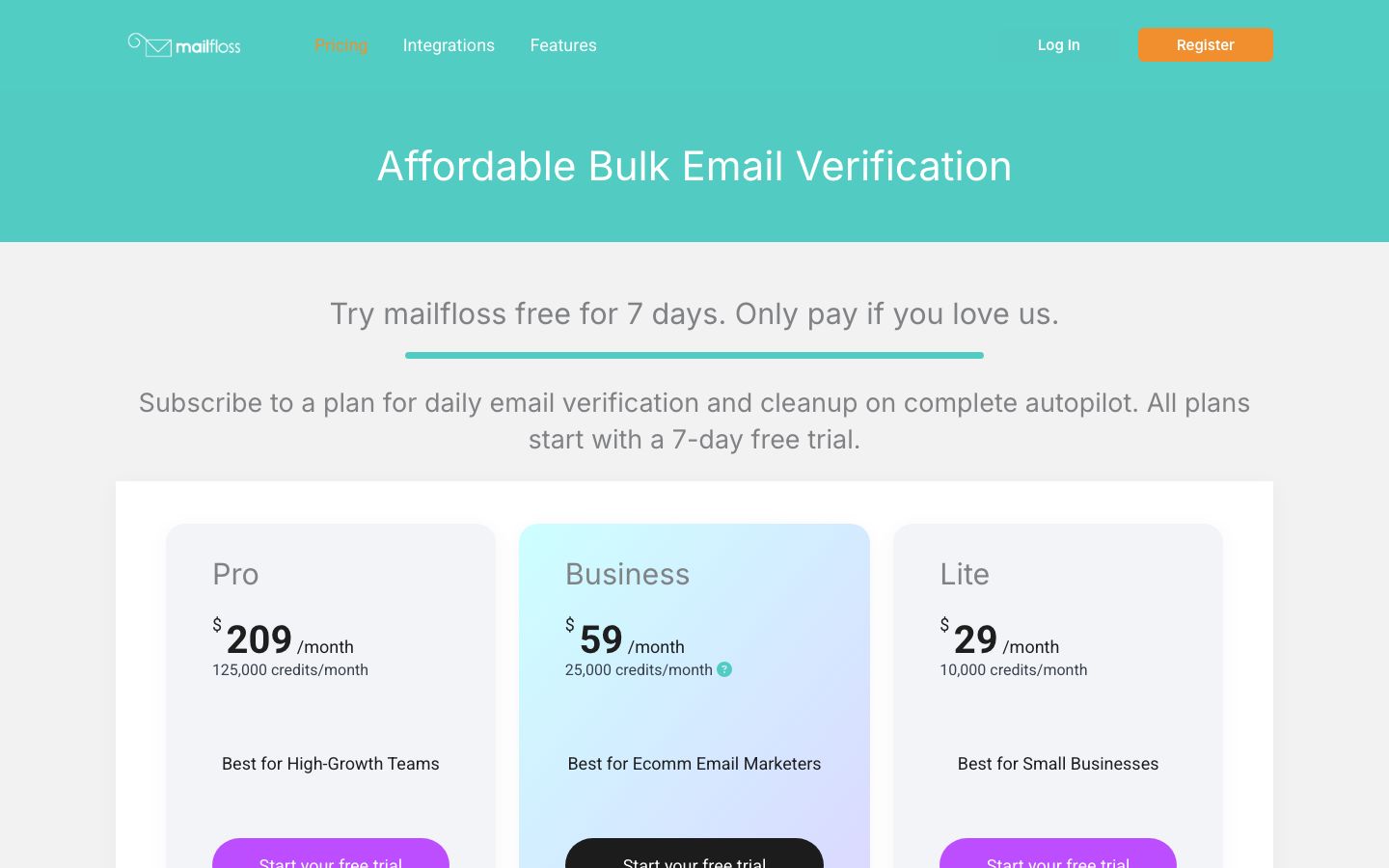
Mailfloss uses monthly subscriptions. The Lite plan is $29 per month for 10,000 monthly verifications and a single ESP integration. The Business plan is $59 per month for 25,000 verifications and up to ten integrations. The Pro plan is $209 per month for 125,000 verifications with unlimited integrations. Annual billing includes two months free, and overage rates fall from $0.005 per email on Lite to $0.001 per email on Pro. Mailfloss also offers a separate prepaid credit option for one-off bulk verification, and those prepaid credits do not expire.
VeriMails uses a credit model with no subscription required. You buy credits, they never expire, and you spend them whenever you verify. Pricing starts at $19 for 10,000 credits and drops sharply at higher volumes.
VeriMails Credit Pricing
| Credits | VeriMails Price | Price per Email |
|---|---|---|
| 10,000 | $19 | $0.0019 |
| 25,000 | $39 | $0.00156 |
| 50,000 | $59 | $0.00118 |
| 100,000 | $99 | $0.00099 |
| 250,000 | $199 | $0.000796 |
| 500,000 | $349 | $0.000698 |
| 1,000,000 | $499 | $0.000499 |
| 2,500,000 | $999 | $0.0004 |
| 5,000,000 | $1,499 | $0.0003 |
Email Finder costs 20 credits only when VeriMails returns a verified person-level email. At the 10,000-credit pack, that is $0.038 per found email. Monthly plans start at $12.50/mo when billed yearly.
Credits never expire. No subscriptions, no monthly fees. 100 free credits on signup. VeriMails also offers monthly annual plans starting at $12.50/month when billed yearly if you prefer a recurring allowance.
Cost Comparison
| Volume | VeriMails | Mailfloss |
|---|---|---|
| 10,000 emails | $19 one-time, credits never expire | $29/mo (Lite plan) |
| 100,000 emails | $99 one-time, credits never expire | $209/mo (Pro plan, 125K allowance) |
The comparison is not perfectly like-for-like, because Mailfloss bundles ongoing automated cleaning into a recurring price while VeriMails sells verification capacity outright. If you verify roughly the same volume every month and want automation, the Mailfloss subscription has real value. If your volume is irregular, or you would rather not pay every month for a list you only clean occasionally, VeriMails credits are usually cheaper and far more flexible.
Who VeriMails Is Best For
Teams that verify across multiple sources, not just one connected newsletter list. Developers who need a full REST API with single and bulk endpoints for signup validation or pipeline enrichment. Sales and outreach teams that want explicit catch-all detection on B2B lists. Anyone who prefers paying per verification with credits that never expire over a recurring monthly subscription.
Who Mailfloss Is Best For
Marketers who run one primary list inside an ESP such as Mailchimp, Klaviyo, or ActiveCampaign and want it cleaned automatically every day. Teams that value set-and-forget automation and decay protection over manual control. Users who benefit from automatic typo correction to recover misspelled signups. Businesses with steady, predictable monthly volume that maps cleanly onto a subscription tier.
Frequently Asked Questions
Why teams switch to VeriMails
“Email is our top revenue channel. We can't afford bounces killing our domain reputation. VeriMails is insurance — $59 a quarter to protect six figures in email revenue.”
— Sophie T. — Head of Retention at DTC Supplements Brand, United Kingdom
“We're pre-revenue and every dollar matters. VeriMails is the only verifier where I don't feel like I'm overpaying. Credits don't expire so I buy when I need them.”
— Tom F. — Co-Founder at HR Tech Startup, United Kingdom
Related Comparisons
Try VeriMails Free
100 free credits on signup. No credit card required. See why teams switch to VeriMails.
Start Free