Email Verification for E-commerce
In e-commerce the email address collected at checkout is not a marketing field, it is the channel for every order confirmation, shipping update, and cart reminder. When that address is wrong, the customer hears nothing and the support tickets start. Verification keeps the address right at the moment it is captured.
For online stores, email verification belongs at checkout, account creation, newsletter signup, and before major campaign sends. Use the API to catch typos while the shopper can fix them, and use bulk verification to clean customer lists before promotions and win-back flows.
The Checkout Email Is Critical Infrastructure
It is easy to treat the email field at checkout as a minor detail next to the payment and shipping fields. It is not. That single address is how the customer receives their order confirmation, their receipt, their shipping notification and tracking link, any delivery problem alert, and the return or refund correspondence that follows. If the address is wrong, every one of those messages fails silently.
The failure modes are ordinary and common. A customer mistypes the address while rushing through checkout on a phone. They write gmial.com or yaho.com or drop a character from their own name. They use an old address they no longer check. The store accepts the order, charges the card, and ships the goods, but the customer never gets a confirmation. From their side it looks as though the order vanished, and the first thing they do is open a support ticket asking where their order is. The store pays for that mistake in support time and in customer trust, all because of a typo no one caught.
Verifying the email as it is entered closes this gap. A real-time check at checkout confirms the address is correctly formatted, sits on a domain that can receive mail, and has a live mailbox behind it. When the customer fat-fingers their address, the form can flag it on the spot and ask them to correct it, while they are still on the page and able to fix it, instead of the error surfacing days later as a missing-order complaint.
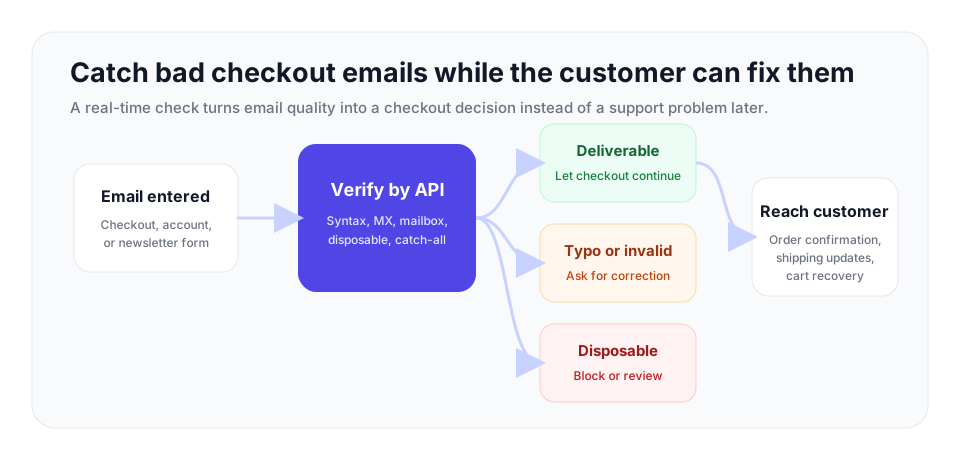
| Verification result | Checkout experience | Back-office action |
|---|---|---|
| Deliverable | Let the shopper continue without adding friction. | Store the address for receipts, shipping updates, and marketing consent workflows. |
| Invalid or typo-like | Show an inline correction prompt before payment is submitted. | Do not create a customer record until a corrected address is provided. |
| Disposable | Block, warn, or route the order for review depending on fraud risk. | Flag promotion abuse, account farming, and card-testing patterns. |
| Catch-all | Allow low-risk orders, but avoid treating the address as fully confirmed. | Monitor bounce behavior and re-check before high-volume promotional sends. |
Fake Addresses and Checkout Fraud
Online stores also attract a steady stream of email addresses that were never meant to be real. Some come from customers who simply do not want marketing email. Many more come from automated abuse. Bots flood checkout and account-creation forms with fake entries, and stores under bot attack can see large numbers of fake abandoned checkouts appear in a short window. Fraudsters lean on disposable and invalid addresses to create throwaway accounts, abuse first-order discounts and signup promotions, and run card-testing attacks where stolen card numbers are probed against a checkout.
Email verification is a useful layer in defending against this. Disposable detection identifies addresses from temporary-mail services, the kind that exist for minutes and are a hallmark of promotion abuse and fake-account creation. Combined with a live deliverability check, verification gives you a fast, automated read on whether the address attached to an order is a real, reachable mailbox or a throwaway. Suspicious addresses can be blocked outright at checkout or flagged for manual review before the order is fulfilled.
Verification is not a complete fraud system on its own, and it should sit alongside payment-level fraud checks rather than replace them. But it is cheap, it runs in real time, and it filters out a category of bad orders, those tied to disposable and obviously invalid addresses, before they consume fulfillment resources or turn into chargebacks.
Verification and Abandoned Cart Recovery
Cart abandonment is one of the largest leaks in e-commerce. Industry estimates have put the global cart abandonment rate around 70%, which means most of the carts your customers build are never completed. Abandoned-cart email flows are the standard tool for winning some of that back, and for many stores they recover a meaningful slice of otherwise lost revenue.
But a recovery email can only recover a cart if it reaches the customer. Many checkout flows capture the email address before the customer abandons, on an early step or as soon as it is typed. If that captured address is mistyped or invalid, the recovery sequence has nowhere to land. The email bounces, the customer never sees the reminder, and a cart that was genuinely recoverable is lost for good, not because the customer was uninterested but because of a data error.
Verifying the address in real time as it is entered fixes this at the source. A valid, confirmed address means your recovery flow can do its job. And when the customer makes a typo, catching it immediately, ideally with a prompt to correct it, means you keep a working address for both the recovery email and every order message that follows once they do complete the purchase.
Protecting Sender Reputation and Marketing
E-commerce brands are heavy email senders. Beyond transactional messages, there are promotions, product launches, win-back campaigns, and post-purchase flows. All of that depends on a healthy sending reputation, and a healthy sending reputation depends on not mailing bad addresses.
Every invalid address that enters your customer list through an unverified checkout becomes a future hard bounce when you send your next promotion. Mailbox providers such as Gmail, Outlook, and Yahoo watch hard bounce rates closely and read a high rate as a sign of poor list quality, responding by pushing more of your mail to spam, including mail to your best, most loyal customers. A practical bounce-rate benchmark is to keep total bounces under 3%, investigate anything between 3% and 5%, and treat anything above 5% as high risk. Customer email addresses also decay over time as people change providers, so a list that was clean a year ago is not clean now.
Verification protects this on two fronts. Real-time verification at checkout and signup stops most invalid addresses from ever entering the list. Periodic bulk verification of the existing customer list removes addresses that have gone stale since they were collected. Together they keep bounce rates low, keep your sender reputation healthy, and keep your marketing email landing in the inbox where it can drive revenue.
How to Verify with VeriMails
VeriMails fits an e-commerce stack in two complementary ways. The REST API verifies an address in real time, so you can call it as the customer enters their email at checkout, account creation, or newsletter signup. Each call returns a clear result, fast enough to run inside the checkout flow without slowing it down, and the response tells you whether the address is deliverable, undeliverable, or disposable so your form can accept it, prompt for a correction, or block it. Bulk verification handles your existing customer database: export it as a CSV, upload it, and VeriMails returns a results file marking every address so you can suppress the dead ones before your next campaign.
Every address, whether checked through the API or in bulk, runs the full set of checks: syntax validation, MX and DNS checks, a live SMTP handshake to test the mailbox, catch-all detection, disposable detection, and role-based detection. Results return clear verification statuses, and catch-all domains are reported honestly as catch-all rather than disguised as a confirmed result.
Pricing makes it easy to start. Verification costs from $0.0019 per email, with 10,000 credits for $19 and volume up to 5 million credits for $1,499, plus annual plans from $12.50/month when billed yearly for stores with steady volume. Real-time and bulk checks both draw from the same credit balance. Every new account includes 100 free credits on signup, with no credit card required, and those credits never expire, so you can test verification on your own checkout before committing.
- Verify before payment confirmation emails, not only before newsletters.
- Clean dormant customer lists before Black Friday, holiday, and win-back campaigns.
- Keep invalid checkout attempts out of abandoned-cart automations so recovery reporting stays honest.
- Use disposable results as one risk signal alongside payment fraud checks and order velocity rules.
Frequently Asked Questions
Related Articles
Start with Clean Data
100 free credits on signup. No credit card required. Put the advice into practice today.
Start Free