VeriMails vs lemlist
lemlist is a multichannel outreach platform that combines email sequencing, LinkedIn automation, cold calling, warmup, and a large B2B lead database with waterfall enrichment. Email verification is folded into that enrichment process. Here is how lemlist's built-in verification stacks up against a dedicated verification layer, and why teams clean their lists with VeriMails before importing them into lemlist.
Updated May 24, 2026
At a Glance
| Feature | VeriMails | lemlist |
|---|---|---|
| Primary purpose | Dedicated email verification | Multichannel outreach and lead database |
| Price | From $0.0019 per email, credits never expire | From around $32 to $55 per seat per month |
| Free tier | 100 credits on signup, no card, never expire | Free trial, monthly credit allowance with plans |
| Catch-all handling | Explicit catch-all detection and flagging | Notes catch-all cannot be confirmed, treat separately |
| Dedicated verification depth | Fresh deliverability, catch-all, disposable, role-based signals | Verification at enrichment time across providers |
| Bulk verification | CSV upload, ~10K rows under 5 minutes, filtered export | Limited by the monthly credit allowance |
| Speed | Fast API response | Runs during the enrichment step |
VeriMails and lemlist do different jobs. The table compares the verification side, not lemlist's sequencing, LinkedIn, or calling features.
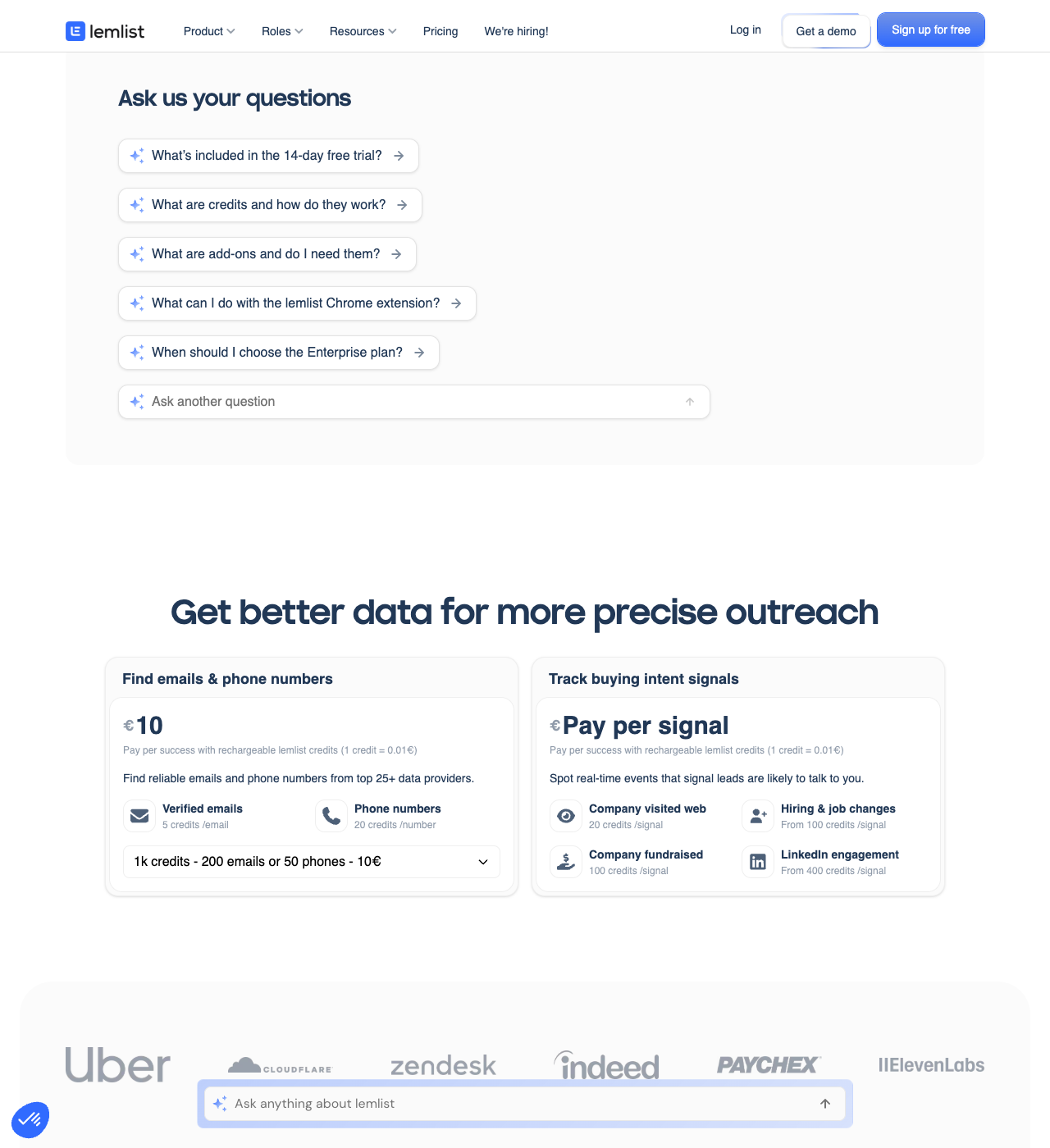
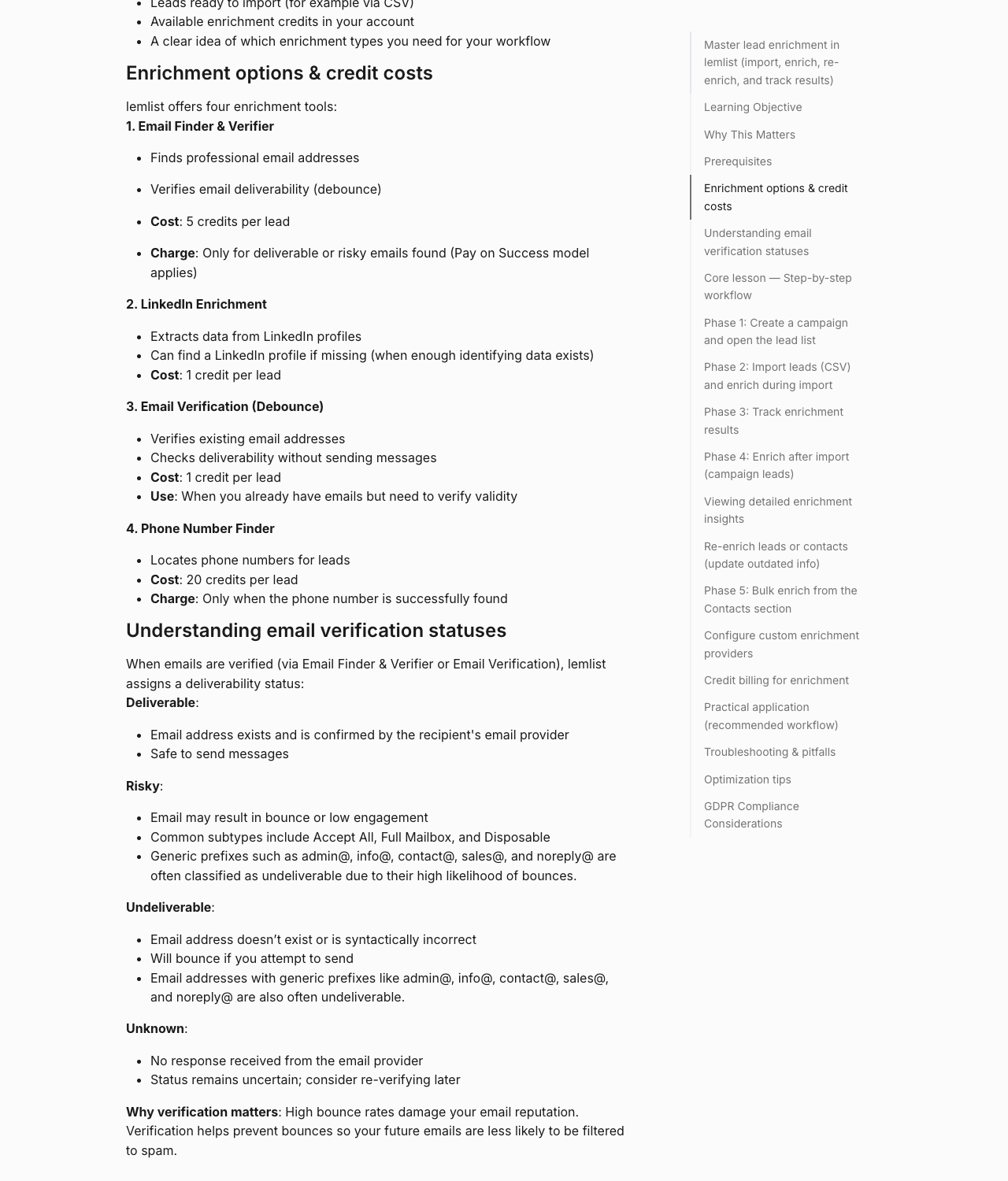
lemlist Pricing and Verification Screens
lemlist combines prospecting, enrichment, verification, and sending. These screens show why verification credits should be treated separately from campaign credits when buyers forecast their real cost per usable email.
Verification Depth
lemlist's verification works differently from most cold email tools, and it is worth understanding the model. Rather than a simple list-cleaning step, lemlist verifies addresses as part of its waterfall enrichment. When lemlist finds a contact, it queries a sequence of premium data providers until one returns a verified email, and the company reports a find rate of around 80 percent with waterfall enrichment turned on. For confirming a newly discovered contact at the moment it is sourced, this is a strong approach.
The limitations are about scope, timing, and budget. First, lemlist's verification confirms an address looked valid when its providers last checked it, at enrichment time, not at the moment you send. Second, if you import a list lemlist did not source itself, that enrichment-time verification does not re-check those addresses. Third, the monthly credit allowance on lemlist plans is modest relative to campaign volume, so verifying a large imported list through lemlist would exhaust those credits quickly. That makes the built-in workflow a poor fit for full campaign-scale verification on its own.
VeriMails is built only for verification, and it verifies the whole list whenever you ask, not only at the moment a contact is found. Every address receives a fresh deliverability check with catch-all, disposable, and role-based signals. VeriMails is built for high-volume list verification and clear deliverability decisions. It does not send email or run sequences. Its single job is to confirm that the list you load into lemlist will actually deliver.
Catch-all Handling
Catch-all domains accept mail for any address, so the receiving server returns a positive response to every SMTP probe whether or not the mailbox exists. In the lemlist workflow, catch-all domains sit in the risky segment because verification cannot confirm or deny the specific mailbox. Those contacts need to be flagged and treated separately from verified ones.
VeriMails turns that honesty into a concrete, repeatable step through catch-all detection. It identifies which domains on your list are configured as catch-all and labels them clearly in the results file. It does not pretend a catch-all mailbox can be confirmed. You get an explicit label on every catch-all domain, so you can keep your confirmed contacts in one segment and route the catch-all contacts into a separate, slower, lower-volume segment exactly as lemlist recommends. For B2B lists, where a large share of company domains are catch-all, that explicit, file-level separation is what lets you act on lemlist's own advice before the list ever reaches a campaign.
Using VeriMails With lemlist
VeriMails and lemlist are complementary, and they work best in a fixed order: verify the raw list with VeriMails first, then import the cleaned file into lemlist.
In practice the workflow runs like this. You gather a list, whether from lemlist's own database export, another scraper, a data vendor, or your CRM. Before that list reaches a campaign, you upload the CSV to VeriMails. VeriMails processes the CSV and returns deliverability and risk labels for each address. You download the filtered results, keep the confirmed deliverable addresses, set the catch-all addresses aside as their own segment, and discard the invalid, disposable, and role-based addresses. Then you import the clean file into lemlist and build your multichannel sequence.
This matters most for lists lemlist did not source itself, because lemlist's enrichment-time verification does not re-check imported addresses, and verifying them at campaign scale would burn through lemlist's limited monthly credit allowance. Verifying with VeriMails first is far cheaper per address and covers the entire imported list. It also gives you a clean catch-all segment so you can follow lemlist's own guidance to treat those contacts separately. Your bounce rate stays low from the first send and your sending domains stay healthy. Teams with engineering resources can automate the step with the VeriMails REST API, which provides single and bulk endpoints, JSON responses, webhook and batch support, and fast response times.
Pricing and Value
lemlist and VeriMails are priced for different jobs, so a head-to-head price is not the right comparison. lemlist is a per-seat monthly subscription for the full multichannel outreach stack. Public email plans start in the range of $32 to $55 per seat per month and rise through Multichannel Expert and higher tiers, with a price update applied in early 2026. Verification is metered through lemlist's credit system, and each plan includes a monthly credit allowance with extra credits available for purchase. That model fits enrichment-driven workflows well, but verifying full imported lists at scale would consume credits quickly.
VeriMails sells verification credits outright. You buy a credit pack, use it whenever you want, and the credits never expire, so there is no lost balance and no monthly commitment for one-time credit packs. For verifying entire imported lists, a flat per-credit rate is far cheaper than spending lemlist credits, and it scales predictably. VeriMails also offers annual plans from $12.50/month when billed yearly if predictable billing suits you better.
VeriMails Credit Pricing
| Credits | VeriMails Price | Price per Email |
|---|---|---|
| 10,000 | $19 | $0.0019 |
| 25,000 | $39 | $0.00156 |
| 50,000 | $59 | $0.00118 |
| 100,000 | $99 | $0.00099 |
| 250,000 | $199 | $0.000796 |
| 500,000 | $349 | $0.000698 |
| 1,000,000 | $499 | $0.000499 |
| 2,500,000 | $999 | $0.0004 |
| 5,000,000 | $1,499 | $0.0003 |
Email Finder costs 20 credits only when VeriMails returns a verified person-level email. At the 10,000-credit pack, that is $0.038 per found email. Monthly plans start at $12.50/mo when billed yearly.
Credits never expire. Credit packs do not require a subscription or monthly fee. New accounts receive 100 free credits on signup.
Who Should Verify Separately
Run VeriMails before lemlist if you import lists lemlist did not source, since lemlist's enrichment-time verification does not re-check imported addresses. Verify separately if your campaign volume runs well past lemlist's monthly credit allowance, where verifying at scale would exhaust those credits. Verify separately if your lists are scraped, purchased, or older than a few weeks, since those carry the most stale addresses. Verify separately if your audience is B2B and full of catch-all company domains that you want explicitly labeled in a file. And verify separately if you want a clear audit trail of why each address passed or failed, or if you need to feed verification into a CRM or pipeline through a dedicated API.
Who lemlist's Built-in Check Is Enough For
lemlist's built-in verification is well suited to a particular workflow, and for some teams it covers the job. If you source contacts mainly through lemlist's own database and waterfall enrichment, addresses are found and confirmed in the same step, and the bundled credit allowance is built around that volume. If you run modest campaigns and stay inside your monthly credits, there is no need for an extra tool. The case for a dedicated verifier grows as soon as you import outside lists, scale campaign volume beyond the credit allowance, or want every imported address checked again right before you send.
Verification Accuracy
lemlist sits close to the sending workflow, so its verification value is tied to campaign prep. VeriMails stays independent of the sending tool. You can check the same list before it reaches any sequencer, CRM, or mail-merge workflow.
For accuracy, separate confirmed valid addresses from invalid, disposable, role-based, and catch-all rows before upload. That keeps your sending tool focused on campaign execution instead of cleaning the list after bounces appear.
API and Developer Experience
lemlist is useful when the API or integration work belongs inside an outreach stack. VeriMails is useful when verification should happen before data enters that stack.
Check new records through the API, store the status, and pass only the confirmed valid rows into your sequence. Bulk jobs handle older campaign lists before a rep or marketer starts sending.
Who VeriMails Is Best For
Choose VeriMails when verification is the job and you want the result before the send.
- You want to clean contacts before they enter a sequence or mail-merge campaign.
- You want prepaid verification credits that never expire.
- You need API and CSV verification without paying for a larger sales platform.
Frequently Asked Questions
Why teams switch to VeriMails
“The agency plan at 1.5M credits covers all our clients with room to spare. Try doing that on ZeroBounce without spending $3K.”
— Rob F. — Head of Operations at Performance Agency, Ireland
“Before VeriMails we were guessing on catch-all domains. Now we filter them out before they hit the sequence. Reply rates went up 20% just from cleaner lists.”
— Priya S. — Revenue Operations at Growth-Stage SaaS Company, United Kingdom
Related Comparisons
Try VeriMails Free
100 free credits on signup. No credit card required. See why teams switch to VeriMails.
Start Free