VeriMails vs BulkEmailVerifier
BulkEmailVerifier is a long-standing bulk email verification brand with self-serve credit packs, subscriptions, API access, email finder queries, inbox placement, and blacklist monitoring. VeriMails is a focused email verification service built around bulk CSV cleanup, API checks, catch-all segmentation, and credits that never expire. This comparison focuses on pricing, list-cleaning workflow, API fit, and which buyer each product serves best.
At a Glance
| Feature | VeriMails | BulkEmailVerifier |
|---|---|---|
| 10,000-email cost | $19 | No exact 10,000 pack; 5,000 credits are $24 and 25,000 are $89 |
| 100,000-email cost | $99 | $279 credit pack |
| 1,000,000-email cost | $499 | $849 credit pack |
| Free entry point | 100 signup credits | 100 free credits for new users |
| API | Single and bulk REST endpoints | API access included in listed packs and subscriptions |
| Best buyer | Teams that want low-cost email-only verification | Teams that want verification bundled with finder queries, inbox placement, and blacklist monitoring |
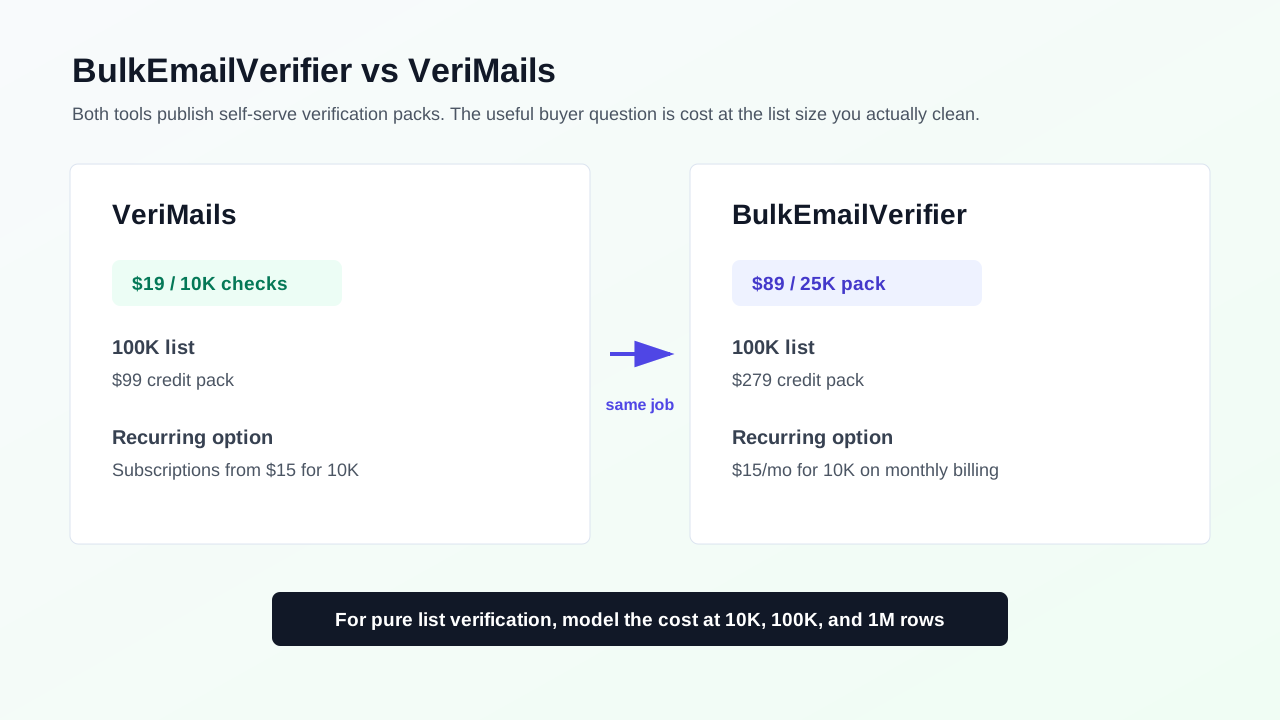
The important 2026 pricing fact is that BulkEmailVerifier now shows both one-time credit packs and monthly subscriptions on its pricing page. That makes the comparison direct: BulkEmailVerifier bundles adjacent deliverability tools, while VeriMails keeps the offer narrow and lower-cost for email verification itself.
Choose by scope
If the job is only to clean an email list, compare verification credit packs and bulk verification. If you also need inbox placement and blacklist monitoring in the same subscription, include those extras in the budget.
Verification Accuracy
BulkEmailVerifier positions the product around reducing bounces, identifying invalid addresses, and processing large email lists quickly. Its pricing page also bundles verification with email finder queries, inbox placement, blacklist monitoring, and API access, which makes it more of an email hygiene bundle than a narrowly scoped verifier.
VeriMails focuses on the verification result itself: syntax checks, MX and DNS checks, live SMTP validation, disposable detection, role-based detection, and catch-all detection. The practical buyer test is to run the same sample list through both tools and compare valid, invalid, catch-all, disposable, role-based, and unknown outcomes against later send results.
If your team wants adjacent deliverability tooling in the same subscription, BulkEmailVerifier is worth evaluating. If the task is simply to clean a large list at the lowest clear verification cost, VeriMails is easier to model.
Catch-all Handling
Catch-all domains accept mail to any address rather than rejecting unknown mailboxes, so the receiving server will not confirm whether a specific mailbox exists. They are common on B2B corporate domains and are the hardest case in verification.
BulkEmailVerifier's pricing page does not spell out catch-all export fields or status naming. Buyers should confirm how catch-all rows are labeled in the dashboard export and API response before using results in production. VeriMails performs dedicated catch-all detection and exposes catch-all status as an explicit field in every result, so you can clearly see which addresses sit on catch-all domains and decide how to treat them.
No verifier can prove a catch-all mailbox is deliverable, since the protocol does not allow it. The value is in clear, consistent labeling, and VeriMails makes catch-all status a first-class field in the result returned by both the dashboard and the API.
API and Developer Experience
BulkEmailVerifier says API access is included in all one-time packs and also lists API access on its subscription tiers. That is useful for buyers who want API access without moving into an enterprise plan. Before integrating, confirm rate limits, response fields, webhook support, and bulk-job behavior against the current API account.
VeriMails is API-first. There is a documented REST API with both a single-verification endpoint and a dedicated bulk endpoint, JSON responses, webhook and batch support for asynchronous jobs, and real-time-friendly single-verification responses. The API and dashboard use the same verification result model, which makes real-time signup validation and CRM or pipeline enrichment straightforward.
VeriMails bulk CSV upload auto-maps the email column and supports asynchronous processing for large CSV jobs, returning downloadable filtered results. The same result model is available through the dashboard and API, which keeps integration and operations aligned.
Pricing and Value
BulkEmailVerifier publishes one-time verification packs: 5,000 credits for $24, 25,000 for $89, 100,000 for $279, 500,000 for $699, and 1,000,000 for $849. Its pricing page says API access is included in all packs and that credits do not expire. It also lists monthly annual plans from $12.50/month when billed yearly for 10,000 verifications and annual billing from $19 per month for the same verification allowance.
VeriMails uses a direct verification credit model. Credits stay available until used, and the price table is visible before you start a verification workflow.
VeriMails Credit Pricing
| Credits | VeriMails Price | Price per Email |
|---|---|---|
| 10,000 | $19 | $0.0019 |
| 25,000 | $39 | $0.00156 |
| 50,000 | $59 | $0.00118 |
| 100,000 | $99 | $0.00099 |
| 250,000 | $199 | $0.000796 |
| 500,000 | $349 | $0.000698 |
| 1,000,000 | $499 | $0.000499 |
| 2,500,000 | $999 | $0.0004 |
| 5,000,000 | $1,499 | $0.0003 |
Email Finder costs 20 credits only when VeriMails returns a verified person-level email. At the 10,000-credit pack, that is $0.038 per found email. Monthly plans start at $12.50/mo when billed yearly.
Credits stay available until used. 100 free credits on signup. Monthly plans start at $12.50/mo when billed yearly if you prefer a recurring allowance.
Current Pricing Comparison
| Question | VeriMails | BulkEmailVerifier |
|---|---|---|
| 10,000 checks | $19 | Monthly subscription starts at $15/mo; nearest one-time packs are 5,000 for $24 and 25,000 for $89 |
| 100,000 checks | $99 | $279 one-time pack |
| 1,000,000 checks | $499 | $849 one-time pack |
| Bundled extras | Email verification, API, catch-all detection, bulk workflow | Email finder queries, inbox placement, blacklist monitors, API access |
BulkEmailVerifier becomes closer at very high volume, but VeriMails remains lower at 100,000 checks and simpler when the only job is verification.
Who VeriMails Is Best For
Teams that want low-cost, email-only verification with predictable credit packs, API checks, bulk CSV processing, clear catch-all segmentation, and no need to pay for adjacent deliverability tools.
Who BulkEmailVerifier Is Best For
Teams that want a subscription bundle combining email verification, email finder queries, inbox placement checks, blacklist monitoring, and API access under one account.
Run the first cleanup on your real list
If you are comparing BulkEmailVerifier with VeriMails, test both tools on the same file instead of relying on a sample screenshot. Use a list with recent leads, older CRM rows, role addresses, and a few known bad addresses. The useful result is not a single accuracy claim. It is the number of records each tool marks valid, invalid, catch-all, disposable, or risky, and whether those labels match the way your sending team makes decisions.
VeriMails is built for that operating workflow. Upload the CSV, download the labeled result, and move the approved segment into your sending tool. If your process also needs real-time checks, add the API later without changing the status model your team already uses.
Frequently Asked Questions
Why teams switch to VeriMails
“We verify 400K emails a month before loading sequences. Bounce rate went from 5.2% to 0.6%. At $99 for 100K credits that pays for itself on the first campaign.”
— Mike T. — Head of Growth at Series A SaaS Platform, United States
“We verify over a million emails a month. At the 1M credit tier it costs us $499. Our old provider charged $2,700 for the same volume.”
— James P. — CTO at Recruitment Tech Startup, Australia
Related Comparisons
Try VeriMails Free
100 free credits on signup. No credit card required. See why teams switch to VeriMails.
Start Free