VeriMails vs Reoon
Reoon Email Verifier is a budget-focused verification tool with a free monthly allowance, one-time instant credits, daily credit subscriptions, quick API mode, power mode, and a bulk API that accepts large batches. VeriMails is a dedicated verifier built around the same list-cleaning job with transparent volume pricing and no daily caps on one-time cleanup work. This comparison weighs the two on accuracy, catch-all handling, API, and cost.
Updated May 24, 2026
At a Glance
Reoon and VeriMails are direct competitors. Both validate email lists you already own, both run a full verification stack with an SMTP handshake, and both offer an API and bulk CSV upload. They also both compete on price, so the meaningful differences are in how credits are metered, how each tool surfaces catch-all results, and how predictable the cost is at scale. The table below sets out the headline points.
| Feature | VeriMails | Reoon |
|---|---|---|
| Price per email | From $0.0019, down to $0.00099 | One-time credits from about $0.0012, lower at very high volume |
| Free tier | 100 credits on signup, no card, never expire | Up to 600 verifications per month, no card required |
| Catch-all handling | Dedicated catch-all detection that clearly flags catch-all domains | Flags catch-all servers as risky; some users report unclear catch-all statuses |
| API | REST API on every plan, single and bulk endpoints | REST API with bulk endpoint up to 50,000 emails per request |
| Bulk verification | CSV upload, auto column mapping, 10K rows under 5 minutes | CSV and TXT upload with auto column detection |
| Speed | Fast API response | Quick Mode under 0.5 seconds; Power Mode runs deeper SMTP analysis |
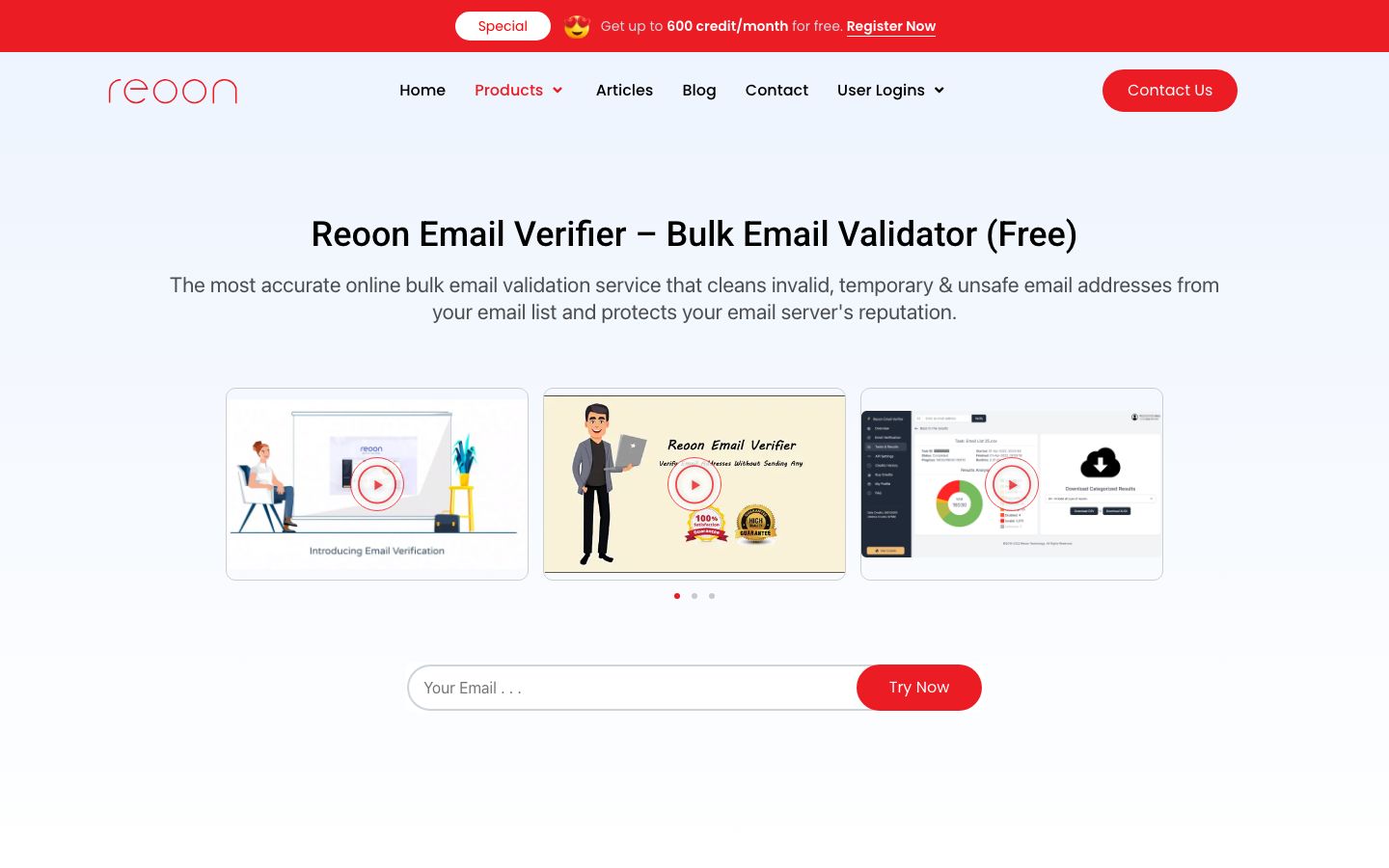
Reoon Product Snapshot
Verification Accuracy
Reoon has a serious verification feature set. Its quick mode is built for sub-half-second checks and covers syntax, disposable or temporary email detection, MX validation, domain acceptance, expired domains, and role accounts. Its power mode runs deeper checks, including whether the individual address exists, whether the inbox is full or disabled, and whether the domain is catch-all.
VeriMails also runs syntax validation, MX and DNS checks, live SMTP validation, disposable detection, role-based detection, and catch-all detection. The practical distinction is workflow design: Reoon gives developers a quick mode and a deeper power mode to choose between, while VeriMails keeps the buyer-facing result model focused on list segmentation and bulk cleanup without daily throttling for one-time credit packs.
Catch-all Handling
Both tools detect catch-all domains, which is the correct baseline. Reoon flags catch-all servers and marks them as risky, and that flagging is genuinely useful. However, multiple user reviews note that Reoon's catch-all statuses can be unclear, with the interface not always explaining why a result is uncertain. That ambiguity is partly an industry-wide limitation, since a catch-all server accepts mail to every address and no verifier can fully resolve it, but clear labeling still matters.
VeriMails performs dedicated catch-all detection and puts clarity first. It identifies catch-all domains and clearly flags every result that sits on one, keeping confirmed deliverable addresses cleanly separate from results that carry that built-in uncertainty. Neither tool can magically confirm a mailbox on a catch-all domain. The practical difference is presentation: VeriMails aims to make the catch-all flag unambiguous so you always know which slice of your list needs a more cautious sending approach.
API and Developer Experience
Reoon has a capable developer offering. It provides a REST API with real-time verification and a bulk endpoint that accepts up to 50,000 emails per request, returns 15 or more data points in its JSON response, and includes a Quick Mode with sub-half-second responses for latency-sensitive use. For a developer who wants to verify in code, Reoon is a reasonable, well-documented choice.
VeriMails ships its REST API on every plan, including the free tier, with no upgrade required for a key. It provides a single-email endpoint for real-time checks, such as validating an address at signup, and a bulk endpoint for verifying lists in code. Responses are JSON and typically returns a clear result, with webhook and batch support for large jobs, and VeriMails maintains 55 or more integrations for teams that prefer connectors over code. Both tools serve developers well. Reoon's large 50,000-per-request bulk endpoint is a real strength for big batch jobs; VeriMails counters with no daily credit caps, a broad integration catalog and a free tier you can build against indefinitely.
Pricing and Value
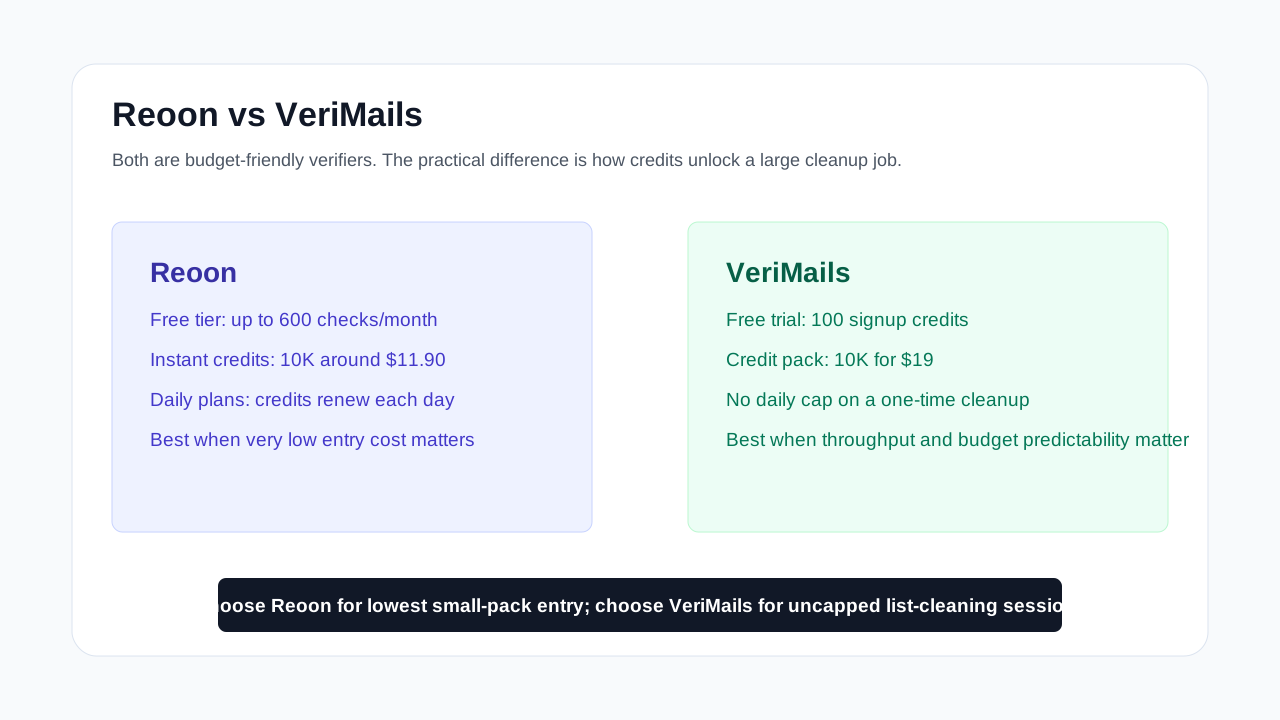
Reoon is built around affordability and offers two main paid models. Instant credits never expire and currently show 10,000 credits at $11.90, 100,000 at $116.40, 500,000 at $522, and 1,000,000 at $960. Reoon also sells daily credit subscriptions starting at $9 per month for 500 credits per day, and its free tier allows up to 600 verifications per month. The main caveat with daily and free allowances is pacing: unused daily credits reset instead of accumulating, which can throttle a large one-off cleaning job.
VeriMails uses transparent volume pricing with no daily caps. One-time credit packs never expire:
| Credits | Price | Per email |
|---|---|---|
| 10,000 | $19 | $0.0019 |
| 25,000 | $39 | $0.00156 |
| 50,000 | $59 | $0.00118 |
| 100,000 | $99 | $0.00099 |
| 250,000 | $199 | $0.000796 |
| 500,000 | $349 | $0.000698 |
| 1,000,000 | $499 | $0.000499 |
| 2,500,000 | $999 | $0.0004 |
| 5,000,000 | $1,499 | $0.0003 |
Email Finder costs 20 credits only when VeriMails returns a verified person-level email. At the 10,000-credit pack, that is $0.038 per found email. Monthly plans start at $12.50/mo when billed yearly.
If you prefer a recurring plan instead of prepaid packs, annual plans start at $12.50/month when billed yearly. Monthly billing is also available inside the dashboard.
The cost comparison is genuinely close and depends on volume. At 10,000 emails, Reoon one-time credits are around 12 dollars against 19 dollars for VeriMails, so Reoon is cheaper at small scale. At 100,000 emails, the two are near level, roughly 117 dollars for Reoon against 99 dollars for VeriMails, with VeriMails slightly ahead. Reoon is honestly one of the better-value budget verifiers available, and its lifetime deal is appealing for occasional users. Where VeriMails wins is predictability and throughput: one-time credits never expire, monthly plans are inexpensive, and no daily cap stands between you and verifying a large list in a single session. For teams cleaning big lists regularly, that freedom from daily throttling is often worth more than a small per-email difference.
Who VeriMails Is Best For
- Teams cleaning large lists in one pass. VeriMails has no daily credit cap, so a 500,000-row list can be verified in a single session rather than spread across days.
- Buyers who want predictable cost at scale. Flat volume pricing means a 100,000-address job costs 99 dollars, with no daily allocation to plan around.
- Users who value a clearly labeled catch-all flag. VeriMails focuses on making catch-all results unambiguous, so you always know which addresses carry extra risk.
- Teams that want a wide integration catalog. With 55 or more integrations, VeriMails slots into existing marketing and sales tooling without custom code.
Who Reoon Is Best For
- Budget-focused users with smaller lists. Reoon's one-time credit pricing is genuinely low at small volume, making it a strong pick when you only verify a few thousand addresses at a time.
- Occasional verifiers drawn to the lifetime deal. Reoon's AppSumo lifetime deal is a real cost saver for anyone who verifies sporadically rather than continuously.
- Developers running very large batch requests. Reoon's bulk API endpoint accepts up to 50,000 emails per request, which is convenient for big programmatic jobs.
- Teams that want a fast Quick Mode option. Reoon's sub-half-second Quick Mode suits latency-sensitive checks where speed is prioritized over the deepest possible analysis.
Frequently Asked Questions
Why teams switch to VeriMails
“Our clients send us lists from 5K to 500K contacts. Bulk upload handles everything, results come back fast, and the pricing is predictable. No surprises on the invoice.”
— Tom R. — Founder at Outbound Agency, Australia
“We tested VeriMails against Reoon and MillionVerifier on the same 100K list. VeriMails caught more invalid addresses and the catch-all detection was noticeably better.”
— Tyler K. — Outbound Operations at Lead Generation Company, Canada
Related Comparisons
Try VeriMails Free
100 free credits on signup. No credit card required. See why teams switch to VeriMails.
Start Free