How VeriMails Measures Email Verification Accuracy
Email verification accuracy is not a single fixed number. It depends on the checks a tool runs, how it handles uncertain mail servers, and how recently a list was verified before sending. This article explains how VeriMails approaches accuracy and why clear result categories matter more than forcing every address into a simple yes-or-no answer.
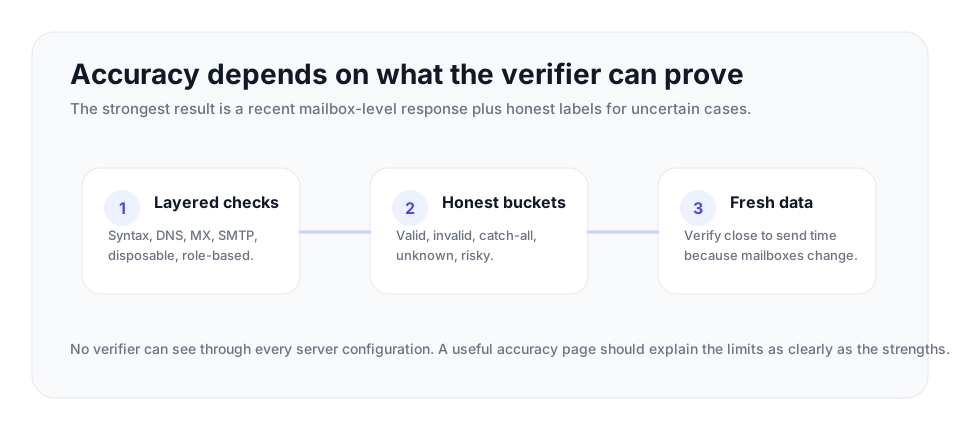
VeriMails builds accuracy from layered checks: syntax, DNS/MX, live SMTP, catch-all detection, disposable detection, and role-based detection. The most useful verifier does not guess on uncertain addresses. It separates valid, invalid, catch-all, unknown, and risky results so you can send from a clean segment and review the edge cases separately.
What accuracy means in email verification
Accuracy is the share of verification results that match real-world delivery behavior. If a verifier marks an address as deliverable and the receiving server accepts mail for that mailbox, that result was accurate. If the verifier marks an address as invalid and it would in fact have accepted mail, that result was wrong. Accuracy is measured by comparing verification verdicts against what actually happens when mail is sent.
In practical terms, the stronger the verification signal, the more useful the result. A recent mailbox-level SMTP response is stronger than a format check. A catch-all label is stronger than pretending an unknown mailbox is confirmed. The sections below explain how each signal contributes to a result you can actually use before sending, and the broader email verification workflow explains where those checks fit.
Why the live SMTP handshake drives accuracy
The single most important reason VeriMails can produce a stronger result than lightweight validation is that it completes a live SMTP handshake on every address. To understand why, it helps to see what weaker verification leaves out.
What syntax and DNS checks tell you
A basic verifier confirms that an address is formatted correctly and that its domain publishes mail exchange records. These checks are useful and fast, and they catch obvious problems such as typos and dead domains. But they cannot tell you whether the specific mailbox exists. A perfectly formatted address at a real domain can still point to a mailbox that was never created or was deleted years ago. A verifier that stops at syntax and DNS will call that address valid, and it will bounce.
What the SMTP handshake adds
VeriMails goes one step further. It opens a connection to the recipient mail server and runs the same protocol conversation that a real sending server would use to deliver a message. The recipient server responds with whether it would accept mail for that exact mailbox. This is the closest you can get to sending a real email without sending one, and it is the only way to confirm an individual mailbox. VeriMails never delivers a message and never places anything in the inbox. It asks the server the question and records the answer.
This is the difference between guessing that an address looks plausible and confirming that the receiving server says it works. It is why a mailbox-level result is more useful than a format-only result.
The full set of checks behind each result
The SMTP handshake is central, but a VeriMails verdict draws on a full sequence of checks. Every address runs through all of them.
Syntax validation confirms the address is correctly formed. MX and DNS lookups confirm the domain exists and can receive mail. The live SMTP handshake confirms the mailbox at the server level. Catch-all detection identifies domains that accept mail for every address. Disposable detection flags temporary throwaway addresses. Role-based detection flags shared addresses such as info@ and support@ that point to a function rather than a person. Each check contributes a piece of the picture, and together they produce a verdict you can act on with confidence.
| Factor | Why it matters | Best practice |
|---|---|---|
| Layer depth | Syntax alone only checks shape; SMTP can test mailbox-level acceptance. | Use layered verification, not format checks alone. |
| Catch-all handling | Accept-all domains can make fake addresses look accepted. | Label catch-all separately rather than forcing valid or invalid. |
| Result categories | Risky, unknown, and role-based addresses need different sending rules. | Segment by status before importing into a campaign tool. |
| Verification timing | Mailboxes can change after a check runs. | Verify close to the campaign or at the point of capture. |
How to act on result categories
Use deliverable results for the clean segment, suppress invalid and disposable addresses, and review catch-all, unknown, or role-based results separately before a campaign. If a list has already been exported from a CRM or campaign tool, run it through bulk verification. If the address is being typed into a form, use the Email Verification API so the decision happens before the address is stored.
Why no verifier can be 100 percent accurate
An honest answer to the accuracy question has to acknowledge that 100 percent is not achievable, by VeriMails or by any competitor. There are two reasons.
Catch-all domains
Some mail servers are set up to accept messages for every possible address on the domain rather than rejecting unknown mailboxes. These are catch-all domains, and they are common on company domains. On a catch-all domain, the SMTP handshake gets a positive response for any address you ask about, real or not, because the server accepts everything. No SMTP handshake can confirm a specific mailbox on a catch-all domain. This is a property of how the receiving server is configured, and it is the same for every verification service.
Mailboxes change
Verification is a snapshot. An address that is valid today can be deactivated tomorrow when an employee leaves, or a mailbox can become full and start rejecting mail. A verdict reflects the moment the check ran. The longer the gap between verification and send, the more the snapshot can drift, which is why verifying close to send time gives the best results.
How VeriMails handles what it cannot confirm
The way a verifier handles uncertain cases is what separates a reliable result from a risky one. VeriMails does not guess. On a catch-all domain, VeriMails performs catch-all detection: it identifies the domain as catch-all and labels the result as a catch-all finding. That label tells you the address sits on a domain that accepts everything, so the verdict is a domain configuration finding rather than a confirmed mailbox. Catch-all is a detection, not a score.
This matters because a verifier could quietly mark every catch-all address as valid to make its numbers look better. That would make the tool appear cleaner while handing you addresses that may bounce. VeriMails reports catch-all addresses as exactly what they are, so you can decide how to treat them. Some senders include catch-all addresses in lower-risk campaigns; others exclude them. Either choice is informed, because VeriMails labels the domain behavior clearly.
Speed and reliability alongside accuracy
Accuracy only matters if the check is usable in real workflows. A verification result has to return fast enough for forms, imports, and automations, and the API has to be reliable enough to sit inside signup, CRM, and campaign workflows. VeriMails is built for both real-time API checks and bulk list processing, so the same verification logic can be used at capture and before send.
How to confirm the accuracy yourself
You do not have to take the workflow on trust. Every new VeriMails account gets 100 free credits on signup, with no credit card required and no expiry. Take a sample of your own data, ideally a mix of addresses you know are good, addresses you know are dead, and a few catch-all domains, and run them through VeriMails. Compare the verdicts to what you already know. This is the most direct way to see how the results behave on the kind of data you actually work with.
If you are evaluating vendors, compare the same sample across your shortlist, review how each tool labels uncertain results, and factor in pricing only after you know which result categories you are comfortable sending to. The comparison pages are useful for narrowing that shortlist before testing.
Frequently Asked Questions
Start with Clean Data
100 free credits on signup. No credit card required. Put the advice into practice today.
Start Free