Email Verification Built for Logistics
A tracking update that bounces is a where-is-my-order ticket waiting to happen. Verify your customer and partner databases with VeriMails so shipping notifications land every time.
The short version: verify first, then send.
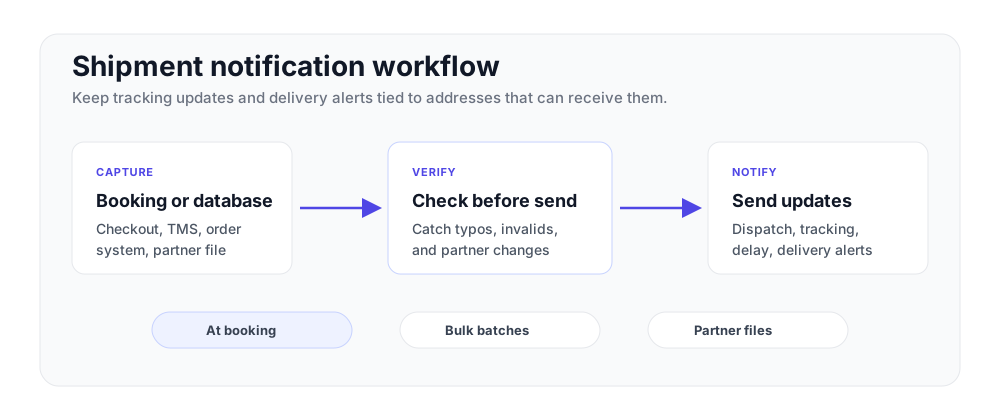
Tracking updates and delivery alerts only reduce support work when they arrive. Verify customer and partner addresses at capture and before large notification sends so shipment communication keeps moving.
Why logistics operations need email verification
From order confirmation to delivery, email carries the status updates customers and partners depend on. Bad addresses break that chain.
In logistics, email is the running commentary on a shipment. An order is confirmed, a parcel is dispatched, a tracking number is issued, an estimated arrival shifts, a delivery completes. Each of those milestones triggers a message, and customers have come to expect every one of them to arrive on time. When they do, your support queue stays quiet because the customer never has to ask where their order is. When a notification bounces, the opposite happens: the customer is left guessing and contacts support, turning an automated email into a live cost. The same is true on the partner side, where carriers, brokers, and warehouses rely on schedule changes and exception alerts reaching the right desk. Customer addresses are captured at a hurried checkout and partner contacts move on, so both databases drift. Bulk verification keeps the addresses behind every notification accurate, while the REST API can check an address the moment a customer enters it, so the commentary never goes silent.
Tracking updates are transactional
Dispatch confirmations, tracking links, and delivery alerts fire on logistics events. Customers expect them fast, and a bounce means a customer left in the dark.
Checkout collects typos
Customer addresses are entered at checkout or booking, often in a hurry. A mistyped domain like gmial.com bounces every notification tied to that shipment.
Bounced alerts drive support tickets
A shipping notification that lands answers where-is-my-order before a customer asks. One that bounces creates the support contact it was meant to prevent.
Partner contacts change
Carrier, broker, and warehouse contacts move on. A delay notice or schedule change sent to a former partner contact never reaches the right desk.
Bounces hurt your sending domain
A wave of bounces from a stale database tells mailbox providers your domain is risky. That reputation hit can push even valid tracking emails toward spam.
Databases decay over time
A customer or partner database that was accurate a year ago carries a real share of dead addresses now. Without verification, that share only grows.
How VeriMails helps logistics teams
Verification keeps the addresses behind every notification accurate.
Bulk-verify customer databases
Export a CSV from your TMS, order system, or CRM. VeriMails auto-maps the email column and verifies the file as a background job.
Verify at the point of capture
Call the REST API when a customer books a shipment or a partner is onboarded. Catch typos and bad addresses before any notification is scheduled.
Protect transactional sends
Verifying first means dispatch confirmations, tracking links, and delivery alerts reach the customer instead of bouncing back undelivered.
Spot role-based partner addresses
Role-based detection flags shared mailboxes like dispatch@ or operations@, so you can decide which partner contacts should receive critical updates.
Catch-all detection
Many business customer and carrier domains accept every address. VeriMails flags catch-all domains so you know which contacts carry delivery uncertainty.
Scale and speed for large databases
Each address gets syntax, MX, DNS, and a live SMTP handshake as part of verification, and credit packs scale up to 5 million credits for the largest customer files.
Stop bad addresses before they create support work
Logistics teams benefit most when verification happens close to capture: checkout, booking, partner onboarding, and database imports. Clean addresses make dispatch, delay, and delivery communication easier to trust.
Notification checklist
- Verify customer emails when orders, bookings, or shipment requests are created.
- Clean partner directories before exception, delay, or schedule-change sends.
- Suppress invalid addresses before large tracking or delivery notification batches.
- Correct high-value customer and carrier records in the TMS, order system, or CRM.
| Moment | Verification step | Outcome |
|---|---|---|
| Checkout or booking | Call the verification API when the email is captured. | Typos are caught before tracking emails are scheduled. |
| Bulk notification | Verify customer segments before dispatch, delay, or delivery batches. | Fewer bounced updates turn into where-is-my-order tickets. |
| Partner update | Clean carrier, broker, and warehouse contact exports. | Schedule changes and exception alerts reach the right operational desk. |
How it works
From a customer or partner export to a clean, deliverable database in minutes.
Export your database
Pull a CSV from your TMS, order system, CRM, or partner directory. Any file with an email column works.
Upload and verify
Drop the file into VeriMails. The email column maps automatically and the file runs as a background verification job.
Send notifications with confidence
Filter to valid addresses, flag the rest for correction, and send tracking updates and delivery alerts knowing they land.
Pricing that scales with shipment volume
Verification starts at $0.0019 per email, so keeping a large customer database accurate stays affordable per shipment. A 10,000 credit pack is $19, and credit packs scale up to 5 million credits for $1,499 for high-volume operations. If you verify addresses continuously through the API, annual plans start at $12.50/month when billed yearly. Every new account gets 100 free credits with no credit card, and credits never expire, so volume bought in advance is always available. See full pricing →
Bounced tracking emails were quietly turning into support tickets. Verifying our customer database cut the where-is-my-order calls, because the delivery updates finally reach the inbox they were meant for.Sofia M. — Logistics Operations Manager, United States
Frequently asked questions
Everything logistics teams need to know about email verification.